
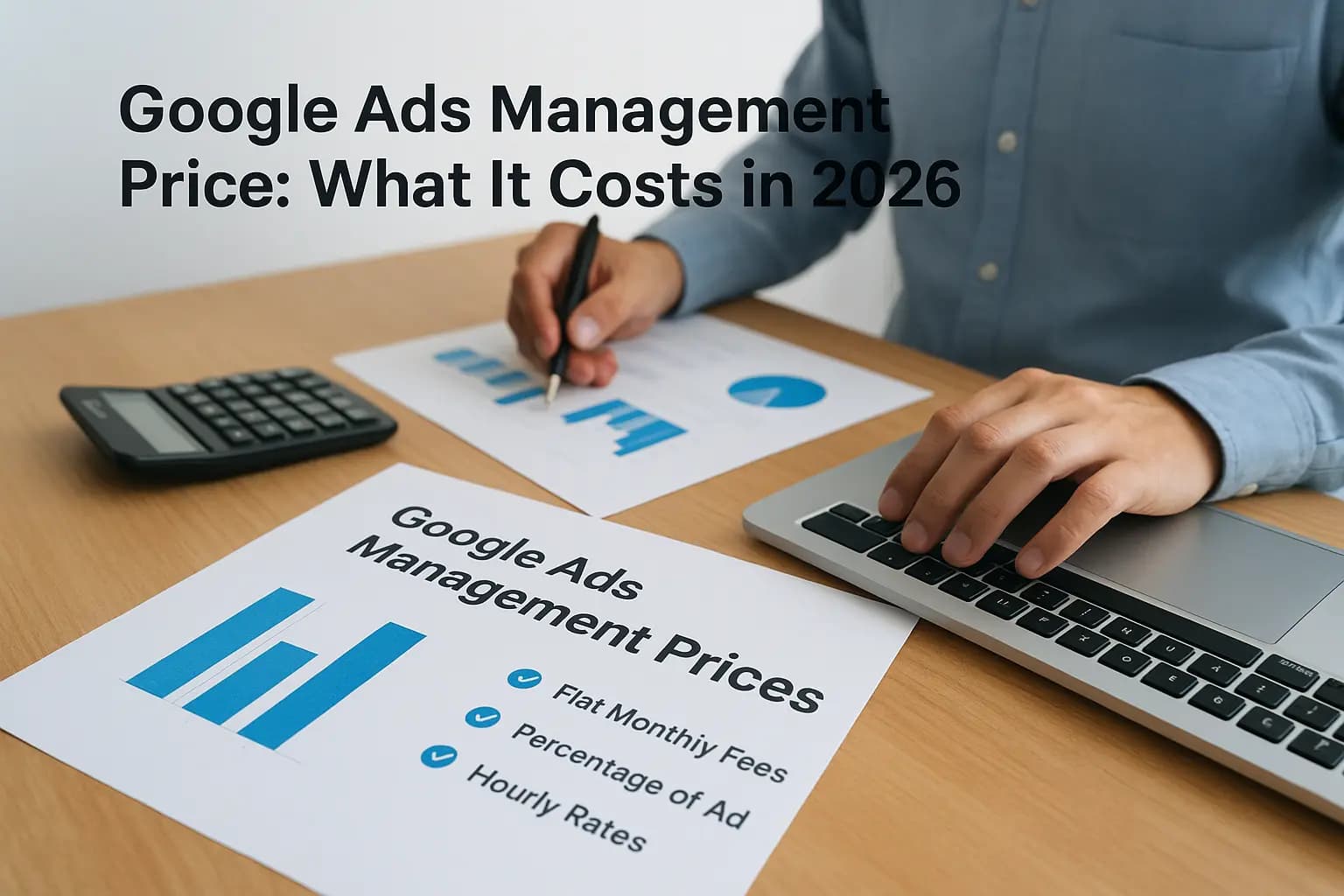
You already know Google Ads can drive calls and leads fast. What you don't know is what you should actually pay someone to run it, and that's the part that trips up most small business owners in Orange County. Ask five agencies for a quote and you'll get five different numbers, with no clear explanation of why one costs $300 a month and another wants $1,500 plus a cut of your ad spend.
This article breaks down google ads management price by the numbers agencies and freelancers actually use in 2026: flat monthly fees, percentage-of-spend models, and hourly rates, along with what typically drives costs up or down. You'll see real ranges for small businesses versus larger accounts, so you're not guessing whether a quote is fair or padded.
We'll also cover what separates cheap Google Ads management from a package that's cheap for a reason, plus how to read a pricing proposal so you know exactly what's included before you sign anything. By the end, you'll have a clear budget number to work with and the questions to ask before hiring anyone to manage your campaigns.
Why Google Ads management prices vary so much
Ask three agencies for a quote on the same account and you'll get three different numbers, and that's not because two of them are ripping you off. Google Ads management pricing shifts based on how much you're spending on ads each month, how complicated your account is, and whether you're hiring an agency, a freelancer, or a junior employee at a marketing shop. A local plumber running three campaigns pays a completely different rate than a law firm bidding on competitive keywords across five cities, even if both call it "Google Ads management."
The three pricing structures agencies use
Most quotes fall into one of three buckets, and each one changes how the final number lands on your invoice.
- Flat monthly fee: A fixed price regardless of spend, common for small accounts under $5,000/month in ad spend.
- Percentage of ad spend: Usually 10% to 20% of what you spend on ads, so the fee grows as your budget grows.
- Hourly rate: Freelancers and consultants often bill $50 to $150 an hour, which works well for one-time audits or lighter, ongoing tune-ups.
| Pricing Model | Typical Range | Best For |
|---|---|---|
| Flat fee | $300–$1,500/month | Small businesses with steady, modest ad budgets |
| Percentage of spend | 10%–20% of spend | Growing accounts with $5,000+ monthly budgets |
| Hourly | $50–$150/hour | Audits, one-off fixes, low-maintenance accounts |
None of these models is inherently better than another. A flat fee protects you if your budget grows fast, while a percentage model can align incentives, since the agency only benefits more when your spend justifies scaling up.
Account complexity drives the real cost
Two accounts with identical ad budgets can cost wildly different amounts to manage well. A single-location service business running search ads for "emergency plumber near me" needs far less hands-on work than an e-commerce store juggling 400 products across Search, Shopping, and Performance Max campaigns. Competitive industries like legal services, home improvement, and immigration consulting also carry higher google ads management fees, because cost-per-click runs higher, keyword lists get longer, and the margin for error on wasted spend shrinks fast.
The price you're quoted should reflect how much account there is to manage, not just a number pulled off a rate card.
Conversion tracking setup, landing page testing, and running multiple platforms at once (Search, Display, YouTube, Performance Max) all add hours to whoever's managing the account. If a quote seems suspiciously low for an account with that many moving parts, ask exactly what's included before you sign.
Who's doing the work changes the price too
Solo freelancers working from home carry lower overhead than full-service agencies with account managers, strategists, and dedicated reporting staff. That doesn't mean freelancers are always cheaper or agencies always better, but it does explain part of the spread you'll see across quotes. Agencies typically bundle in strategy calls, custom reporting dashboards, and backup coverage if your main contact is out sick. Freelancers often compete on price and personal attention but may lack that backup or broader cross-channel expertise. Business owners comparing quotes in Orange County should ask directly who will manage the account day to day, not just who signs the contract, since that person's experience level affects both the price and the results you'll actually see from your google ads management cost.
How to choose the right pricing model for your budget
Picking the right pricing structure comes down to one question: how fast do you expect your ad spend to grow over the next year? If you're a single-location business planning to spend $1,500 a month on ads indefinitely, a flat fee keeps your google ads management costs predictable and easy to plan around. If you're scaling toward $10,000 or $20,000 a month, a percentage model might actually save you money in the long run, since agencies often cap or discount their percentage rate once your spend hits certain thresholds.
Match the model to your spend level, not just the sticker price
Small accounts under $3,000 a month almost always do better with a flat fee. A percentage-based fee on a small budget either rounds up to an unreasonably low dollar amount that no agency will accept, or gets padded with a minimum fee that erases the supposed savings. Ask any agency quoting you a percentage on a small budget what their minimum monthly fee is, because that number tells you the real price.
Match the pricing model to where your budget is headed, not where it sits today.
When percentage-of-spend starts making sense
Once your monthly budget crosses roughly $5,000, percentage pricing starts aligning incentives better. The agency has a reason to help you scale spend responsibly, since their fee grows alongside real results rather than staying flat while your account gets more complex. Just confirm whether the percentage applies to your total ad spend or only to spend the agency directly manages, since some google ads management packages carve out branded search or remarketing from the fee calculation.
Where hourly billing fits
Hourly arrangements work best for narrow, defined tasks rather than full account management. A one-time audit, a conversion tracking fix, or a monthly check-in on an account you mostly run yourself all suit an hourly consultant better than a retainer. Watch for vague hourly quotes with no cap, since a $75/hour rate on an account needing 20 hours a month costs more than most flat-fee packages.
Use this quick gut check before you commit to a model:
- Spend under $3,000/month: flat fee, ask for the exact deliverables included.
- Spend $5,000 to $15,000/month: percentage of spend, confirm the calculation base.
- Spend growing fast or unpredictable: flat fee with a spend-tier trigger, so the price only jumps at defined thresholds.
- Occasional help only: hourly, with a monthly hour cap agreed upfront.
A quick call with the agency about your growth plans, not just your current budget, usually points you toward the right structure faster than comparing quotes side by side.
What you can expect to pay by ad spend level
Numbers make more sense once you tie them to real ad spend tiers, so here's what most Orange County small businesses actually see when they get a quote. A business spending $1,000 a month on ads should expect a flat fee somewhere between $300 and $600, since anything higher eats too much of the total budget to make sense. Google Ads management fees at this level should cover basic campaign setup, keyword management, and monthly reporting, not a full custom dashboard or weekly strategy calls.
Small budgets: $1,000 to $5,000 a month
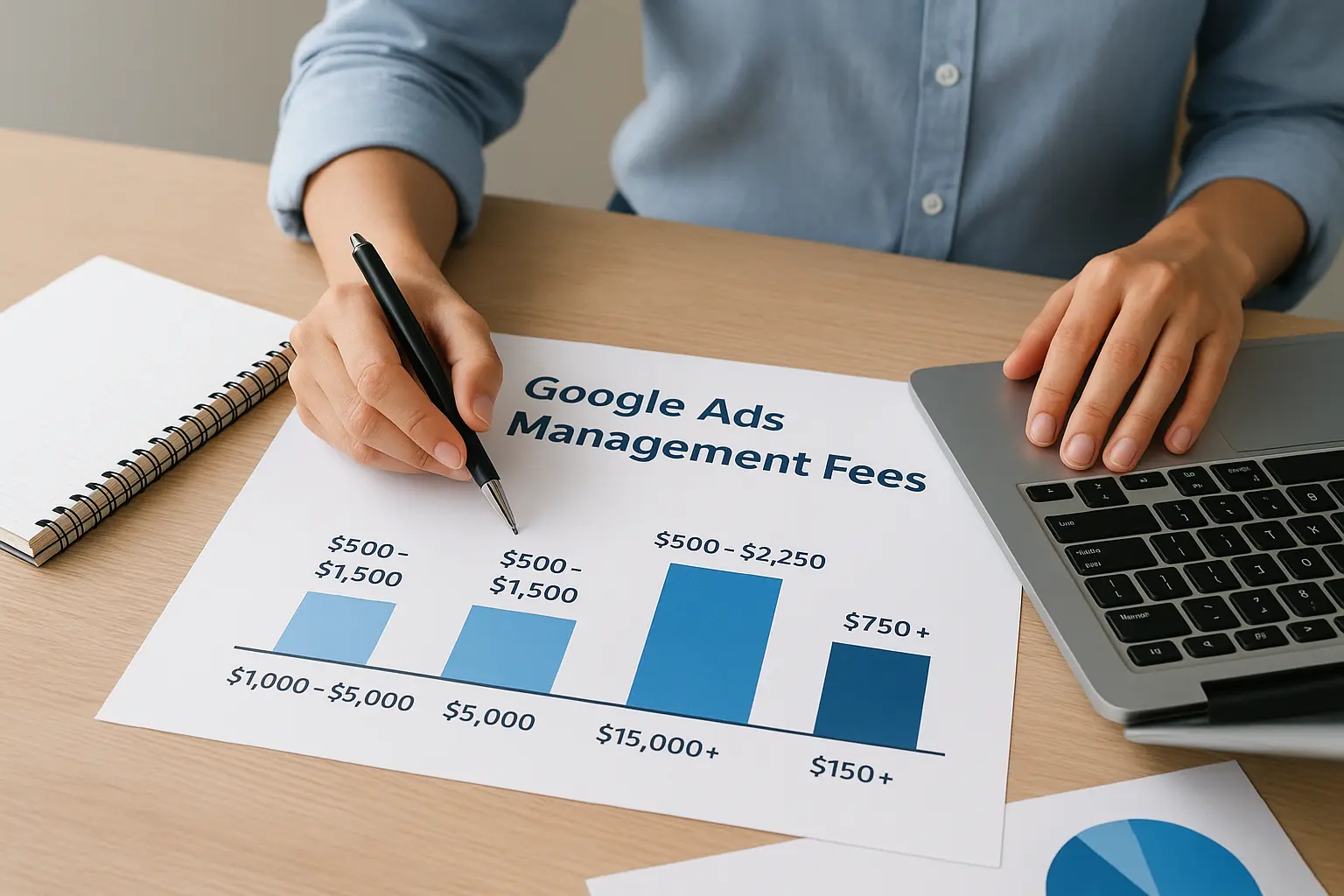
At this range, flat fees between $500 and $1,500 a month are typical, and a percentage model rarely fits well since 10% to 20% of a $2,000 budget lands too low for most agencies to justify the work involved. Expect campaign monitoring, bid adjustments, negative keyword updates, and a monthly report, but not necessarily dedicated Shopping feed management or landscape-wide testing across platforms. Businesses in Costa Mesa, Irvine, or Santa Ana running local service ads usually sit comfortably in this tier.
Mid-size budgets: $5,000 to $15,000 a month
A fair price at this stage reflects steady account growth, not just a bigger number on the invoice.
Once spend crosses $5,000, percentage-of-spend pricing becomes more common, typically 10% to 15%, which translates to $500 to $2,250 a month depending on where in that range you land. This tier usually includes more active bid strategy work, A/B testing on ad copy and landing pages, and expanded keyword research since the account has more room to scale. How much does Google Ads management cost at this level often comes down to how many campaigns you're running across Search, Shopping, and Display simultaneously.
Larger budgets: $15,000 and up
Agencies managing accounts spending $15,000 or more a month often drop their percentage to 5% to 10%, since the dollar amount still supports a healthy fee even at a lower rate. Expect dedicated account strategists, custom reporting dashboards, and proactive testing on Performance Max and remarketing campaigns.
| Monthly Ad Spend | Typical Fee Structure | Estimated Monthly Cost |
|---|---|---|
| $1,000–$5,000 | Flat fee | $500–$1,500 |
| $5,000–$15,000 | Percentage (10%–15%) | $500–$2,250 |
| $15,000+ | Percentage (5%–10%) | $750+ |
Growing past $15,000 a month usually means the agency assigns more senior staff to your account, which is part of why the rate percentage drops even as the total dollar figure climbs. Use these ranges as a starting point, not a hard rule, since account complexity still shifts the final number up or down within each tier.
How to spot hidden fees and overpriced packages
Setup fees catch more small business owners off guard than any other line item in a Google Ads proposal. Some agencies charge $500 to $2,000 upfront before your campaigns even go live, and that fee sometimes duplicates work you're already paying for in month one. Before you sign anything, ask whether the setup fee covers something separate from ongoing management, like conversion tracking installation or a full account rebuild, or whether it's just padding tacked onto a quote that otherwise looks competitive.
Ad spend markups and platform fees
Occasionally you'll see agencies quote a management fee that looks reasonable, then add a separate "platform fee" or ad spend markup on top of what you're actually spending on clicks. That means you could be paying 15% management plus another 5% just to run ads through their account, which pushes your real google ads management fee well past what the initial quote suggested. Ask for a single, combined number that shows exactly what portion goes to Google and what portion goes to the agency, and get it in writing.
If a proposal can't tell you the exact split between ad spend and agency fee, that's the number to question first.
Long contracts and vague deliverables
Watch for agreements that lock you in for 12 months with no exit clause, especially from newer agencies still proving themselves. A month-to-month arrangement, or at most a 90-day initial term, protects you if the results don't show up. Vague deliverables are the other red flag: a proposal that promises "ongoing optimization" without specifying reporting frequency, campaign types included, or response time on questions gives the agency room to do less while charging the same rate.
Run through this checklist before signing any google ads management packages agreement:
- Setup fee: Is it separate from month one management, and what exactly does it buy?
- Contract length: Can you exit after 30 or 90 days without penalty?
- Reporting: How often, and does it show actual campaign data, not just screenshots?
- Included platforms: Search only, or does it cover Display, YouTube, and Performance Max too?
- Fee transparency: Is the ad spend clearly separated from the management fee on every invoice?
Cheap doesn't automatically mean bad, and expensive doesn't automatically mean thorough. The real test is whether the proposal spells out deliverables clearly enough that you'd notice if something stopped happening. A Google Ads management partner worth hiring should be able to answer every item on that checklist without hesitation.
Google Ads management vs. DIY and in-house hiring
Hiring an agency isn't the only path, and plenty of small business owners in Orange County start by running campaigns themselves or trying to bring someone in-house. Each option carries a real cost, even when the sticker price looks like zero, so it's worth weighing them against the google ads management cost you'd pay a specialist before deciding.
The real cost of managing it yourself
DIY management looks free on paper, but your time isn't free, and Google Ads has enough moving parts that mistakes get expensive fast. Wasted clicks from poor keyword match types, missing conversion tracking, and bids left on autopilot for months can burn through a $2,000 monthly budget without producing a single qualified lead. Factor in the hours you'd spend learning the platform instead of running your business, and DIY often costs more than a $500 flat-fee agency once you account for the ad spend that gets wasted along the way.
DIY management only looks cheaper until you count the leads lost to mistakes you didn't know you were making.
What hiring in-house actually runs
Bringing on a full-time marketing hire to manage Google Ads means covering a salary, typically $50,000 to $75,000 a year for someone with real PPC experience, plus payroll taxes and benefits. That number dwarfs even the highest google ads management fees an agency would charge for the same account, unless you have enough marketing work to keep that person busy across multiple channels, not just paid ads. Most small businesses in Costa Mesa or Irvine don't generate enough workload to justify a dedicated hire until they're spending well past $20,000 a month on ads.
Comparing the three paths
| Approach | Monthly Cost | Best For |
|---|---|---|
| DIY | $0 fee, but time + mistake cost | Very small budgets, hands-on owners with time to learn |
| Agency/freelancer | $300–$2,250+ | Most small to mid-size businesses |
| In-house hire | $4,000–$6,500+ (salary alone) | Large budgets, multi-channel workload |
Agencies and freelancers sit in the middle for a reason: you get specialized expertise without carrying a full-time salary, and you can scale the relationship up or down as your ad spend changes. That flexibility matters most in the first year or two of running paid ads, before you know exactly how much ongoing management your account actually needs.
Putting the numbers into perspective
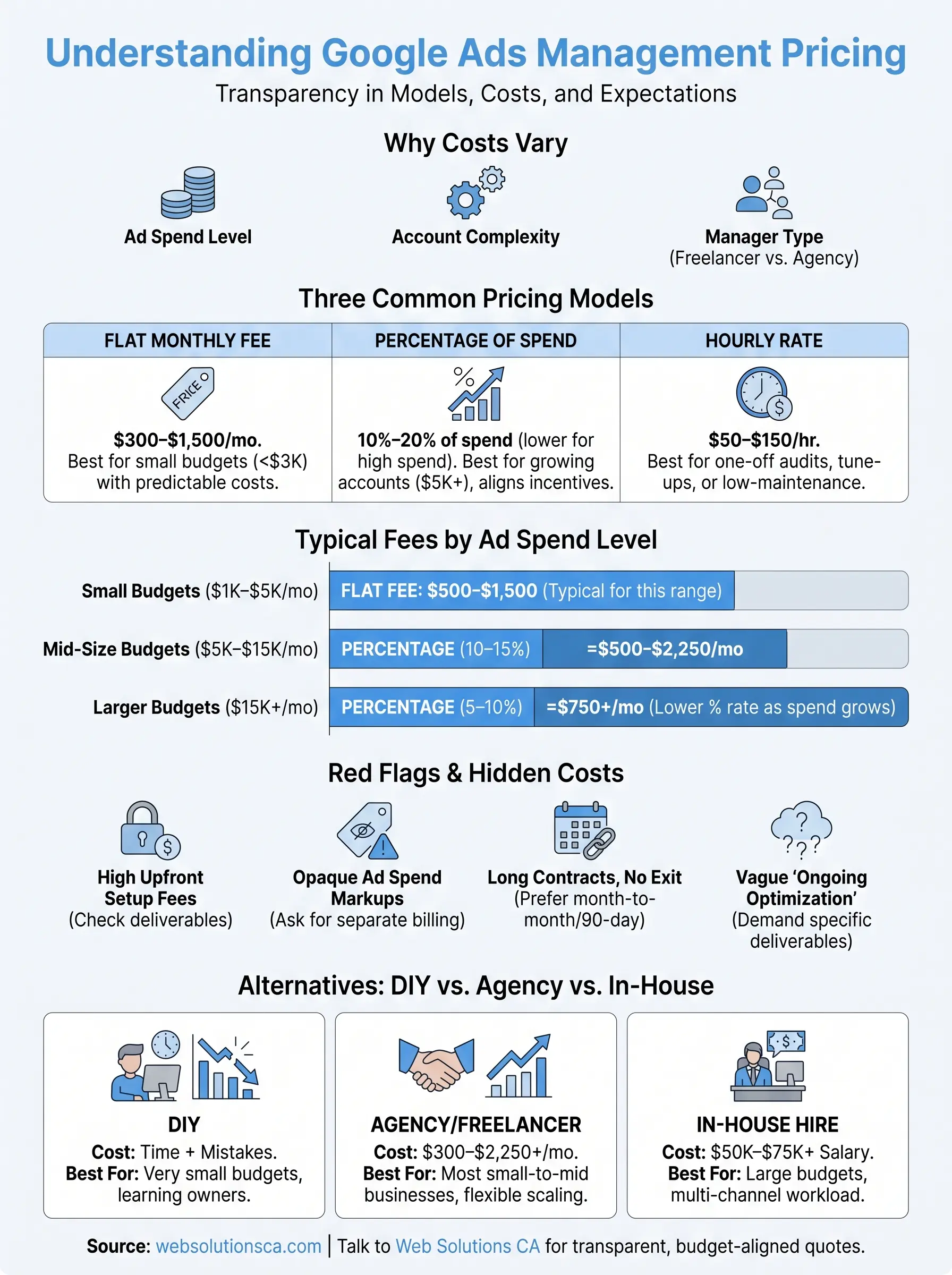
At the end of the day, Google Ads management price comes down to matching the pricing model to your actual spend and growth plans, not chasing the lowest number on a quote. A flat fee under $1,500 fits most small budgets, percentage pricing makes sense once you cross $5,000 a month, and hourly billing works for narrow, one-off tasks. What matters most is transparency: a fair google ads management cost should come with a clear breakdown of deliverables, no buried setup fees, and no vague promises about "ongoing optimization."
Before you sign anything, run the proposal through the checklist above and ask direct questions about who manages your account day to day. If you'd rather skip the guesswork entirely, talk to Web Solutions CA about a straightforward, transparent quote built around your actual budget and goals.