
Your website affects calls, leads, and sales every day. Visitors decide fast. If your site loads slowly, feels confusing, or looks outdated, people leave. Google tracks this behavior and lowers rankings. Choosing the right web designer in Orange County protects your budget, your time, and your visibility in local search.
This guide breaks the decision into five clear steps. Fewer steps. Full detail. Every important point covered, without filler.
Why choosing the right web designer in Orange County matters
Orange County is highly competitive. Service businesses, professionals, and local companies often offer similar services. Customers compare two or three websites before contacting anyone. A weak website loses trust within seconds and sends traffic to competitors.
A strong website helps you:
- Get more phone calls
- Get more form submissions
- Rank higher in local Google results
- Build trust with first time visitors
- Convert mobile users
Most local searches happen on phones. If your website performs poorly on mobile, you lose both rankings and leads.
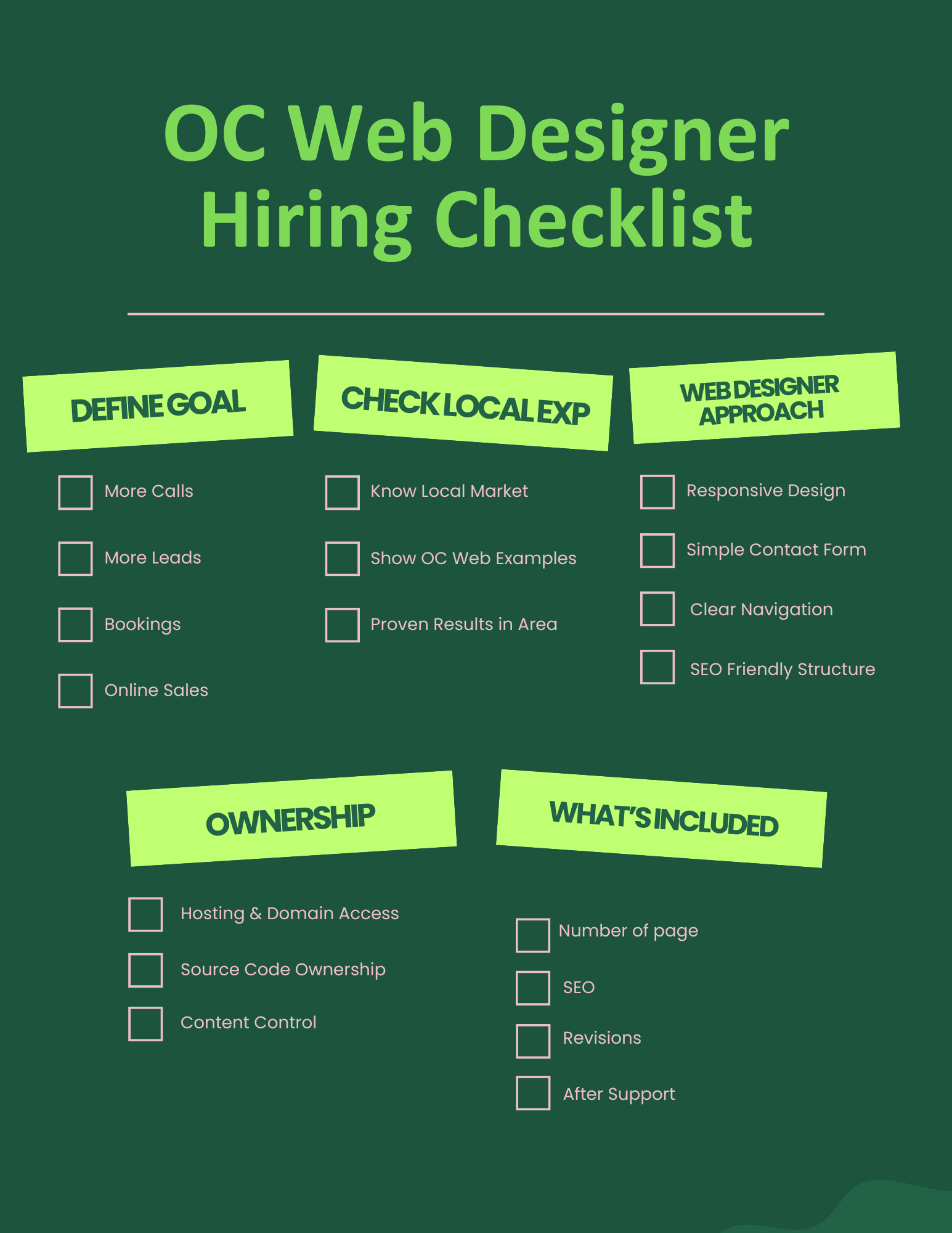
Step 1. Define your goal and how success looks
Before you contact any web designer, get clear on your goal. Without a goal, design choices become random and results suffer.
Choose one primary objective:
- Phone calls for local services
- Form leads for follow up
- Appointment bookings
- Online sales
Then define success with numbers. Examples:
- Five calls per day
- Ten form leads per week
- Twenty bookings per month
This goal shapes layout, content, and structure. A professional web designer starts here. If someone jumps straight to colors or templates, you risk paying for a site without direction.
Also think about growth. Ask yourself if you plan to run Google Ads, Facebook Ads, or SEO later. Your website structure should support this from day one.
Step 2. Confirm Orange County experience and local results
Local experience improves outcomes. Search behavior, competition, and trust signals change by city.
A web designer familiar with Orange County understands:
- Competition in Irvine, Costa Mesa, Anaheim, Santa Ana, Huntington Beach
- Google Maps behavior and local rankings
- Local search intent for service based businesses
- What local users expect before contacting a business
Ask for examples of Orange County websites they built. Visit those sites on your phone. Check how fast they load. Check how easy it is to call or submit a form. Look for clear service pages and local references.
Go further. Ask about performance. Ask if those sites generate calls, leads, or traffic. Design without results does not help your business.
Step 3. Evaluate the web designer's approach to structure, SEO, and content
When hiring a web designer, you are not buying visuals. You are hiring someone to build a system that attracts traffic and converts visitors. Structure, SEO, and content must work together. If a designer treats these as separate tasks, results suffer.
Start by asking how they structure websites.
Ask the web designer to explain how they build pages. A qualified designer should plan for:
- Fast loading pages
- Mobile friendly layouts
- Clear navigation paths
- Visible phone numbers on every page
- Simple contact forms
- Separate pages for each service
If they focus only on appearance and ignore usability, leads drop.
Next, ask how SEO is handled during the build.
SEO must be included from the start. Ask direct questions:
- Who writes page titles for local search
- Who writes meta descriptions
- How headings are structured
- How pages link to each other
- How images are optimized
- How URLs are structured
- How local SEO is handled
If SEO is offered later as an add on, expect higher costs and slower rankings.
Then review how the designer handles content.
Content affects rankings and trust. Ask:
- Who writes the website content
- How service pages are structured
- How local keywords are included naturally
- How calls to action are placed
A strong web designer explains how content guides visitors toward calls or form submissions. Thin or copied content signals inexperience and hurts long term performance.
This step helps you filter out designers who focus only on looks and keep those who understand results.
Step 4. Confirm ownership, pricing, and process
You should always control your website. Ownership issues cause long term problems.
Ask clearly:
- Which platform powers the site
- Who controls hosting
- Who controls the domain
- Who owns the content and files
- How updates and backups work
Avoid setups where access stays locked or changes cost extra.
Next, review pricing in detail. Ask for a full breakdown:
- Number of pages included
- Content included or extra
- SEO included or separate
- Revisions allowed
- Hosting setup included
- Support after launch
Low prices often skip essentials. High prices often include services you do not need. Clear details protect your budget.
Also ask about the process. A professional follows steps:
- Planning and discovery
- Design
- Development
- Review and revisions
- Launch and testing
A clear workflow prevents delays and confusion.
Step 5. Choose the right working model and long term support
This choice affects communication, speed, and cost. Bigger does not mean better.
Freelancers usually offer:
- Lower cost
- Direct contact
- Faster changes
Agencies usually offer:
- Larger teams
- Higher pricing
- Less direct access to the person building your site
There is a simpler option. A small local studio that combines both.
At Web Solutions CA, you work directly with the person building your website. SEO is built in from the start. Communication stays clear. Support continues after launch. This setup works well for Orange County businesses that want strong results without high agency costs or slow back and forth.
Also confirm long term support and performance tracking:
- How leads are tracked
- How calls and forms are monitored
- How updates are handled
- Response time for fixes
Websites need ongoing care. Clear support terms reduce stress.
Timelines and pricing expectations in Orange County
Understanding timelines helps planning.
Typical timelines:
- Small business website. Two to four weeks
- Custom website with SEO. Four to eight weeks
Pricing varies based on scope and support.
Common Orange County ranges:
- Basic small business website. $300 to $1,000
- Custom website with SEO. $1,000 to $3,000
- Ongoing SEO or paid ads. Monthly plans vary
Price alone does not define value. Structure, SEO, communication, and support matter more.
Final advice
Choose a web designer who listens, explains clearly, and builds with purpose. A strong website works daily without constant fixes. Clear goals, local experience, SEO built in, and active communication lead to better results.
If you want help building a website focused on local leads and search visibility in Orange County, work with someone who understands local businesses and values clarity at every step.