Conversion Audit
Review important landing pages, calls to action, forms, navigation, messaging, mobile experience, trust signals, and conversion paths to identify friction and missed opportunities.
Conversion Rate Optimization • Orange County
Turn more of the traffic you already have into calls, forms, bookings, quote requests, and other valuable customer actions.
Web Solutions CA combines website development, landing-page optimization, conversion tracking, user-experience improvements, and testing strategy to identify where visitors drop off and what should be improved next.
What Is CRO?
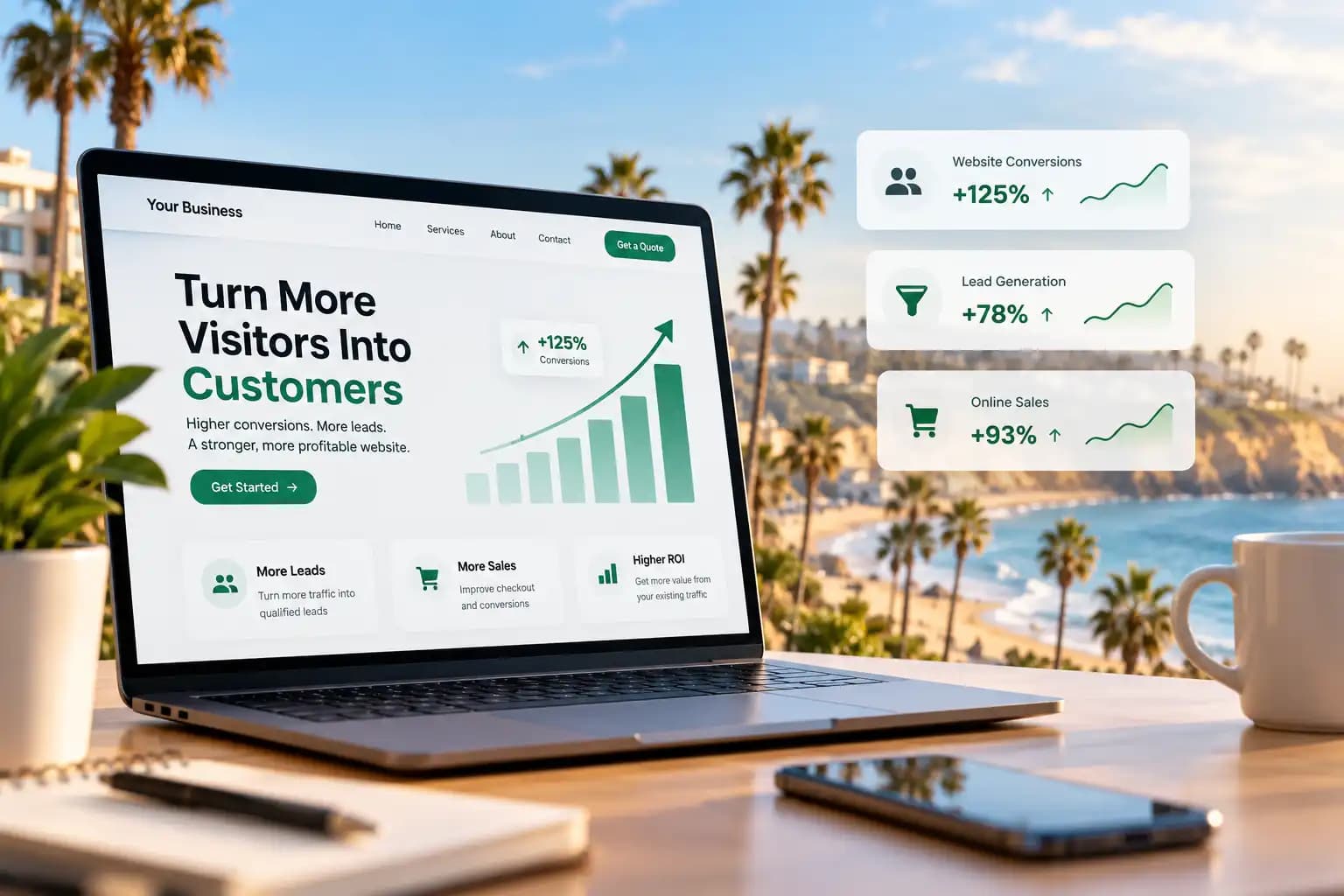
Conversion rate optimization improves the percentage of website visitors who complete an action that matters to the business.
CRO looks at what happens after a visitor reaches your website. Instead of only asking how to get more traffic, it asks why existing visitors do or do not become leads or customers.
Improvements can involve messaging, page structure, landing pages, forms, calls to action, mobile usability, trust, navigation, speed, conversion tracking, and testing.
The goal is not to change a page simply because a different design looks better. The goal is to identify friction, form a reasonable hypothesis, make a measurable improvement, and learn from the result.
CRO Services
The right CRO scope depends on the website, traffic source, customer journey, available data, and the action the business wants more visitors to complete.
Review important landing pages, calls to action, forms, navigation, messaging, mobile experience, trust signals, and conversion paths to identify friction and missed opportunities.
Improve the relationship between traffic source, page message, offer, supporting proof, page structure, and the action you want visitors to take.
Review form length, field order, mobile usability, validation, confirmation flow, placement, and the amount of commitment required from the visitor.
Improve CTA wording, placement, visibility, hierarchy, and consistency so visitors can clearly understand what to do next.
Identify confusing navigation, weak transitions, unnecessary steps, unclear content, distracting elements, and other friction that can interrupt the path to conversion.
Review mobile layouts, tap targets, sticky actions, form usability, page speed, content order, and other issues that can affect visitors on smaller screens.
Review or improve tracking for meaningful actions such as calls, forms, bookings, purchases, quote requests, and other lead events where measurement is available.
Prioritize testable hypotheses and evaluate changes using available conversion data rather than making random design changes without a clear reason.
Existing Website CRO
This is one of the strongest reasons to consider CRO. If people are already reaching the website, improving what happens after the click can sometimes be more efficient than simply buying more traffic.
Traffic is increasing but leads are not
Google Ads clicks are reaching weak landing pages
Visitors reach service pages but do not contact the business
Forms are started but not completed
Mobile users have a difficult experience
Calls to action are unclear or inconsistent
The website has too many competing actions
Tracking does not clearly show which pages generate leads
A redesign changed the site but did not improve inquiries
The business wants more value from existing traffic before buying more traffic
Before You Commit
You should understand the direction of the work before committing to an optimization project.
We can review the visible conversion path and explain the major issues we see, what we would investigate first, and the types of tests or improvements that may be appropriate.
A complete testing roadmap requires access to your analytics, conversion data, traffic sources, website, and enough evidence to make responsible recommendations. We do not invent test priorities without reviewing the underlying data.
Initial CRO Review
Primary conversion goal
Traffic-source and landing-page match
Major page friction
Form and CTA issues
Mobile conversion barriers
Trust and credibility gaps
Tracking limitations
Highest-priority opportunities
Testing & Optimization
Not every project needs every test. We prioritize the areas most closely connected to the visitor's intent and the business's conversion goal.
Headline clarity, service relevance, offer, trust signals, CTA visibility, and whether the page immediately answers the visitor's main question.
Content order, service explanation, objections, proof, FAQs, calls to action, and whether the page supports the intent of the traffic source.
Number of fields, field relevance, form placement, reassurance, validation, mobile usability, and confirmation experience.
Reviews, credentials, real projects, service details, business information, guarantees only where legitimate, and other signals that reduce uncertainty.
Whether visitors can quickly find the right service, understand the next step, and move from research to action without unnecessary friction.
Content hierarchy, sticky actions, tap targets, spacing, page speed, forms, and other factors that can affect mobile conversion performance.
Our CRO Process
We use the best information available to prioritize improvements instead of changing pages randomly.
We look at the traffic source, landing pages, user journey, forms, calls to action, tracking, and the business action you want more visitors to complete.
We identify the areas most likely to create hesitation, confusion, unnecessary effort, weak relevance, or tracking gaps.
Recommendations are ranked by likely business impact, implementation effort, available traffic, and whether the change can be measured.
We make agreed website or landing-page changes, verify tracking where possible, and compare performance over time.
CRO is iterative. Once one area is improved, the next test or optimization is selected using the best available evidence.
Connected Strategy
Conversion problems are often connected to the traffic source, website, landing page, or tracking setup—not just one button or headline.
Web Design
When the current website has broader design, mobile, structural, or usability problems, CRO can work alongside targeted redesign and development improvements.
Explore Orange County Web Design →Google Ads
Paid traffic becomes more useful when the landing page matches the search intent, conversion action is clear, and tracking shows which campaigns are producing meaningful results.
Explore Google Ads Management →SEO
SEO can help the right people reach important pages. CRO helps make those pages easier to understand, trust, and act on once the visitor arrives.
Explore Orange County SEO →CRO Resources
Use our guides to understand CRO concepts, consultants, tools, and ecommerce optimization before deciding what type of support you need.
Frequently Asked Questions
Conversion rate optimization, or CRO, is the process of improving a website or landing page so a higher percentage of visitors complete a meaningful action such as calling, submitting a form, booking an appointment, requesting a quote, or purchasing. CRO combines user-experience improvements, messaging, design, tracking, and testing.
Yes. CRO often starts with the existing website. If the current site has a workable technical foundation, individual pages, forms, calls to action, messaging, navigation, and tracking can be improved without rebuilding the entire website.
We can provide an initial assessment of the major conversion issues we see and explain the first areas we would prioritize. A complete testing roadmap depends on access to the website, analytics, conversion tracking, traffic sources, and enough data to make responsible recommendations.
Not every CRO improvement requires a formal A/B test, but reliable testing generally becomes easier when a website has enough traffic and conversions. Lower-traffic websites can still improve clarity, forms, mobile usability, page structure, tracking, and other obvious conversion barriers.
Lead-generation CRO can include service pages, landing pages, phone-call actions, contact forms, quote forms, booking flows, CTA placement, trust signals, navigation, mobile usability, page speed, and conversion tracking.
CRO can improve the landing-page experience after someone clicks an ad. Better message match, clearer calls to action, stronger forms, improved mobile usability, and more reliable tracking can help a business get more value from the traffic it is already paying for.
No. Web design focuses on the website's broader design and functionality. CRO focuses specifically on how visitors move through the website and whether pages make it easier for them to complete valuable actions. The two often overlap when design changes affect conversion performance.
A CRO consultant reviews the user journey, website or landing pages, conversion data, messaging, forms, calls to action, tracking, and friction points. The consultant then prioritizes changes and tests that can improve the percentage of visitors who take meaningful actions.
Yes. Web Solutions CA is based in Costa Mesa and serves Orange County businesses, but conversion optimization work can also be performed remotely for businesses outside the area when the project is a good fit.
Conversion Rate Optimization
Tell us where your traffic comes from, what action you want visitors to take, and what is currently happening on the website. We'll identify the most practical place to start.