
Your website can be fast, well-designed, and packed with the right keywords, and still get buried on page two of Google. Nine times out of ten, the missing piece is local link building. Search engines treat backlinks from other websites as votes of confidence, and if your competitors have more relevant local votes than you, they win the local pack every time.
This article gives you ten practical ways to earn those votes. We're not talking about buying sketchy links or spamming directories. You'll get realistic, Orange County-friendly tactics, from partnering with local chambers of commerce to getting featured in community news sites, that actually move the needle for small businesses without a corporate marketing budget.
We built this list from what actually works for the local service providers and startups we support here in Costa Mesa and across Orange County. Whether you run a tax prep office in Santa Ana or a window company in Irvine, you'll find link building strategies you can start this week, plus guidance on which ones deserve your limited time first. By the end, you'll have a clear roadmap for building local authority that search engines and customers both trust.
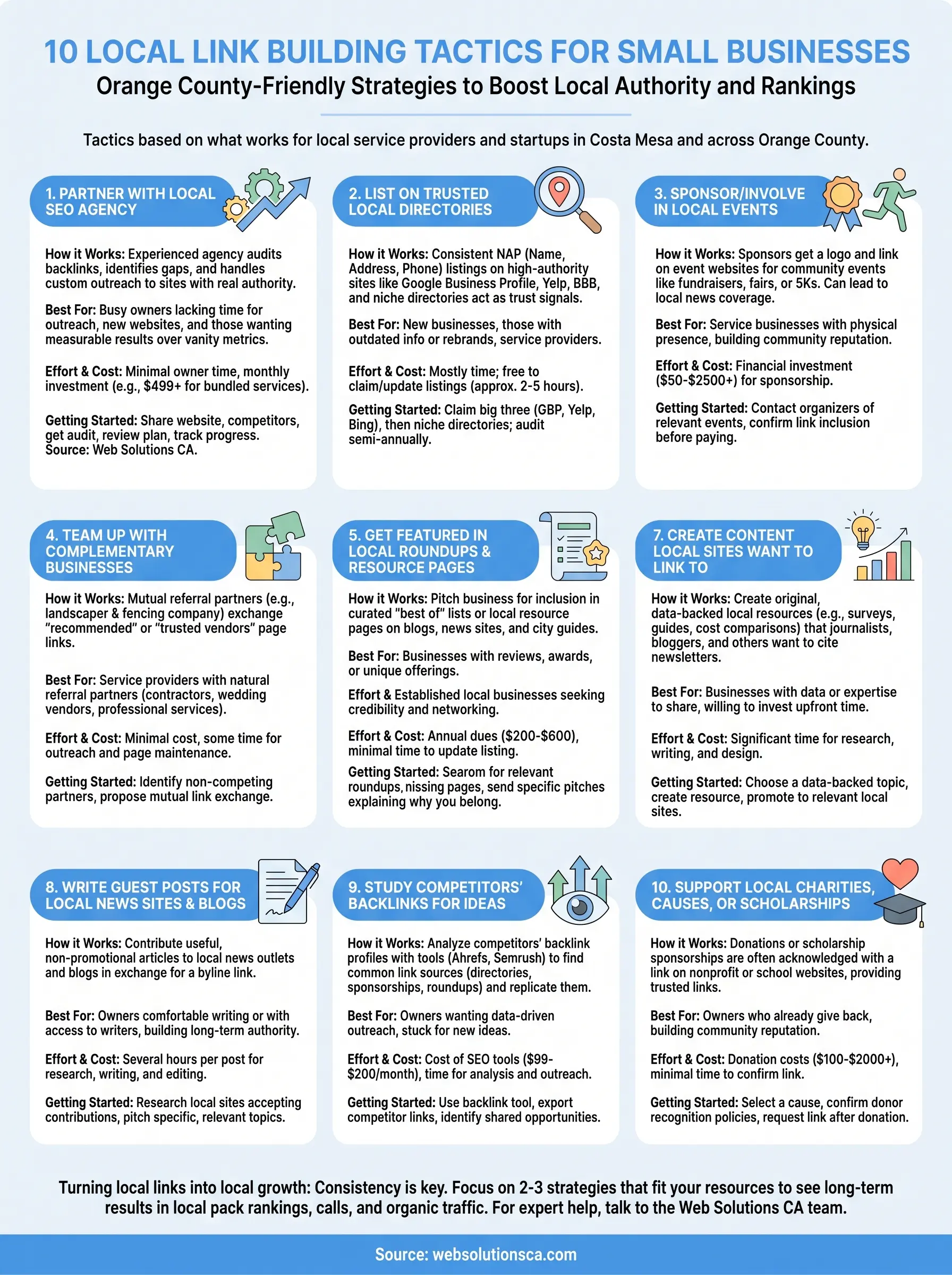
1. Partner with a local SEO agency for expert link building
Outsourcing your local link building to a team that does this daily is the fastest way to get results without burning your own hours on outreach emails that go nowhere. A good agency already has relationships with local publications, directories, and community organizations, so they skip the cold-pitch phase most business owners get stuck in for months.
How it works
An experienced agency audits your current backlink profile, identifies gaps compared to your local competitors, and builds a custom outreach plan targeting sites with real domain authority in your city or region. Web Solutions CA's SEO services combine this outreach with on-page fixes, Google Business Profile optimization, and citation cleanup, so the links you earn actually translate into higher local pack rankings instead of sitting unused on a spreadsheet.
A local agency doesn't just find you links, it builds a system that keeps earning them long after the first campaign ends.
Who it's best for
This route suits busy owners who don't have five extra hours a week for outreach, follow-up, and reporting. It also fits businesses that tried DIY link building once, got a handful of low-quality directory links, and want a partner who can show measurable movement in rankings and calls instead of vanity metrics, so it's worth comparing the local SEO agencies working in Orange County before you commit.

| Scenario | Fit for agency partnership |
|---|---|
| No time for outreach | Strong fit |
| Already ranking page 1 for most terms | Lower priority |
| New website with zero backlinks | Strong fit |
| Comfortable doing manual outreach | Optional |
Effort and cost
Expect to spend far less of your own time here than with any other tactic on this list, since the agency handles research, pitching, and reporting. Monthly SEO service with Web Solutions CA starts at $499.99, which typically bundles link building with technical fixes and reporting rather than charging separately for each link secured. Cheap providers who promise hundreds of links for $99 a month are usually selling low-quality directory spam that can hurt you more than help, and cleaning it up later means building a Google disavow file for those spammy domains, so treat rock-bottom pricing as a red flag rather than a bargain.
How to get started
Getting started only takes a short conversation about where your website stands today. Here's the typical process:
- Share your current website, target service areas, and top competitors.
- Get a backlink and citation audit showing gaps versus local competitors.
- Review a monthly plan outlining target sites and expected timelines.
- Track new links and ranking movement through monthly reports.
If you'd rather have this handled for you, reach out to Web Solutions CA and we'll map out where your local link profile stands right now.
2. List your business on trusted local directories
Directory listings might feel outdated, but local citation building still forms the foundation most local SEO efforts sit on. Google cross-references your business name, address, and phone number across the web to confirm you're real and active in the area you claim to serve, and clean, consistent listings on trusted sites give it exactly that signal.
How it works
Each directory listing includes a link back to your website along with your NAP (name, address, phone), and search engines use the consistency of that information across multiple sites as a trust signal. Focus on sites with actual authority, think Yelp, the Better Business Bureau, a fully optimized Google Business Profile listing, and industry-specific directories, rather than the hundreds of low-value sites that exist purely to sell listings.
Directory links won't win you the top spot alone, but skipping them makes every other tactic on this list work harder than it should.
Who it's best for
This strategy fits any local business, but it matters most for newer companies with thin backlink profiles and service providers who haven't touched their listings in years. If you've moved locations, changed phone numbers, or rebranded recently, this is also where you fix lingering inconsistencies before they confuse both customers and search engines.
Effort and cost
Most core directories are free to claim and update, so the real cost is your time.
- Claim your Google Business Profile, Yelp, and Bing Places listings (roughly 2 hours total), following a step-by-step profile setup guide for California businesses if you're starting from scratch
- Search for 5 to 10 relevant industry directories in your niche
- Set a calendar reminder to audit listings every six months
How to get started
Start with the big three: Google Business Profile, Yelp, and Bing Places, then branch into niche directories relevant to your trade or region.
3. Sponsor or get involved in local events
Community events, from a 5K run in Huntington Beach to a farmers market in Tustin, almost always need sponsors, and sponsors almost always get a link on the event website. This is one of the easiest ways to build community backlinks while getting your business name in front of the exact neighbors who might hire you.

How it works
Event organizers typically list sponsors on a dedicated page, often with a logo, a short blurb, and a link back to your site. Chambers of commerce, school fundraisers, youth sports leagues, and city-run festivals all publish these pages year-round, and most only ask for a modest donation or in-kind contribution in exchange. Local event sponsorship also tends to get picked up by local news coverage, which can add a second, higher-authority link on top of the event page itself.
Sponsor the events your customers already attend, and the links follow almost automatically.
Who it's best for
This tactic suits service businesses with a physical presence, like contractors, dentists, and restaurants, that want visibility with the same residents who'll eventually search for them online. It also works well for businesses trying to build a friendlier, community-first reputation alongside their SEO goals.
Effort and cost
Sponsorship costs vary widely, but plenty of local nonprofits and school events accept $100 to $500 for a logo placement and link.
- Small community event: $50 to $250
- Chamber-sponsored mixer or fair: $250 to $1,000
- City festival or 5K run: $500 to $2,500
How to get started
Reach out to event organizers directly through their contact page or social media, ask what sponsorship tiers include a website link, and confirm the link before you pay.
4. Team up with complementary local businesses
A plumber and a real estate agent aren't competitors, but they share the same customers. Teaming up with businesses that serve your audience without competing for your jobs creates one of the most natural forms of local link building you can pursue, because the referral relationship already exists before you ask for anything online.
How it works
Start by identifying businesses whose customers overlap with yours but whose services don't. A landscaper and a fencing company, or a wedding photographer and a florist, can each add a "recommended partners" or "trusted vendors" page linking to each other's websites. Reciprocal business partnerships work best when both sides genuinely refer clients, since Google can tell the difference between a real relationship and a link swap done purely for SEO.
The strongest local links come from businesses that already send each other customers, not strangers trading links for the sake of it.
Who it's best for
This approach suits service providers with natural referral partners, think contractors, wedding vendors, healthcare specialists, and professional services like accountants and attorneys. It works less well for businesses without an obvious complementary trade nearby, so retail shops may need to lean on other tactics on this list instead.
Effort and cost
This strategy costs nothing but a few conversations and a little page maintenance.
- Identify 5 to 10 non-competing businesses you already refer clients to
- Reach out and propose a mutual partner or resources page
- Add their link, request they add yours, and check back quarterly
How to get started
Make a short list of businesses you'd happily hand your customers off to, then send a quick email proposing a simple exchange:
Subject: Quick partnership idea

Hi [Name],

We send each other customers already, so I wanted to see if you'd be open to adding a short link to our site on your recommended vendors page. Happy to do the same for you.

[Your name]
5. Get featured in local roundups and resource pages
Many local blogs, news sites, and city guides publish "best of" lists like "Best Contractors in Orange County" or "Top 10 Dentists in Irvine." Landing on one of these pages earns you a relevant local backlink plus direct traffic from readers actively looking for what you sell. This tactic works especially well because these roundup pages are often actively promoted and updated, so your link doesn't just sit there collecting dust like an old directory listing.
How it works
Site owners publish roundups because readers want curated recommendations, and they need real businesses to fill those lists. Search Google for "[your city] + [your service] + best" or "resources," find pages missing your business, and pitch yourself with a short note explaining why you deserve a spot. Resource page link building works the same way, you find pages listing helpful local tools or services and ask to be added.
A single mention on the right roundup page can outperform months of cold outreach elsewhere.
Who it's best for
This fits businesses with reviews or awards to point to, since roundup editors want proof you belong on their list. Newer businesses without much reputation yet may need to build a few reviews first before pitching.
Effort and cost
This costs nothing but time spent searching and emailing.
- Search 10 to 15 relevant roundup queries for your city and service
- Note which pages already include competitors but not you
- Send a short, specific pitch to each site owner
How to get started
Open Google, search a handful of roundup queries for your niche, and list every page missing your business. Then send a quick note:
Subject: Add [Business Name] to your [City] roundup?

Hi [Name],

I found your list of [topic] and noticed we're not on it yet. We've got [X reviews/years in business] and think we'd be a great fit for your readers.

[Your name]
6. Join your local chamber of commerce
A chamber of commerce membership gets you more than networking mixers and a certificate for your wall. Most chambers list every member on their website with a link back to your site, and that single link comes from a domain Google already trusts as a legitimate local institution. It's one of the simplest ways to add chamber of commerce backlinks to your profile without any outreach at all.

How it works
Once you pay your membership dues, the chamber typically adds your business to a member directory page, often organized by category or neighborhood. Some chambers go further, publishing member spotlights, ribbon-cutting announcements, or newsletter features that each carry their own link. Local business associations like this often rank well themselves for city-plus-industry searches, so your listing can also drive real traffic, not just link equity.
A chamber membership pays for itself in links and referrals before you ever attend a single event.
Who it's best for
This fits established local businesses that want credibility and networking alongside SEO value, particularly those serving Costa Mesa, Irvine, Newport Beach, or nearby cities with active chamber programs. It's less useful for online-only businesses without a real local presence to promote.
Effort and cost
Membership dues usually run $200 to $600 a year depending on your city and business size.
- Small business membership: $200 to $350/year
- Mid-size membership with added perks: $350 to $600/year
- Time to update your listing: under an hour
How to get started
Contact your city's chamber directly, ask what membership tiers include a directory listing and link, and request that they add your website URL as soon as you join. Follow up within a few weeks to confirm the listing went live and links correctly.
7. Create content that local sites want to link to
Some links come from asking, but the best ones come from publishing something worth citing. Original local content, like a survey of Orange County homeowners or a data-backed guide to permit costs in Santa Ana, gives journalists, bloggers, and fellow business owners a reason to link to you without a single outreach email. This is the strategy that turns your website into a resource other sites want to reference, rather than just another business page competing for the same handful of directory links.
How it works
Building this kind of linkable local content starts with a question your audience actually asks: average water heater lifespan in coastal climates, typical remodel costs by Orange County zip code, or a checklist for first-time home buyers in Irvine. Turn the answer into a genuinely useful page, complete with real numbers, a chart, or a downloadable checklist, and promote it to the same roundup sites, chambers, and local reporters you'd pitch elsewhere.
Content people want to cite earns links while you sleep, outreach only earns links while you're working.
Who it's best for
This works well for businesses with real data or firsthand experience to share, like contractors who track project costs or service providers who survey their own customers. It suits owners willing to invest a few hours upfront rather than expecting instant results.
Effort and cost
Expect real time investment here, spread across research, writing, and design.
- Pick one specific, data-backed topic your customers actually search for
- Draft the page, add original numbers or a simple chart
- Promote it to 10 to 15 relevant local sites and reporters
How to get started
Pick one question you answer for customers weekly, build a page around it, then pitch it to local blogs and news sites covering your city.
8. Write guest posts for local news sites and blogs
Many community news sites and local blogs run on a small staff and welcome outside contributors who can fill their content calendar with useful, locally relevant articles. Writing a guest post local SEO strategy around gives you a byline, a link back to your site, and exposure to an audience that already trusts the publication. It's slower than buying a directory listing, but the links you earn from real editorial sites carry far more weight than anything you'd get from a paid placement.
How it works
Find local news outlets, neighborhood blogs, and industry-specific sites that accept outside submissions, then pitch a topic that fits their audience rather than one that just promotes your business. A landscaper might write about drought-tolerant plants for Orange County yards, while a tax preparer might cover common filing mistakes for local freelancers. Editors approve local guest blogging pitches faster when the topic serves their readers first and mentions your business only where it naturally fits, usually in a short author bio with a link.
Editors say yes to guest posts that help their readers, not ones that read like an ad for your business.
Who it's best for
This fits business owners comfortable writing, or willing to work with a freelance writer, and who have genuine expertise to share beyond a sales pitch. It suits patient businesses building authority over months rather than those chasing a quick ranking bump.
Effort and cost
Expect several hours per post between research, writing, and back-and-forth edits with an editor.
- Identify 5 to 8 local sites that accept guest contributions
- Pitch one specific, useful topic idea per site
- Budget 3 to 5 hours per accepted post, including revisions
How to get started
Search "[your city] blog write for us" or check the contact page of local news sites for submission guidelines, then send a short pitch with two or three topic ideas before writing anything.
9. Study your competitors' backlinks for new ideas
Every competitor who outranks you in the local pack already earned links somewhere, and you can see exactly where. Competitor backlink analysis turns their outreach work into your shortcut, showing you which directories, sponsorships, and news sites already link to businesses like yours instead of making you guess where to start your next round of local link building.
How it works
Run your top three local competitors through a backlink tool like Ahrefs, Semrush, or Moz, then export the full list of sites linking to them. Sort for patterns: chamber listings, sponsorship pages, guest posts, or roundup mentions that show up across multiple competitors. Backlink gap analysis like this reveals the sites that already link to businesses in your niche and city, which means they're far more likely to say yes when you pitch them too.
If three competitors got a link from the same site, that site is proof your pitch will probably work there too.
Who it's best for
This fits owners who want data before spending time on outreach, since it removes the guesswork of pitching sites that never respond. It also suits anyone stuck for fresh ideas after exhausting directories, chambers, and roundup pages already covered in this list.
Effort and cost
Most backlink tools charge $99 to $200 a month, though some offer limited free reports.
- Run 3 competitors through a backlink tool
- Export and filter for sites relevant to your city or trade
- Rank opportunities by how many competitors already have that link
How to get started
Pull a free backlink snapshot from Ahrefs' free backlink checker, note any site linking to two or more competitors, and add those to your outreach list before writing a single pitch.
10. Support local charities, causes, or scholarships
Giving back to a cause you actually care about is one of the few local link building tactics that feels good even before the link shows up. Nonprofits, schools, and scholarship funds almost always list donors and sponsors on their website, which means your generosity turns into a charity backlink from a domain Google tends to trust as a legitimate community organization.

How it works
Most nonprofits publish a donor or sponsor page thanking contributors by name, often with a link back to the business's website. Setting up a small scholarship link building program, say a $500 award for a graduating senior at a local high school, tends to earn an even stronger link, since schools frequently dedicate a page to the scholarship itself with your business name attached permanently.
A charity link costs you a donation, but it earns trust a paid placement never will.
Who it's best for
This suits owners who already give back locally and want that generosity reflected online instead of going unnoticed. It also fits businesses trying to build a genuine community reputation alongside their SEO goals, rather than owners looking purely for a quick link.
Effort and cost
Donations typically range from $100 for a small sponsorship to $1,000 or more for a named scholarship fund.
- One-time charity donation: $100 to $500
- Annual scholarship fund: $500 to $2,000
- Time to confirm the link: 15 to 30 minutes
How to get started
Pick one cause you'd support regardless of SEO, reach out to confirm they list donors online, and politely ask them to link your business name to your website once the donation clears.
Turning local links into local growth
None of these ten tactics work as a one-time sprint. Local link building rewards businesses that keep showing up, sponsoring the same 5K next year, pitching a second roundup after the first one ignores you, checking competitor backlinks every quarter instead of once. Pick two or three strategies that fit your budget and personality this month rather than trying all ten at once, since a handful of real links from trusted local sites beats a pile of directory spam every time.
Owners who stack these efforts consistently see the payoff where it matters: higher local pack rankings, more calls, and steadier organic traffic that doesn't disappear the moment ad spend stops. If building that link profile alongside a site that's actually built to convert those visitors sounds like more than you want to handle solo, talk to the Web Solutions CA team about turning your local visibility into real, measurable growth.