

Monthly SEO services are an ongoing agreement where an agency or consultant does a set amount of search engine optimization work for you each month in exchange for a fixed fee. For a small local business, that fee usually falls between $500 and $3,000. The work covers technical fixes, on-page optimization, Google Business Profile management, content, and reporting. They are worth it when search can bring you customers and you can commit to six to twelve months.
In plain terms, "SEO services" means paying someone to help your site show up higher in Google when people search for what you sell. The monthly model dominates because rankings are never finished. Competitors publish, Google changes how it ranks, and your own site picks up small errors over time.
This guide covers why the retainer model exists, what a package includes, what it costs, how to compare providers, and how to tell whether you are getting your money's worth. We run these plans for small businesses in Orange County, so we will be direct about where a retainer fits and where it does not.
Why monthly SEO services are worth paying for
Monthly SEO services are worth paying for when search can send you customers and you can stay in for at least six months. Rankings move slowly, they decay without upkeep, and the gains compound, which is exactly what a retainer is built for.
Why SEO needs ongoing work
Search results are a moving target. Competitors keep publishing pages and earning links, Google ships core updates several times a year, and your own site changes. A plugin update breaks a redirect, a new page goes live without a title tag, a service page gets slow. Each problem is small. Left alone for six months, they add up to lost rankings.
The upside is compounding. A page you publish and optimize in month three can still bring in calls in month fourteen. Reviews and links you earn stack up and make every later page easier to rank. That is why month twelve of a retainer is worth more than month one at the same price, and why stopping and restarting resets much of your progress.
SEO is an asset you keep building, and a retainer is what pays for the building.
When a retainer beats a one-time project
A retainer is not always the right first purchase. This table shows which model fits which situation.
| Your situation | Better fit |
|---|---|
| You do not know what is wrong with your site | One-time audit |
| You are launching a new site or changing domains | Project first, then a retainer |
| Competitors outrank you and you want steady growth | Monthly retainer |
| You need leads within 30 days | Paid ads first, SEO alongside |
| You cannot commit to six months | Project, such as a local SEO setup |
Many owners start with an audit or setup project, then move to a monthly plan once the foundation is fixed. Just make sure the audit gets implemented. An audit nobody acts on is an expense, not an investment.
Is SEO still worth it with AI?
Yes. People still search for plumbers, accountants, and window installers, and Google still decides which businesses to show them. AI tools have cut the time routine tasks take, such as keyword clustering and reporting, so you should expect more work per dollar than a few years ago. Strategy, content that shows real expertise, and earned links still take human hours.
What a monthly SEO package includes
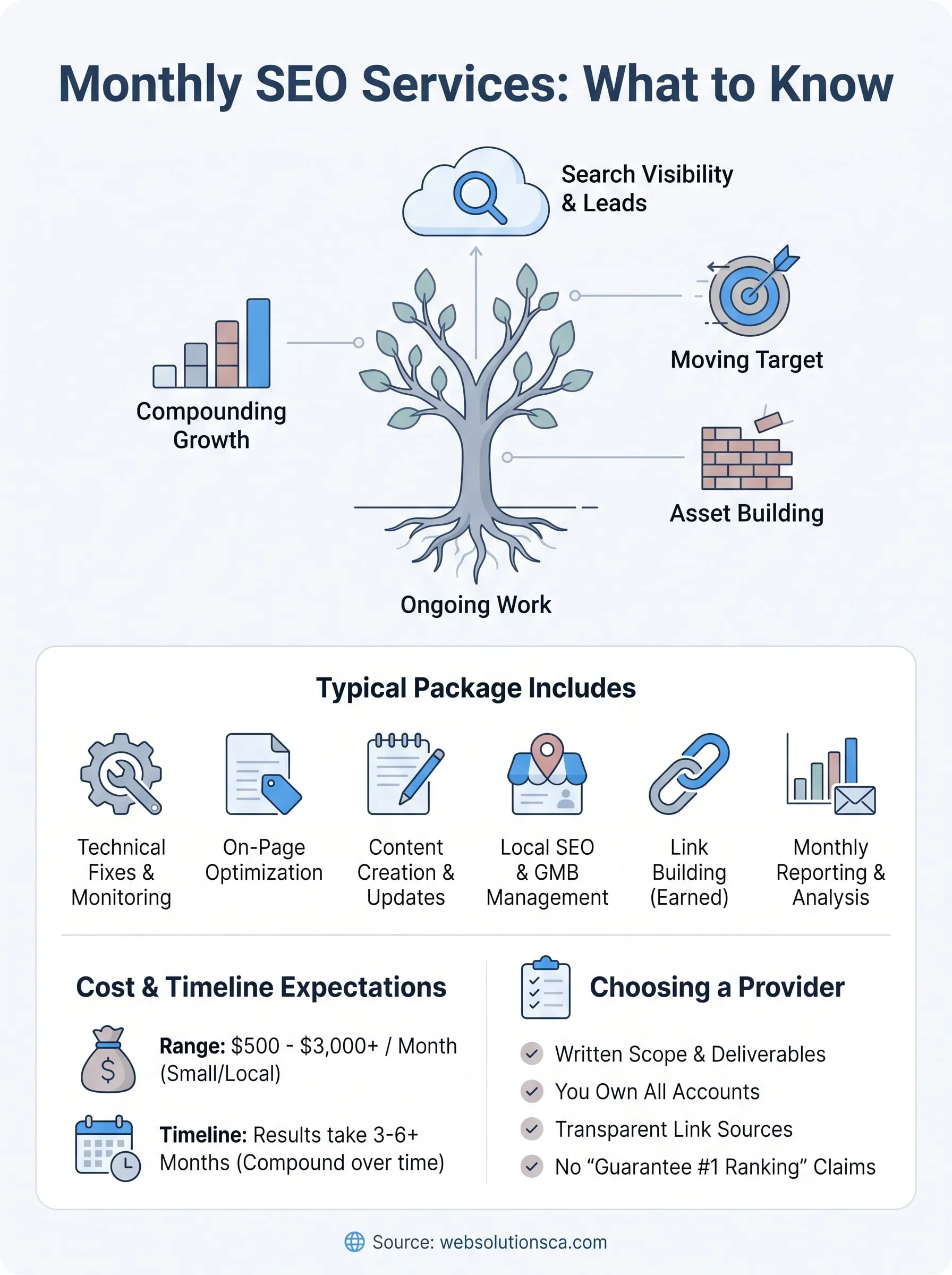
A monthly SEO package includes technical maintenance, on-page optimization, content, local SEO, link building, and a report. The mix changes with your budget, but a plan that lacks a clear written list of these items is not a plan.
The core monthly deliverables
Most legitimate monthly SEO services draw from the same seven deliverables. Ask which ones you get and how many pages or hours each covers.

- Technical monitoring and fixes: crawl errors, page speed, mobile usability, broken links, and indexing problems.
- On-page optimization: titles, headings, internal links, and copy on the pages that earn money.
- Keyword research and tracking: finding the searches your buyers use and watching your position for them.
- Content: new service pages, location pages, or articles, plus updates to older pages.
- Local SEO: Google Business Profile updates, citation cleanup, and review requests.
- Link building: earning links from relevant sites, never buying them in bulk.
- Reporting: a monthly report and a short call or email that explains what changed.
For a business with one location, the local items matter most. A clean Google Business Profile and consistent citations often move the needle faster than blog posts.
How the work changes over the first year
The first three months are foundation work: an audit, technical fixes, a keyword map, and profile cleanup. Expect little change in traffic. Months four to six bring early movement on long-tail and local searches. Months seven to twelve are where leads usually grow, assuming your market is not dominated by much larger sites.
A good provider also applies the 80/20 rule. A small share of your pages and fixes produces most of the results, so the early months go to those first. If a plan spreads effort evenly across fifty pages, ask why.
A monthly SEO plan should spend its first dollars on the few pages that bring you customers.
What a retainer does not include
Monthly SEO services usually exclude ad spend, a full website redesign, and any promise of a specific ranking. Content is often capped, so ask exactly how many pages or posts the fee covers. If your site is slow, outdated, or built on a template that cannot be fixed, you may need web work before SEO can pay off.
How much monthly SEO services cost
Expect roughly $500 to $3,000 a month for a local small business, $3,000 to $7,500 for a regional or e-commerce site, and $7,500 or more for large catalogs and national competition. These are US market ranges from published agency pricing, and individual quotes vary.
Typical price ranges by tier
| Tier | Typical monthly price | Who it fits |
|---|---|---|
| Entry-level local | $500 to $1,500 | One location, small site, few target pages |
| Standard local | $1,500 to $3,000 | One to three service areas, steady content |
| Mid-market | $3,000 to $7,500 | Multi-location, regional, or e-commerce |
| Advanced | $7,500 to $15,000+ | Large catalogs, national or competitive niches |

Lower tiers do less work, not worse work. A $500 plan can be a good fit when the scope is narrow and the competition is local. It is a poor fit when you expect new content every week and dozens of links.
What drives the price
Five factors explain most of the gap between quotes:
- Competition: ranking for "immigration consultant" in a crowded city takes more effort than a niche service.
- Number of locations: each added location means more pages, profiles, and citations.
- Site size and condition: large or messy sites need more technical hours.
- Content volume: four posts a month costs less than twelve.
- Provider type: freelancers often charge $1,000 to $3,000, boutique agencies $2,500 to $7,500, and larger firms more.
How to sanity-check a quote
Divide the monthly fee by the hours the provider says it covers. A $3,000 plan with 20 hours of work is $150 an hour, which sits inside the typical range for a generalist SEO. Rates far above or below that need an explanation.
At the very bottom, be skeptical. A fee under $500 with no written deliverables often means templated reports and little real work. Ask what a person actually does on your account each month, and if the answer is vague, move on.
A price only means something when it comes attached to a written list of work.
How to choose a monthly SEO provider
Choose a monthly SEO provider by scope, transparency, and fit with your market. You want written deliverables, ownership of your own accounts, and a plain explanation of how links are earned.
Questions to ask before you sign
Put these questions to every provider you consider, and compare the answers side by side.
- What exact work will you do each month, and how many pages or hours does it cover?
- Who owns the Google Business Profile, Search Console, and Analytics accounts? The answer must be you.
- How do you build links, and will you show me where they come from?
- What does the monthly report include, and can I see a sample?
- What is the contract length, and what is the cancellation process?
- Which results do you expect at three, six, and twelve months, and how will we measure them?
A provider who answers these clearly is usually one you can work with. One who dodges them is telling you something.
Red flags to walk away from
No one can guarantee a #1 ranking. Google says so in its own guidance on whether you need an SEO expert, so a guarantee is a sales line. Other warning signs include refusing to name link sources, locking your accounts under the agency's login, and reports that show only impressions without leads or calls.
Be careful with long lock-ins, too. Six months is a fair minimum for monthly SEO services, since results take time. A twelve-month contract with no exit and no deliverables list is not.
Choosing a local provider in Orange County
If you serve customers in Costa Mesa, Irvine, Santa Ana, or nearby cities, local knowledge helps. A provider who understands how people search in your area can build service-area pages that match real neighborhoods and tune your Google Business Profile for map results. Ask for examples of local work, not just national claims.
Our own monthly SEO plans at Web Solutions CA start at $499.99 and cover keyword research, on-page work, Google Business Profile optimization, technical fixes, local citations, and monthly reporting. We also build custom packages that combine SEO with web design, ads, and automation when a business needs more than SEO alone.
How to tell if your SEO retainer is working
Your retainer is working when organic leads and revenue trend upward over three to six months. Rankings alone can mislead you, because a page can climb for a keyword nobody buys from.
Metrics worth tracking
Focus on numbers that connect to the business:
- Organic leads: calls, form fills, quote requests, and direction requests from search.
- Google Business Profile actions: calls, website clicks, and direction taps.
- Organic traffic trend: judged over quarters, not week to week.
- Rankings for money keywords: the searches that lead to sales, not vanity terms.
- Conversion rate: the share of organic visitors who contact you.
If call tracking or form tracking is not set up, fix that first. Without conversion tracking, you cannot calculate a return.
A simple way to calculate return
Take the revenue from customers who came through organic search in a month, subtract the retainer, and divide by the retainer. Here is a hypothetical: you pay $800 a month, organic search brings six leads, and two become jobs worth $1,200 each. Revenue is $2,400, so return is ($2,400 minus $800) divided by $800, which is 200%. One new job a month can cover a small retainer.
Divide organic revenue by what you pay, and keep tracking until the answer holds steady.
What to do when results stall
First, check that the provider delivered the agreed scope. If the plan says two pages and a profile update each month, look for proof. Second, confirm the local SEO timeline: before month four, flat results are normal. Third, ask for a written plan for the next 90 days. A good provider can explain what changed, what is next, and why.
Making the call on a monthly plan
Monthly SEO services pay off for businesses that get customers from search and give the work time. Look for a written scope, accounts you own, honest pricing, and reports tied to leads. Skip anyone who guarantees rankings or hides how links are earned.
If you want to see what monthly SEO services for small businesses would look like for your business, talk to Web Solutions CA. We will review your site, tell you whether a monthly plan, a one-time project, or web work should come first, and quote it in writing.