

If your Orange County business isn't showing up when someone nearby searches for what you offer, something in your local SEO setup is broken. Maybe it's your Google Business Profile, maybe it's inconsistent citations, maybe your rankings just quietly slipped and you never noticed. A local SEO audit is how you find out exactly what's wrong before you spend another dollar trying to fix the wrong thing.
This guide walks you through auditing your own local presence step by step, covering your Google Business Profile, citation consistency, review signals, and where you actually rank against nearby competitors. You don't need expensive software to start, just a 12-step local SEO checklist and about an hour of focused work.
We put this together after running audits for tax preparers, window installers, and immigration consultants across Costa Mesa, Irvine, and Santa Ana who had no idea why phones weren't ringing. If you'd rather skip the DIY route, we also cover what to expect from professional local SEO audit services and how to tell if an agency is doing the job right.
What a local SEO audit covers and why it matters
A local SEO audit is a systematic check of every signal Google uses to decide whether your business shows up in the Local Pack, Google Maps, and organic results for nearby searches. It's not a single scan or a five-minute tool report. It pulls together your Google Business Profile, your citations across directories like Yelp and Bing Places, your website's on-page and technical health, your review profile, your backlink footprint, and your actual keyword rankings compared to competitors down the street. Skip any one of these and you're guessing at what's actually holding your visibility back.
Businesses often assume a slow website or a low star rating is the whole problem, when really it's a mismatched phone number sitting on an old directory listing from three years ago. That's why a proper audit looks at the full picture instead of one symptom, and why doing this before you spend on ads or a redesign saves you money.
The core components of a local SEO audit
Here's what a thorough audit covers, broken down by category:
| Audit Area | What You're Checking | Why It Matters |
|---|---|---|
| Google Business Profile | Categories, hours, photos, Q&A, posts, completeness | Primary ranking factor for the Local Pack |
| Citations & NAP | Name, address, phone consistency across directories | Inconsistent data confuses Google's confidence in your business |
| On-page & technical SEO | Title tags, location pages, site speed, mobile usability | Determines whether Google can crawl and match your site to local intent |
| Reviews | Volume, recency, star rating, response rate | Trust signal for both Google and searchers |
| Backlinks & rankings | Local link profile, keyword position vs. competitors | Shows real competitive standing, not just potential |
A local SEO audit only works if you check every ranking signal together, not just the one you assume is broken.
Why rankings slip without anyone noticing
Local rankings rarely crash overnight. They erode gradually: a competitor earns five new reviews while you earn none, a directory you signed up for years ago still lists your old suite number, or Google quietly updates its algorithm and rewards businesses with more complete profiles. None of these show up as an alert in your inbox. You just notice, months later, that the phone stopped ringing as much. Google's own guidance on local ranking factors confirms that relevance, distance, and prominence all shift based on ongoing signals, not a one-time setup.
Owners who never audit their presence tend to fix the wrong thing first, usually by throwing money at ads to compensate for a broken foundation. An audit tells you where your actual weak point sits before you spend another dollar chasing the wrong fix.
DIY checklist vs. professional local SEO audit services
Running the checklist yourself takes about an hour if you're organized, and it's worth doing at least once before hiring anyone. A full professional audit, though, typically digs deeper: pulling rank-tracking data across dozens of keywords, auditing your entire citation footprint with paid tools, and cross-referencing competitor backlink profiles you can't see with free software. If your business depends on local search for most of its leads, that depth matters. The steps below walk you through the DIY version first, then we'll cover what separates a real professional audit from a generic automated report.
Step 1. Audit your Google Business Profile
Your Google Business Profile (GBP) is the single biggest lever in local search, so start your audit there before touching anything else, and learn how to make your profile work harder in local search as you go. Log into your profile at business.google.com and go through it the way a potential customer would, not the way you set it up two years ago. Small gaps here, an outdated phone number, a missing category, a photo nobody's updated since 2023, quietly cost you visibility every day they sit unfixed.
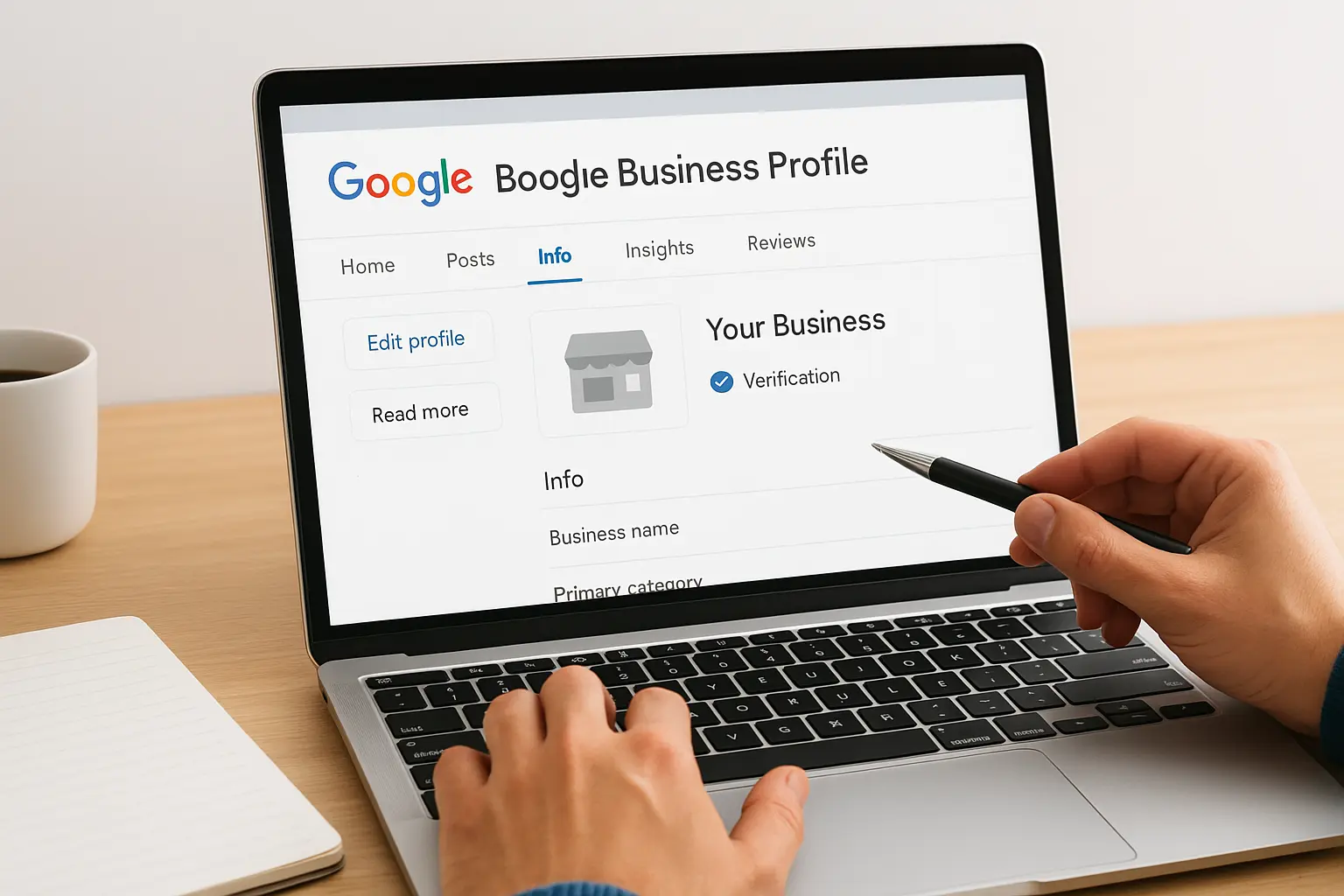
If your Google Business Profile isn't complete and accurate, nothing else in your local SEO audit will matter much.
Work through this list in one sitting:
- Business name: matches your storefront sign and legal name exactly, no keyword stuffing ("Costa Mesa's Best Plumber" gets your listing suspended, not ranked)
- Primary category: the most specific option available, not a generic catch-all
- Secondary categories: cover every real service you offer, but skip ones that don't apply
- Hours: correct for today, including holiday hours if you've set special hours before
- Phone number: matches the number on your website exactly, digit for digit
- Website URL: points to your homepage or a relevant location page, not a broken redirect
- Photos: at least 10, updated within the last 90 days, no stock images
- Q&A section: no unanswered questions sitting there for months
- Posts: at least one in the last 30 days
- Products/services list: filled out with real descriptions, not left blank
Check your service area setting next if you're a service-area business without a storefront. A lot of Orange County contractors and consultants set this once and never revisit it, and it quietly narrows or expands who sees them without anyone noticing.
Spotting the profile issues that actually hurt rankings
Beyond completeness, look for signals Google actively penalizes. Duplicate listings you need to remove, often created accidentally when a past employee or agency set up a second profile, split your review count and confuse Google about which one to rank. Search your business name in Google Maps and scroll past the first result to check. Also verify your primary category is still the right fit; businesses that pivot services (say, a tax preparer who added bookkeeping) often forget to update this, and it directly affects which searches you show up for. This step alone, done properly, usually surfaces the first fixable issue in a local seo audit.
Step 2. Check NAP consistency across citations and directories
NAP stands for name, address, and phone number, and it needs to match exactly everywhere your business appears online. Google cross-references these listings to confirm your business is real and stable, and even small discrepancies, a suite number left off one listing or an old phone number surviving on a directory you forgot existed, chip away at that confidence. This is the step most Orange County business owners skip, because it feels tedious compared to fixing a website. It's also usually where a local seo audit turns up the most surprises.
Google trusts businesses whose name, address, and phone number match everywhere, so one wrong digit on a forgotten directory can quietly cost you rankings.
Where to check first
Start with a free tool like Moz Local or BrightLocal's citation tracker to pull a quick snapshot, then manually verify these directories yourself since automated tools sometimes miss older listings:
- Google Business Profile
- Bing Places
- Yelp
- Apple Maps
- Facebook Business Page
- Yellow Pages
- Better Business Bureau
- Industry-specific directories (Avvo for attorneys, Houzz for contractors, etc.)
Search your business name plus your city in Google and scan the first two pages of results. Old listings from a previous address or a defunct phone plan surface here more often than owners expect, especially if the business moved within Orange County in the last few years.
Fixing inconsistencies without creating new ones
Work through each mismatched listing one at a time rather than mass-editing everything at once. Claim any unclaimed profiles first, since you can't correct a listing you don't control. Then update the format consistently: decide whether you write
Step 3. Review your website's on-page and technical SEO
Your website is where all that Google Business Profile traffic actually lands, and if it loads slowly or never mentions your city, you lose visitors right after you earned the click. Start by checking whether your homepage and service pages actually say where you work. A plumber in Tustin who never mentions "Tustin" anywhere on the site is asking Google to guess at relevance it shouldn't have to guess at. This part of a local SEO audit catches problems a GBP check alone never will.
A fast, location-aware website turns the visibility you've earned into actual calls and form submissions.
What to check on each page
Work through your main pages with this list:
- Title tags: include your primary service and city ("Emergency Plumber in Tustin, CA" beats "Home")
- H1 headings: match search intent, not just your business name
- Location pages: one dedicated page per city you actively serve, with unique content, not copy-pasted blocks
- NAP on-page: your address and phone number appear in the footer of every page
- Mobile usability: test on your own phone; buttons and forms should work without pinching to zoom
- Site speed: run your homepage through Google PageSpeed Insights and aim for a score above 70 on mobile
- Schema markup: LocalBusiness structured data present and matching your GBP details exactly
Running through this checklist usually takes less than thirty minutes once you know what you're looking for.
Technical issues that quietly tank local rankings
Beyond the checklist, dig into a few things that don't show up at a glance. Broken internal links between your service pages confuse both users and crawlers, so click through your own navigation like a stranger would. Duplicate or thin location pages, ones with the same three sentences swapped out for a different city name, can actively hurt you instead of helping, since Google treats them as low-value content rather than genuine local relevance. Finally, check your site's SSL certificate is active and your URLs don't redirect through multiple hops before landing on the final page; each extra hop slows things down and dilutes crawl efficiency. Fixing even two or three of these issues often moves the needle faster than any citation cleanup does.
Step 4. Analyze reviews, backlinks, and local rankings
Reviews, backlinks, and your actual position in search results make up the final piece of a local SEO audit, and together they tell you how Google currently ranks your business against everyone else fighting for the same customers in Orange County. This is where you find out whether competitors are pulling ahead on trust signals you haven't matched yet, or whether you're actually closer to the top than you thought.

A business with more recent reviews than its competitors usually outranks one with a higher star rating and no new reviews in months.
What to check in your review profile
Pull up your Google Business Profile reviews and compare them directly against your top three local competitors:
- Total review count: stack it against competitors ranking above you
- Review recency: anything older than 60 days without a new one signals stagnation to Google
- Average star rating: below 4.0 actively suppresses click-through from the Local Pack
- Response rate: unanswered reviews, especially negative ones, look neglected to both Google and searchers
- Review keywords: mentions of your service and city in review text reinforce relevance signals
Don't skip Yelp and Facebook reviews either. Google increasingly factors sentiment pulled from across the web, not just what sits on your GBP.
Backlinks and competitive rank tracking
Search your top three service keywords plus your city in an incognito browser and note exactly where you land, then repeat the search for two competitors who consistently outrank you, or use a tool that monitors your local rankings for you. Free tools like Ahrefs' Backlink Checker or Moz's Link Explorer show a rough count of domains linking to your site and theirs; if a competitor has 40 local backlinks from Orange County chambers of commerce and community sites and you have four, that gap explains a lot of the ranking difference. Check whether those links come from real, local, relevant sources rather than spammy directories, since quality outweighs quantity when you're earning backlinks from nearby businesses and organizations. Owners searching for local SEO audit services usually want this competitive comparison specifically, because it's the piece free tools handle poorly on their own. This step tells you whether your ranking problem is a content gap you can fix quickly or a genuine authority gap that takes months of consistent link-building to close.
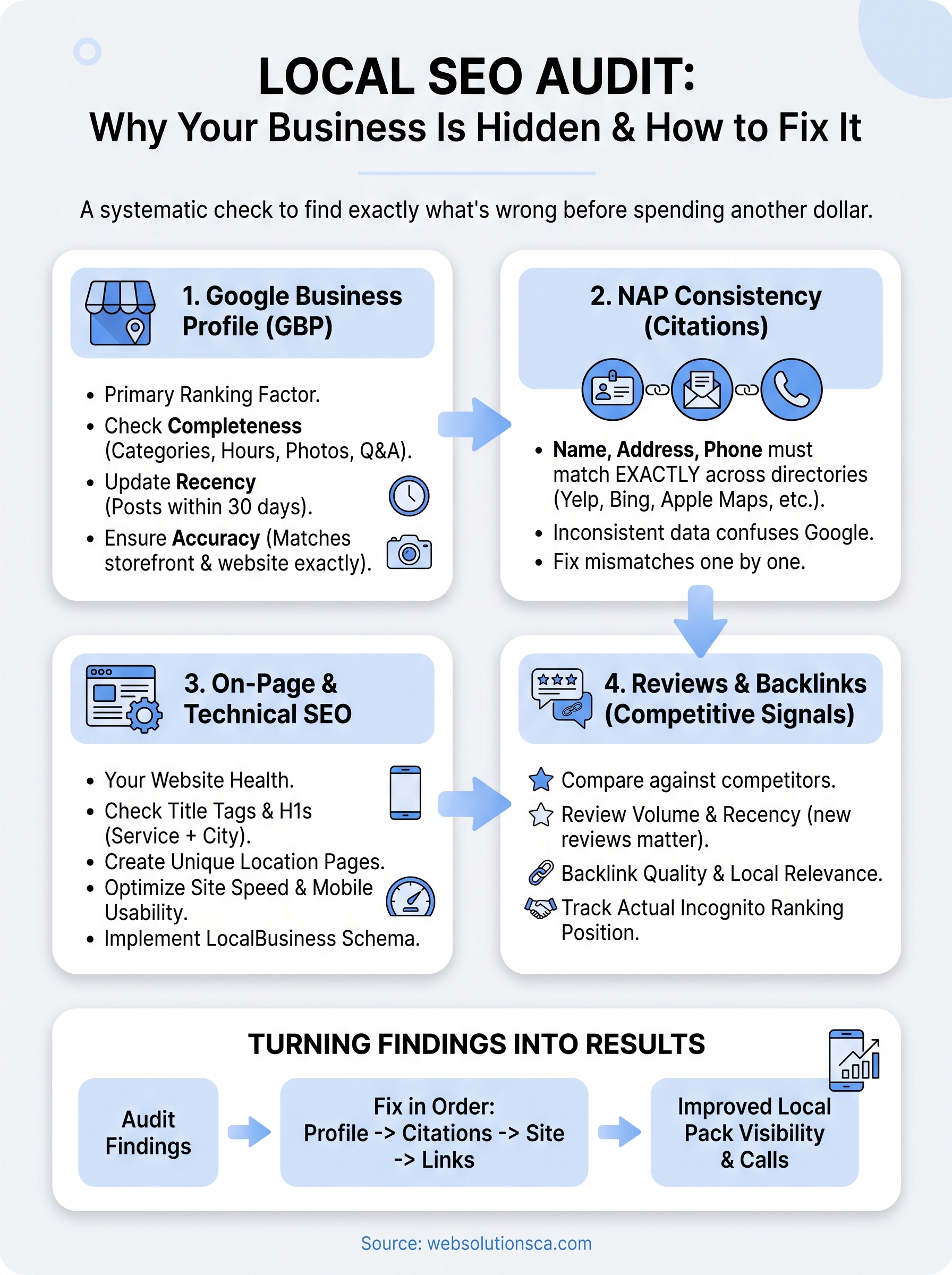
Turning your audit findings into results
By now you've got a list: a stale Google Business Profile, a handful of mismatched directory listings, maybe a competitor with 40 more backlinks than you. That list is worth more than any single fix, because it tells you exactly where your local SEO audit uncovered real gaps instead of guesses. Fixing them in order, profile first, then citations, then on-page issues, then reviews and links, is what actually moves you back into the Local Pack.
Some of this you can knock out yourself in an afternoon. The competitive gaps, especially backlinks and rank tracking against businesses that outrank you, take more time and tools than most owners want to manage alongside running their business. If you'd rather hand the whole process to someone who does this daily, see how our SEO services for Orange County businesses turn a full audit into fixes and rankings.
If you want a deeper review of your technical SEO, content, indexing, Local SEO, internal links, and search performance, explore our professional SEO audit services.