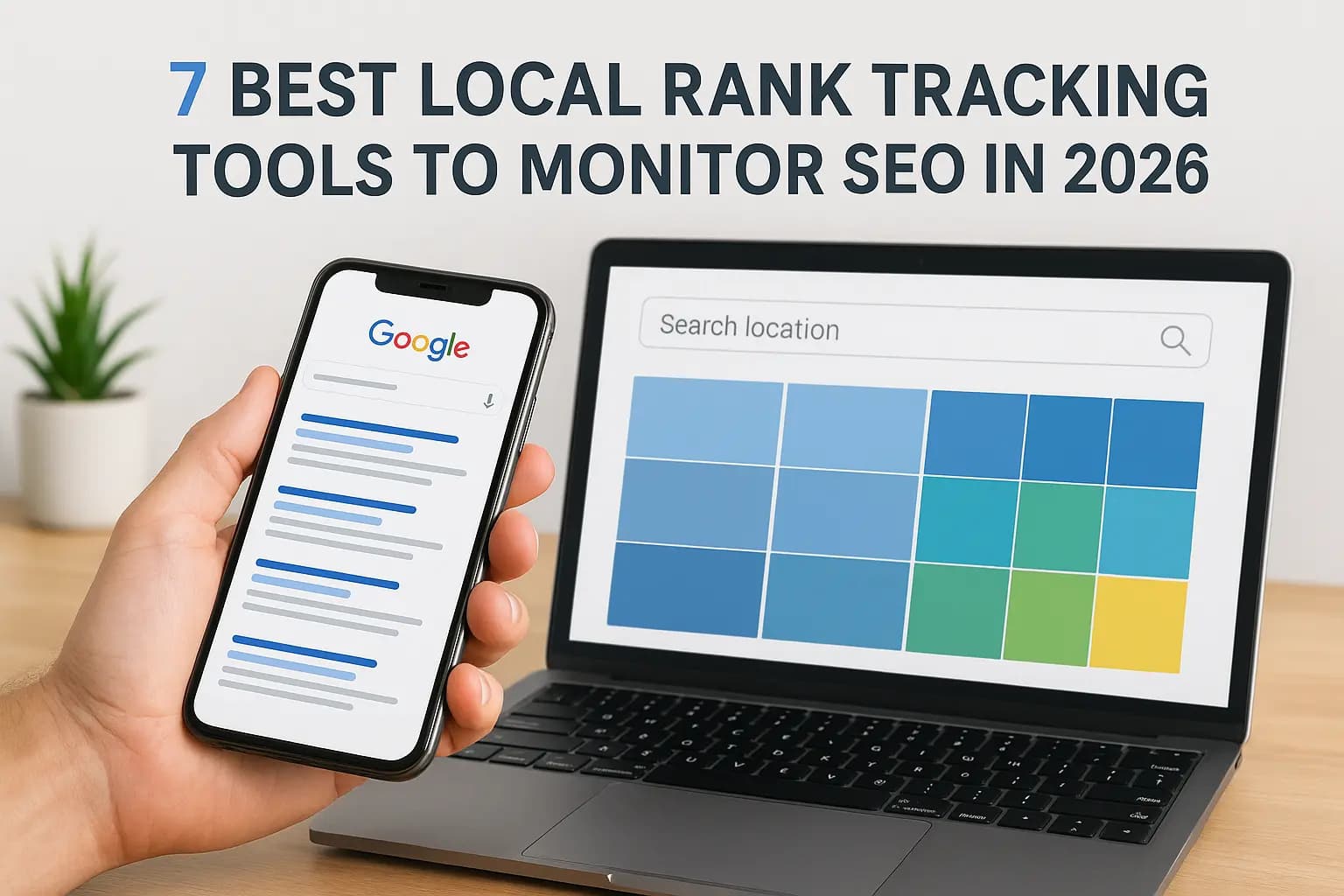
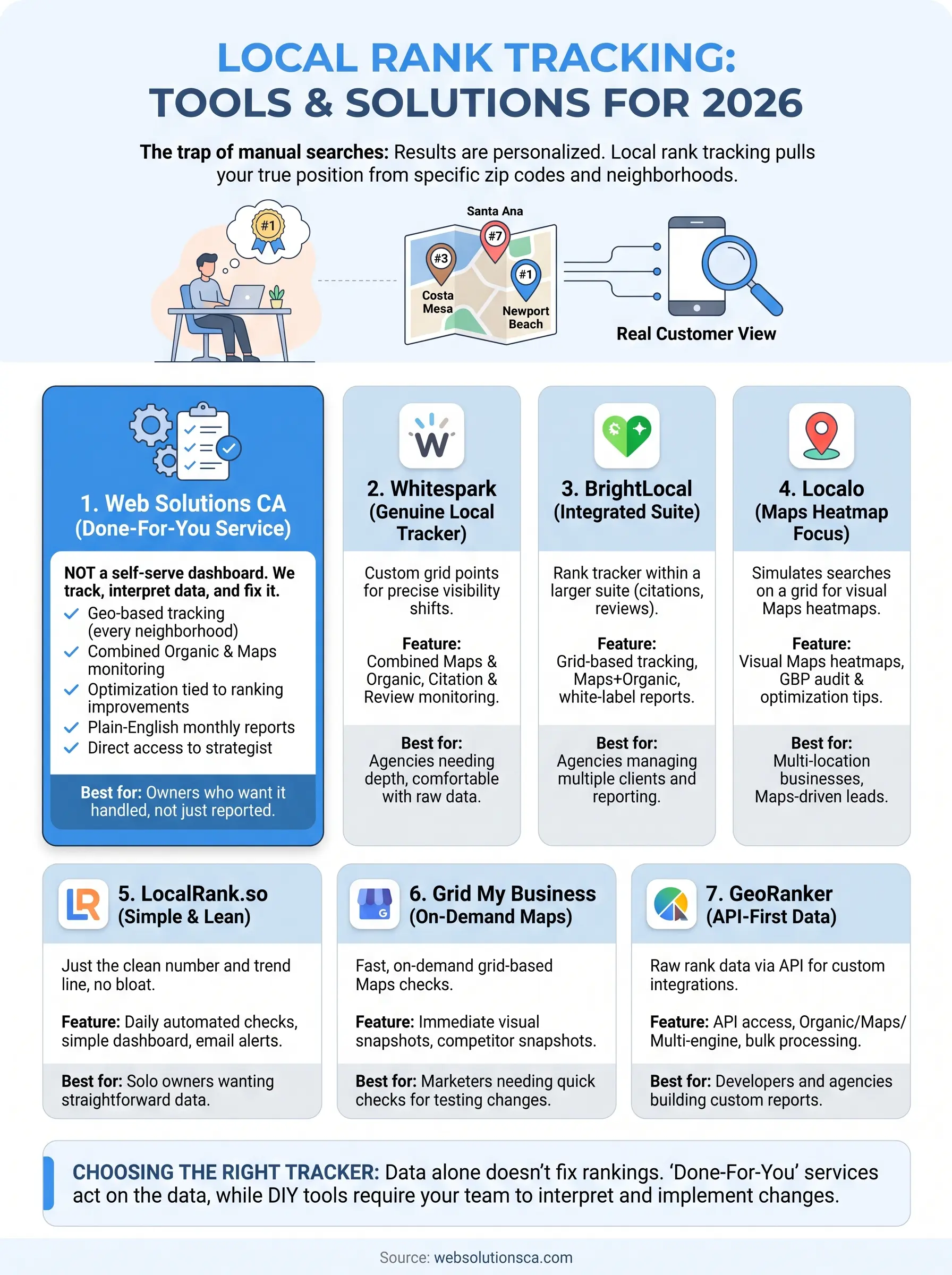
You're ranking on page one for your main keyword when you search from your office, but a customer three miles away in Irvine swears you're nowhere to be found. That's the trap of checking rankings manually. Google results can change based on location, device, and other context, so your own searches show only one limited view of your visibility. Local rank tracking measures how you appear for the same search from different locations, instead of relying on the result you see at your own desk.
If you're searching for a local SEO rank checker that measures Google Maps and organic positions across the areas you actually serve, you're in the right place. These tools can track specific keywords from different search locations so you can compare your visibility in Costa Mesa versus Santa Ana versus Newport Beach.
Below, we review six local SEO software products and explain when managed rank tracking makes sense. Each option includes how it works, who it suits, key features, and pricing considerations. We also show you how to track rankings across cities and interpret geographic ranking grids.
What is local rank tracking in SEO?
Local rank tracking is the process of measuring where a business appears in search results for specific keywords from specific geographic locations. It helps you understand your visibility in Google Maps, the local pack, and standard organic search results across neighborhoods or cities.
For example, a Santa Ana accountant might rank well for "tax accountant near me" close to the office but much lower from Irvine. A single rank reported for all of Orange County would hide that difference.
Local rank tracking answers four useful questions:
- Which keywords show your business in Google Maps or organic results?
- Where do you rank within the places your customers actually search?
- Which competitors appear ahead of you in particular areas?
- Did visibility change after a website update, review activity, or Google Business Profile improvement?
Which local rank tracker should you choose? BrightLocal and Whitespark are strong starting points for broader local SEO reporting. Grid My Business and Localo are worth considering for geographic Maps visibility. GeoRanker is oriented toward technical reporting needs. The right choice depends on what you need to measure, how frequently you want reports, and how you intend to act on the findings.
Google Maps rank tracking vs. organic rank tracking
These are different results and should be tracked separately.
| Type of ranking | What it measures | Example | Most useful for |
|---|---|---|---|
| Google Maps or local pack | Where your Google Business Profile appears for searches from a location | "plumber near me" from central Santa Ana | Calls, directions, and local discovery |
| Local organic rankings | Where a page on your website appears in standard search results | "web design santa ana" | Service-page traffic and inquiries |
| Geo-grid tracking | Maps rankings at a set of individual points | 5 by 5 points across a service area | Seeing neighborhoods with weak visibility |
| Search Console performance | Actual organic impressions, clicks, and average positions for your site | Queries bringing visitors to a service page | Measuring organic traffic outcomes |
Google Search Console does not replace a dedicated Google Maps geo-grid tracker, and a Maps grid does not replace website analytics. Use them together when making decisions.
How to track local SEO rankings effectively: step-by-step
Step 1: Choose keywords based on your actual services
Start with five to ten high-intent keywords, such as "accountant santa ana," "tax preparation costa mesa," or "drywall repair huntington beach." Add relevant "near me" variations and informational searches only where they support business goals.
Use local keyword research to separate your main money keywords from supporting topics. Don't track hundreds of low-value phrases just because your plan allows it.
Step 2: Choose the locations customers search from
For a single-location business, select points around the actual business location and meaningful nearby neighborhoods. For a service-area business, choose points in the areas it legitimately serves.
Example: A business based in Costa Mesa might monitor visibility from Costa Mesa, Santa Ana, and Irvine. Those locations are useful to compare, but your Google Business Profile does not automatically qualify for top map visibility in every city you serve.
Step 3: Track Maps and organic results separately
Configure a local rank tracker to monitor Google Business Profile results and, where supported, website organic rankings. Record the search location, device, date, and keyword so your comparisons are consistent. Use a geo-grid tool for a more detailed picture within a city.
Step 4: Establish a baseline
Save an initial report and note the strongest and weakest keywords, geographic coverage, and notable competitors. One scan is a snapshot, not a trend. Run comparable scans over several weeks before drawing conclusions.
Step 5: Compare visibility with actual business results
Connect your tracking observations to Google Search Console, website analytics, qualified inquiries, calls, and bookings where available. A move from position 9 to position 4 can be helpful, but it is not the same as getting four extra leads.
Step 6: Turn ranking data into an optimization plan
If organic visibility is low, check relevant page quality, indexing, content, internal links, and authority. If Maps visibility is weak, review your Business Profile's category, relevance, business information, legitimate reviews, and proximity considerations.
Use our local SEO checklist to prioritize fixes. Review changes over time instead of assuming a specific edit caused a ranking shift.
How to check rankings in multiple locations
Businesses with several offices should create separate tracking projects for each real location, with its own address, Business Profile, keywords, and geographic grid.
For businesses with only one physical office but customers in multiple cities, track the same business across several service areas without suggesting it has branches it does not operate.
| Example keyword | Costa Mesa | Santa Ana | Irvine |
|---|---|---|---|
| Tax accountant near me | 3 | 8 | 16 |
| Small business bookkeeping | 5 | 11 | 19 |
| Tax preparation services | 2 | 7 | 14 |
Illustrative rankings, not data from a real business.
The example shows why one city-wide average can be misleading. Also remember that ranking in the Maps pack depends heavily on geographic relevance and proximity. Creating a location landing page does not create another verified office location.
1. Whitespark local rank tracker
Whitespark built its reputation on local SEO tools long before rank tracking became a crowded market, and its tracker still reflects that focus. This is a genuine local SEO rank tracker, not a general SEO suite with local features bolted on, which matters if local search is your entire business model.
How it works
Whitespark tracks localized search rankings for specified keywords and locations, helping you monitor changes in organic and local pack visibility. It provides local pack and organic ranking results. Whitespark also offers other local SEO tools, so verify which features are included in the Rank Tracker itself rather than assuming citation and review products are bundled.
Rank tracking shows positions. Reviews, business relevance, and citations provide additional context when investigating changes.
Best for
Agencies and consultants who manage multiple client locations need this kind of local SEO rank tracking depth. It can also suit business owners who want to monitor local pack and organic visibility over time.
Key features
- Location-specific rankings by keyword and search location
- Combined Maps and organic tracking
- Additional citation and reputation tools available separately
- White-label reporting for agencies
Pricing
Whitespark offers plans based on location-keyword allowances and tracking frequency. Its published weekly-tracking annual plan has been listed from $14 per month, while monthly billing and daily tracking cost more. Check Whitespark's current plan selector before purchasing.
2. BrightLocal rank tracker
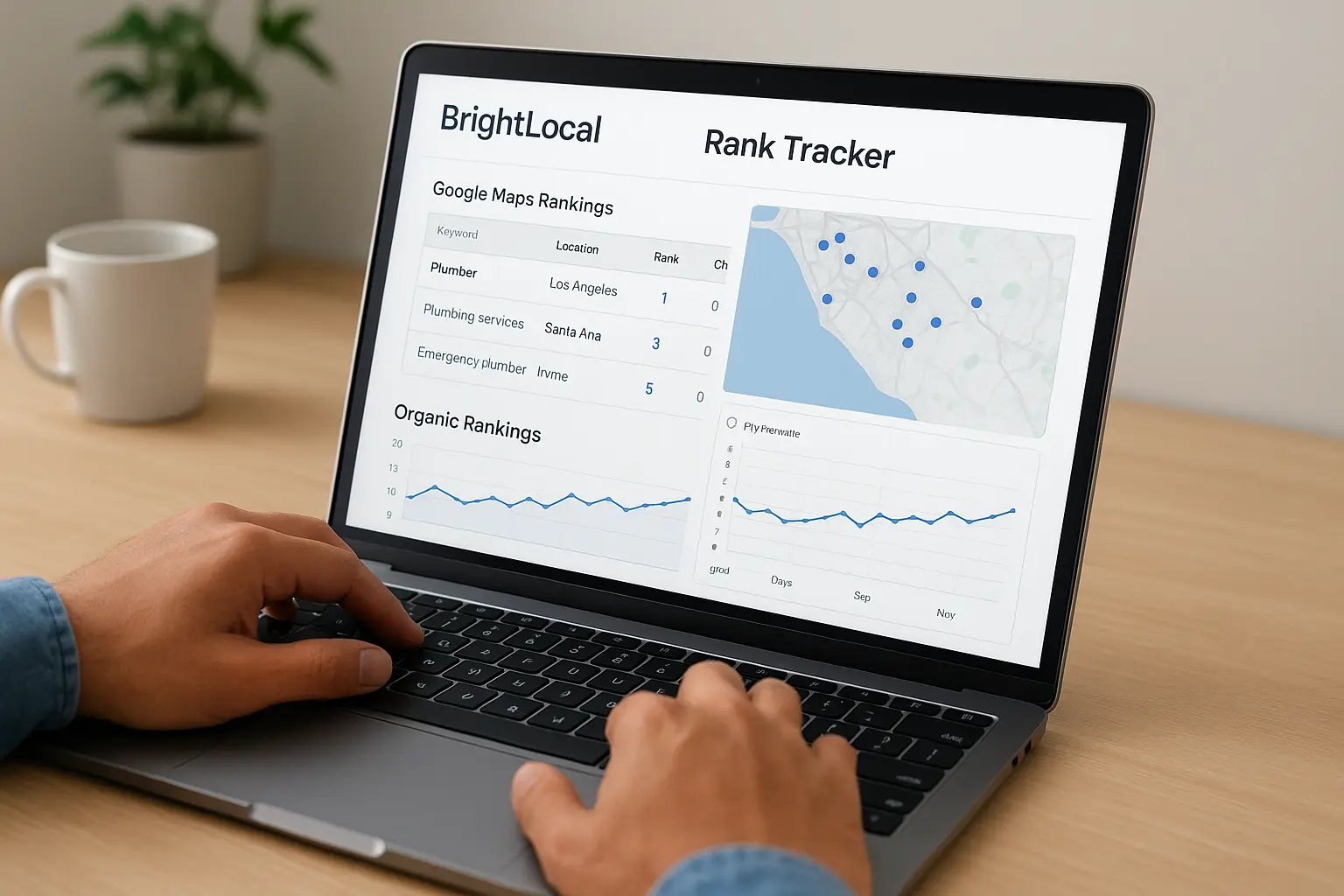
BrightLocal has been a staple in the local SEO industry for years, and its rank tracker is often the first stop for agencies building out full local search reports. This isn't a standalone gadget, it's part of a bigger suite that also handles citations, reviews, and audits, so the local search rank tracking data sits next to everything else you need to run a campaign.
How it works
You plug in your target keywords and locations, and BrightLocal offers a Local Rank Tracker for location-based organic and local results, plus a separate Local Search Grid product that checks map rankings from multiple points. Other BrightLocal products support citation and review workflows. Compare the products and pricing rather than assuming that one plan includes every feature.
Rankings can change for several reasons, including competitors, relevance, proximity, and search updates. Learn more about local SEO ranking factors.
Best for
Agencies and consultants managing several clients at once benefit most, since the platform is built for juggling multiple businesses and generating client-ready reports without extra formatting work.
Key features
- Local Rank Tracker for location-based reports; separate Local Search Grid for map-point scans
- Combined Maps and organic reporting
- Built-in citation and review tracking
- White-label PDF reports for client delivery
Pricing
BrightLocal's total cost depends on the plan and any additional products or credits required for grid scans. Review BrightLocal's current rankings product and compare the cost for your exact locations, keywords, and scan frequency.
3. Localo
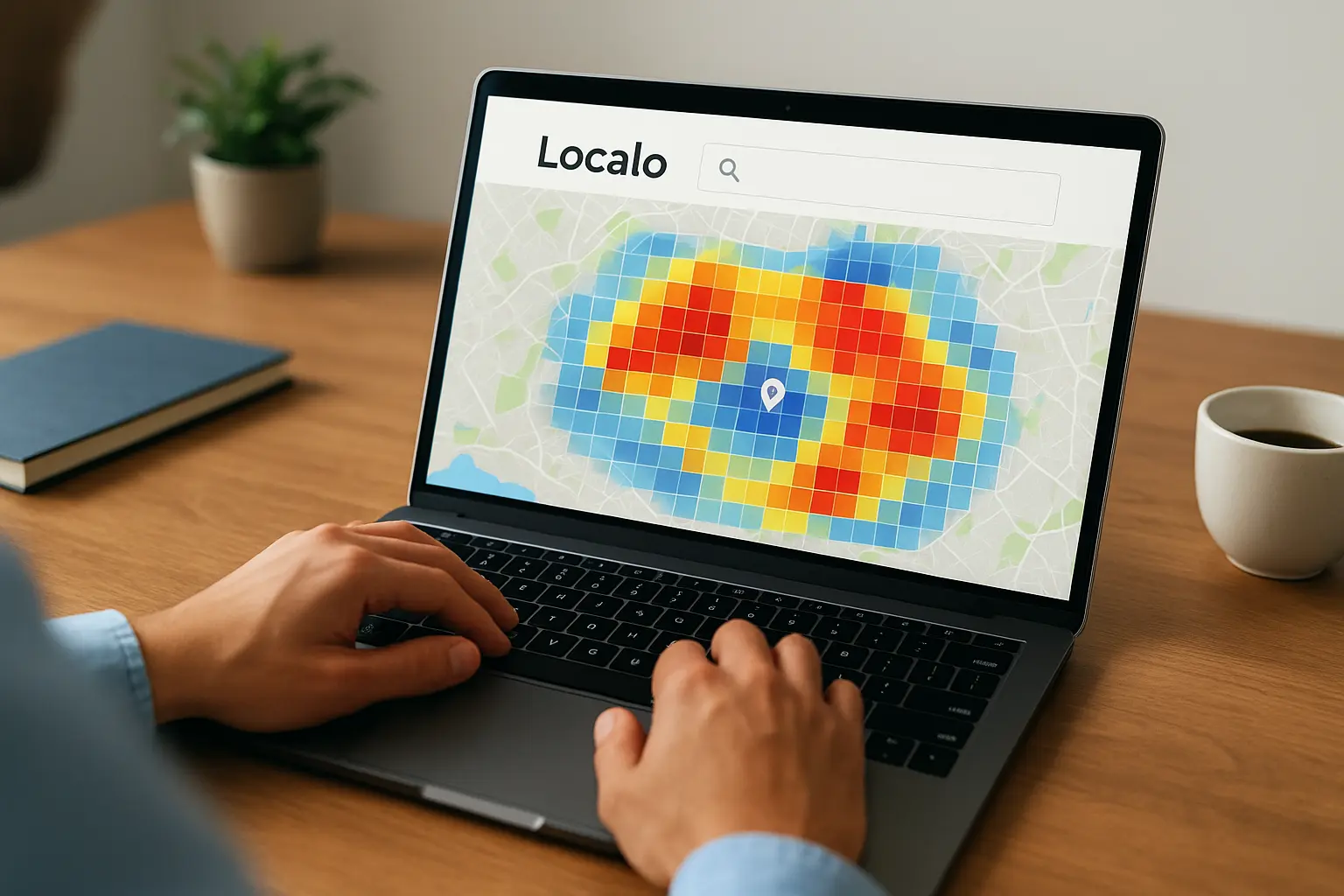
Localo combines Google Maps position tracking with Google Business Profile optimization features. Its location-specific maps can show where a listing performs well and where it loses visibility. If your leads come almost entirely from Google Maps rather than organic blue links, this local rank tracking software deserves a serious look.
How it works
Localo checks a keyword from multiple geographic points and displays positions on a map. Its Advanced Grid feature supports configurable 3 by 3, 5 by 5, and 7 by 7 grids. It also provides profile optimization guidance. Compare the included scan limits and configuration options for your plan.
A single ranking number can hide geographic variation. A map grid makes those gaps easier to see.
Best for
Owners, multi-location businesses, and agencies that want to visualize differences in Google Maps visibility by neighborhood. It also suits owners who want to test how Google Business Profile edits affect visibility before committing to bigger SEO changes.
Key features
- Geographic map scans for Google Maps rankings
- Google Business Profile audit and optimization suggestions
- Competitor comparison at the grid level
- AI-driven recommendations tied to ranking changes
Pricing
Localo's plans and available features may change. Confirm the current price for your location count and the exact rank-monitoring functionality you need on Localo's website.
4. LocalRank.so
LocalRank.so is a newer entrant built for simplicity, stripping away the citation audits and reputation dashboards that bloat bigger suites. It positions itself as a lean local SEO rank checker for owners who just want a clean number and a trend line, not a full marketing platform bolted onto a tracker.
How it works
Set up your business profile, add your target keywords and service areas, and LocalRank.so presents local ranking reports for configured keywords and locations. The product emphasizes rank reports and branded client reporting. Review the current interface to decide whether it fits your preferred reporting workflow.
Choose a tracker that makes trends clear and gives you the context needed to act.
Best for
Small businesses and teams looking for a focused reporting interface may prefer this option. It also suits anyone tracking a single location who wants dependable local SEO rank tracking without paying for agency-scale features they'll never touch.
Key features
- Automated ranking reports; confirm available frequency and search result types
- Simple, uncluttered dashboard built for single-location owners
- Keyword and location organization; confirm current plan options
- Ranking change notifications, where supported
Pricing
LocalRank.so currently advertises plans from $47.50 per month when billed annually or $57 month-to-month. Verify current inclusions and pricing on its official tracking page.
5. Grid My Business
Grid My Business earned its name honestly, since grid-based Maps checks are the entire product. It's a local rank tracking software built for owners who care almost exclusively about where they land in the Google Maps three-pack, without the citation audits and review dashboards bundled into bigger suites.
How it works
A grid scan checks the position of a business in Maps results from several configured points across a service area. This gives you a fast, visual snapshot of local search rank tracking without waiting on a scheduled crawl, which matters if you just made a change to your listing and want to see the impact today.
An on-demand scan provides a new snapshot, but meaningful trends usually require several comparable checks.
Best for
Owners and marketers who want quick, on-demand local rank tracking rather than a scheduled dashboard fit this tool best. It can also suit marketers comparing rankings before and after a planned Google Business Profile update, while allowing enough time for changes to take effect.
Key features
- On-demand grid scans instead of fixed weekly checks
- Visual heatmaps for Google Maps rankings
- Competitor snapshots at each grid point
- Historical scan comparisons to track progress over time
Pricing
Check Grid My Business pricing for its current plans and scan allowances. Your cost will depend on scan frequency, grid points, keywords, and locations.
6. GeoRanker local rank checker
GeoRanker rounds out this list as an API-first option built more for developers and larger agencies than solo owners. It's a local rank tracking software that treats rank data as raw material you can pipe into your own dashboards, spreadsheets, or client portals, rather than a fixed interface you're stuck viewing.
How it works
GeoRanker provides location-oriented ranking data for teams building custom reports. Confirm API endpoints, result types, and search-engine coverage in its current documentation. Depending on the product and API available, you can use location-based results in custom dashboards or reports. For context on creating locally relevant content, see city pages for service areas.
Data only helps the business that can actually use it, so match the tool to your team's technical comfort.
Best for
Agencies and developers who want to build their own reporting layer on top of reliable local SEO rank tracking data get the most value here. It also suits larger operations tracking dozens of locations that need automated data pulls instead of manually checking a dashboard.
Key features
- API access to raw ranking data
- Organic, Maps, and multi-search-engine coverage
- Custom location targeting by coordinates or radius
- Bulk keyword and location processing for scale
Pricing
GeoRanker's API access, usage limits, and commercial terms should be checked directly on GeoRanker before choosing it for a custom reporting setup.
How to interpret a local ranking grid
A geo-grid displays search rankings from several points around a business. For example, a 5 by 5 grid checks 25 points and can reveal whether visibility weakens with distance or differs in particular neighborhoods.
Some platforms color-code strong positions in green and weaker ones in warmer colors. BrightLocal's documentation, for example, describes green for positions 1 to 3, amber for 4 to 10, orange for 11 to 20, and red for 21 or lower.
Use the grid to identify patterns, not to diagnose causes automatically. A red outer ring may reflect normal distance effects rather than a technical problem. A sudden change across most points may deserve an investigation of profile status, category changes, competitors, or wider search updates.
Why does my local rank tracker show different results than Google?
Search results can vary by exact search location, device, language, time, personalization, the type of results measured, and how each tool collects data. Even two trackers can produce different values.
For meaningful comparisons, stick to the same tool and scan configuration over time, and investigate large changes rather than overreacting to one point.
Frequently asked questions about local rank tracking
What is rank tracking in SEO?
Rank tracking measures how a website or business listing appears for chosen keywords over time. Local rank tracking adds a geographic dimension so you can compare visibility between cities, neighborhoods, or map points.
What's the best rank tracker for local SEO?
For combined local organic and Maps reporting, compare BrightLocal and Whitespark first. For visual Google Maps geo-grids, evaluate Grid My Business, Localo, or BrightLocal Local Search Grid. The best choice depends on features, location count, scan frequency, and reporting needs.
What is the best Google Maps rank tracker?
A grid-based tool is particularly useful when you want to see how Google Maps visibility changes across a neighborhood. Grid My Business, Localo, and BrightLocal Local Search Grid are useful starting points. Compare scan settings and reports before deciding.
How can I track website rankings effectively?
Track a focused keyword list from consistent locations and devices, save a baseline, review trends, and combine ranking observations with Google Search Console and actual leads. Avoid relying on repeated manual searches from your own device.
How do I check local SEO rankings in multiple locations?
Set up location-specific tracking projects for real branches, or monitor the same business from several geographic points in its service area. Compare results for the same keywords and dates. Do not create fake business locations for tracking.
Can Google Search Console show Google Maps rankings?
Not as a substitute for dedicated geographic Maps rank tracking. Search Console is especially useful for website search impressions, clicks, queries, and average positions. Maps grid tools measure listing visibility at specified map points.
How often should I check local rankings?
For many small businesses, weekly scans and a monthly review are enough to identify broad trends. Highly competitive or multi-location campaigns may benefit from more frequent checks. Keep the methodology consistent and assess actual business impact.
Does a higher Maps ranking guarantee more leads?
No. A strong Maps position may improve discovery, but calls and conversions also depend on customer intent, competition, reviews, services, business hours, and the quality of your website or contact experience.
Official sources and further reading
- Localo: How ranking maps and point-based results work
- Localo: Advanced Grid sizes and configuration
- BrightLocal: Local Rank Tracker documentation
- BrightLocal: Local Search Grid explained
- Whitespark: Local Rank Tracker plans
- LocalRank.so: tracking product and plans
- Grid My Business: local grid rank tracking
Managed local SEO tracking with Web Solutions CA
Web Solutions CA offers local rank tracking as part of its managed SEO services, rather than as a self-serve software product. For business owners who want the results interpreted rather than another dashboard to manage, a service can help connect the rank data to improvements in content, technical SEO, and Business Profile management.
How it works
Before we touch your website, we build a keyword list based on how your real customers search, then track your local ranking position across the locations relevant to your business, from Costa Mesa to Huntington Beach to Tustin. We check both organic results and the Google Maps three-pack, because the two result types can perform very differently. You get a plain-English monthly report showing movement over time, tied directly to the SEO work we're doing.
Ranking reports become useful when they lead to informed action.
Best for
Business owners who want local search rank tracking handled alongside an SEO strategy, without managing an additional software subscription. This fits service businesses and startups that don't have an in-house marketing person and don't want to become one, the same crowd we had in mind when we compared local SEO services aimed at small businesses. It's also a strong fit if you've tried a DIY tracker before and found the raw data confusing without context.
Key features
- Location-based monitoring for agreed target cities and search areas
- Combined organic and Google Maps position monitoring
- Google Business Profile optimization tied to ranking improvements
- Monthly reporting explained in plain language, not just spreadsheets
- Recommendations based on ranking trends and business priorities
Pricing
Local rank tracking is bundled into our monthly SEO services, which start at $499.99 per month. There's no separate software fee, and pricing scales with how many locations and keywords you need tracked, which puts it in range of most affordable local SEO options. We'll walk you through exact numbers during a free consultation once we understand your goals.
Choosing the right rank tracker for your business
When choosing a tracker, prioritize the type of search results it monitors, location accuracy, reporting frequency, the number of keywords you can afford to track, and how clearly it presents changes. A ranking decline is a prompt to investigate, not proof that one specific SEO element is broken. Use a step-by-step local SEO checklist.
That's the gap we built our approach to close. Instead of asking you to log into a dashboard and figure out next steps alone, we can monitor your positions across the Orange County locations relevant to your SEO campaign and turn that data into actual changes to your Google Business Profile, on-page content, and citations. Our goal is to connect those observations with practical changes and measurable inquiries.
If you would rather have someone monitor your rankings and act on the findings, explore our monthly SEO services for Orange County businesses with done-for-you local rank tracking built in.