
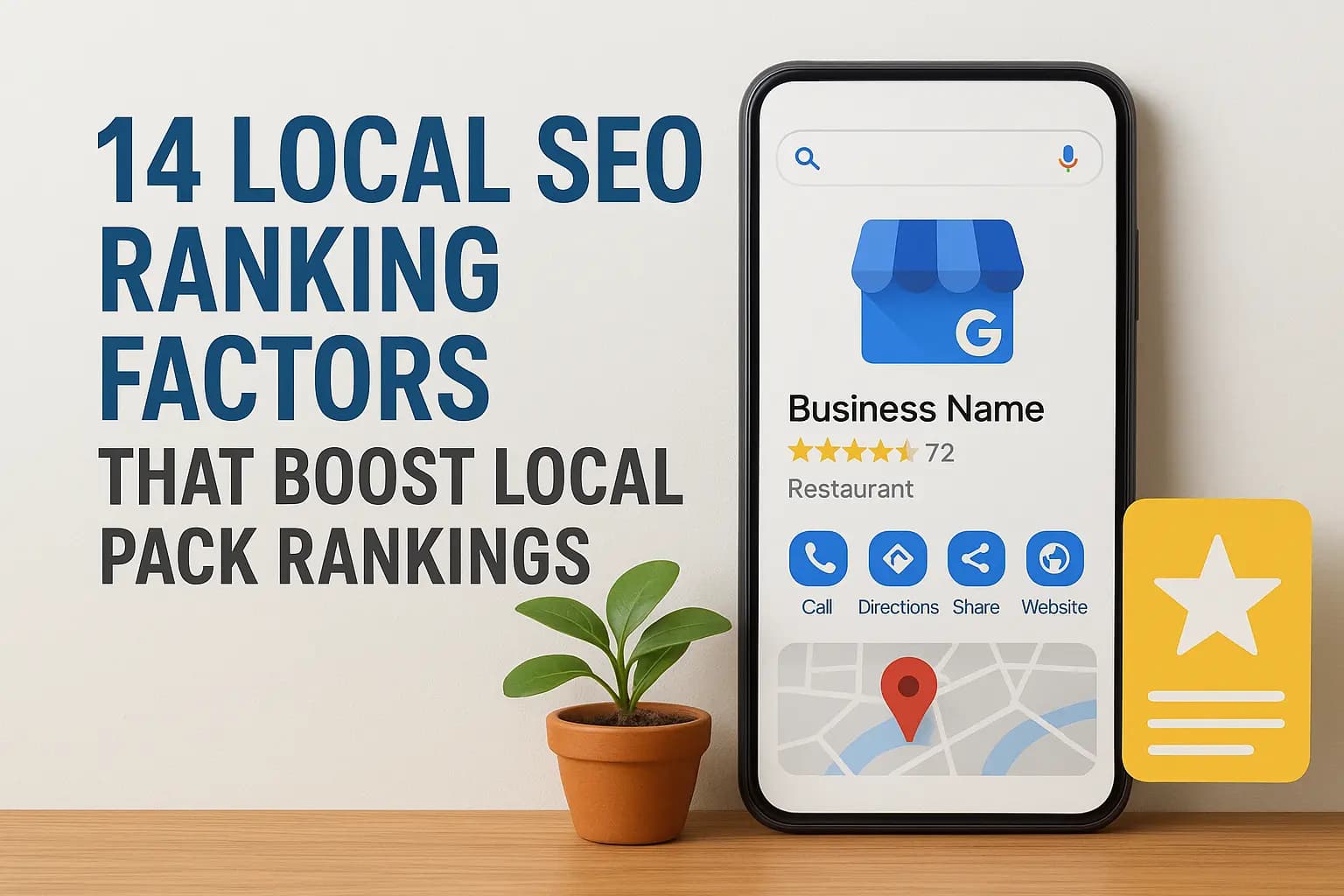
You show up on page three for the exact service you offer, three blocks from your shop, and a competitor with a worse website sits in the local pack. That's not bad luck. Google weighs specific, measurable signals when deciding who ranks in those top three map results, and most business owners never touch them. Understanding local seo ranking factors is the difference between hoping for calls and actually generating them.
So what actually moves the needle? Google looks at Google Business Profile optimization, review volume and response rate, citation consistency across directories, on-page signals, and physical proximity to the searcher, among other things. These local pack ranking factors interact with each other, so fixing one without touching the rest rarely gets you far.
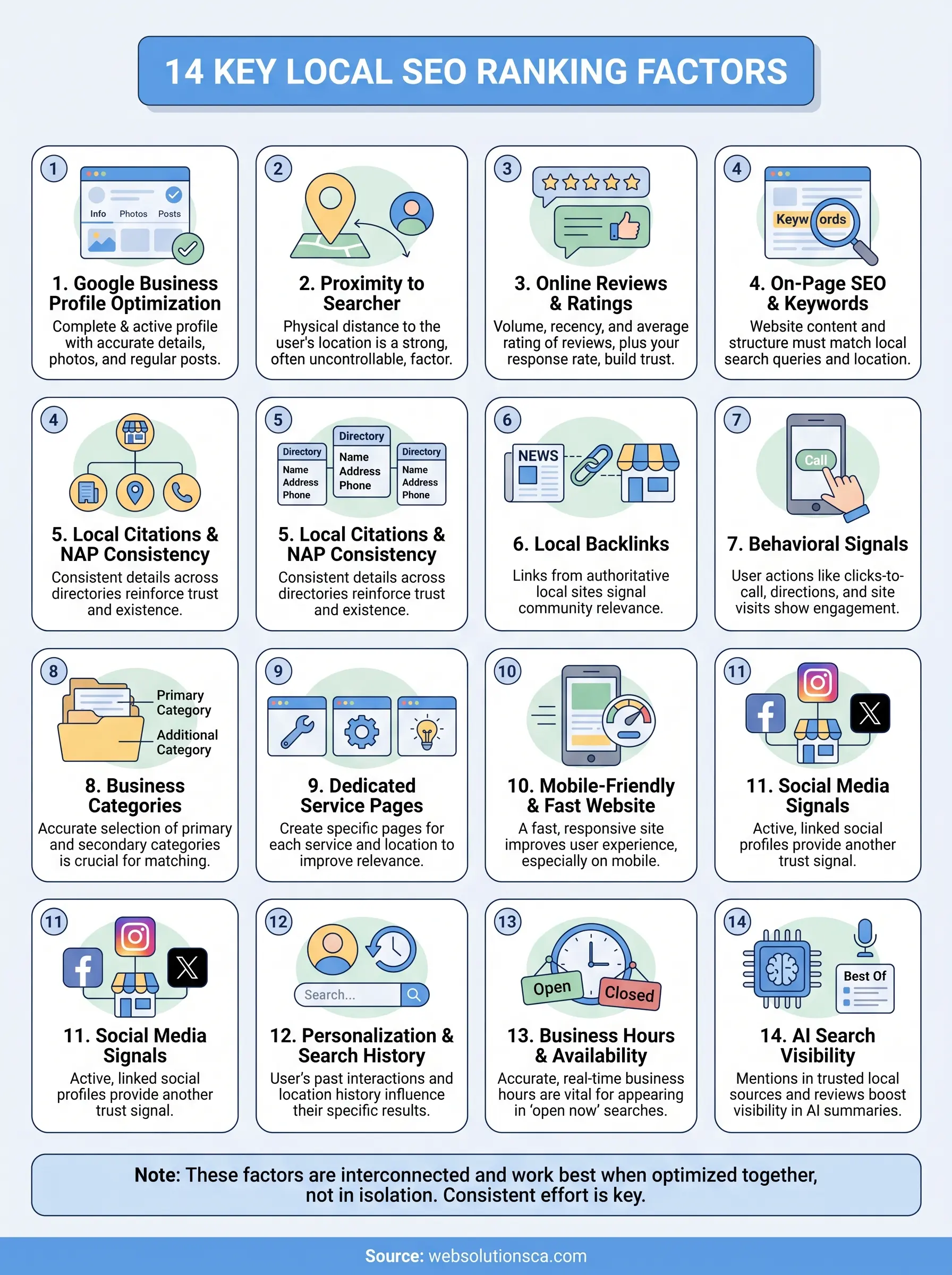
We work with small businesses across Orange County, from Costa Mesa to Irvine to Santa Ana, and we see the same gaps kill rankings over and over. Below are 14 factors we check on every client audit, in the order we'd tackle them if we were starting from zero today.
1. Google Business Profile optimization
Your Google Business Profile is the single biggest lever you control in local search. Google pulls your business name, category, hours, photos, and posts directly from this profile to populate the local pack, so an incomplete or outdated listing tells Google's algorithm it can't trust your business information enough to rank you above a competitor who filled theirs out properly. We've seen businesses jump from position seven to inside the top three just from tightening up this one profile, no new website, no new backlinks.
A half-finished Google Business Profile is the fastest way to hand your local pack spot to a competitor.
Why it matters for rankings
Google has said directly that relevance, distance, and prominence determine local pack rankings, and your profile feeds all three signals at once. A complete profile with accurate categories tells Google what you do, recent photos and posts signal an active business, and a steady stream of Q&A responses and updates builds the prominence score that pushes you above competitors with thin, neglected listings.
How to optimize it
Treat your profile like a living asset you update weekly, not a form you filled out once and forgot, and start from a proper Google Business Profile setup in 2026 if yours was never finished.
- Fill out every field: hours, service area, attributes, products, and a full description using your actual services
- Choose one accurate primary category and add relevant secondary categories
- Upload new photos monthly, interior, exterior, team, and completed jobs
- Publish a Google Post every one to two weeks with an offer or update
- Answer every question in the Q&A section, even ones nobody asked yet
- Respond to every review within 48 hours
We handle the work of mastering profile optimization for clients as part of our SEO packages, since most owners don't have the hours to maintain this consistently alongside running their business.
Common mistakes to avoid
Stuffing your business name field with keywords like "Smith Plumbing - Emergency Plumber Costa Mesa" violates Google's guidelines and can trigger a listing suspension you'll have to appeal. Leaving your profile unclaimed or unverified is worse, since it means anyone can suggest edits to your hours or address. Other frequent errors we catch during audits:
| Mistake | Why it hurts rankings |
|---|---|
| Wrong or too many categories | Confuses relevance matching |
| No photos added in 6+ months | Reads as inactive to Google |
| Ignoring negative reviews | Signals poor prominence and trust |
| Duplicate listings for one location | Splits your ranking signals |
Getting this profile right takes an afternoon the first time, then maybe an hour a week after that. Skip it, and every other tactic on this list works twice as hard to compensate.
2. Proximity to the searcher's location
Distance is one of the three pillars Google names outright, and it's the one factor you can't fully control through content or optimization work. Proximity to the searcher means Google favors businesses physically closer to whoever typed the query, especially for "near me" searches or ones without a city name attached. A locksmith in Tustin searching for "emergency locksmith" will see different local pack results than the same search run from Mission Viejo, even if both businesses have identical websites and review counts.
You can outrank a closer competitor on relevance and prominence, but you can never out-optimize geography alone.
Why it matters for rankings
Google weighs this factor heavily because user convenience drives its entire local search product. Someone searching for a plumber wants the closest qualified option, not the best-optimized website three cities away. This is part of why one of the biggest local pack ranking factors disproportionately rewards businesses with a real, verified address inside the service area they're targeting.
How to optimize it
You can't move your storefront, but you can influence how proximity plays out in your favor:
- List a real, staffed address, never a virtual office or PO box
- Set an accurate service area radius in your Google Business Profile if you're a mobile business
- Create separate location pages that rank and convert for each city you genuinely serve
- Build local citations that reinforce your address in each service area
Common mistakes to avoid
Setting a service radius that stretches 50 miles beyond where you actually work confuses Google and dilutes your relevance for nearby searches. Listing a fake or shared address to appear closer to a lucrative zip code violates Google's guidelines and risks suspension. We also see businesses ignore this factor entirely, assuming reviews and website content can override geography, when in reality proximity often decides which three businesses even get considered.
3. Online reviews and star ratings
Customers trust star ratings almost as much as a personal referral, and Google knows it. Online reviews feed directly into the prominence signal we mentioned earlier, so a business with 150 reviews at 4.8 stars will usually beat a competitor sitting at 12 reviews and 3.9 stars, even with a weaker website. Review count, average rating, recency, and how you respond all factor into the algorithm's math.
A steady flow of fresh five-star reviews often outranks a perfectly optimized website with none.
Why it matters for rankings
Google treats review signals as a proxy for real-world trust, since it can't visit your shop to check quality itself. Review velocity, meaning how consistently new reviews come in, matters more than one big burst followed by silence. A business earning three or four reviews a month looks healthier to Google than one that got 40 reviews two years ago and nothing since.
How to optimize it
Make asking for reviews part of your actual workflow, not an afterthought:
- Text or email a review link within 24 hours of finishing a job
- Use your Google Business Profile's short review link to cut friction
- Respond to every review, positive or negative, within two days
- Never offer discounts or incentives in exchange for reviews
We build review request automation into the workflow automation we set up for clients, so the ask goes out automatically after each completed job.
Common mistakes to avoid
Buying reviews or trading them with other business owners violates Google's policies and can trigger a listing suspension fast. Ignoring negative reviews instead of responding professionally signals poor prominence, and disabling reviews entirely (which Google doesn't allow anyway) would only hurt you if it were possible.
4. On-page SEO and keyword relevance
Your website still matters to the local pack, even though Google Business Profile carries more weight day to day. On-page SEO tells Google exactly what you do and where you do it, using the actual words on your homepage and service pages rather than what's crammed into your profile description. A tree service company whose homepage never mentions "tree removal" or the cities it serves gives Google nothing to match against local queries, no matter how many five-star reviews it has.
If your homepage doesn't say what you do and where, don't expect Google to guess.
Why it matters for rankings
Relevance, one of Google's three named ranking pillars, gets calculated partly from your website content. Keyword relevance on-page confirms what your Google Business Profile category already claims, and mismatches between the two weaken your standing. Pages that name specific services and specific neighborhoods rank for those exact combinations far more often than generic "About Us" copy ever will.
How to optimize it
Write pages the way a customer would search, not the way a brochure would read:
- Include your primary service and city in the title tag and H1
- Add a short, specific paragraph for each core service you offer
- Mention neighboring cities you actually serve, not every city in the county
- Use schema markup so Google can parse your business type and address programmatically
We rebuild this kind of on-page structure into every website design project, since it's rarely present on outdated sites we inherit from clients.
Common mistakes to avoid
Stuffing every page with the same city name repeated a dozen times reads as spam to Google's algorithm, not relevance. Thin, one-paragraph service pages that never mention specifics leave nothing for Google to match against a search query. Copying competitor content word for word is another common shortcut that backfires, since duplicate content confuses which page Google should actually rank.
5. Local citations and NAP consistency
A citation is any mention of your business name, address, and phone number on another website, whether that's Yelp, an industry directory, or the local chamber of commerce page. NAP consistency means those three details match exactly everywhere they appear, since Google cross-references citations to verify your business actually exists where you claim. A plumber listed as "555-1234" on Yelp but "(714) 555-1234" on Angi creates a small doubt that adds up across dozens of directories.

Google trusts businesses it can verify in multiple places, and mismatched citations chip away at that trust one directory at a time.
Why it matters for rankings
Citations reinforce the prominence and relevance signals your Google Business Profile already sends. Local citations act like votes confirming your business details are real and stable, and the more consistent those votes are across trusted directories, the more confidence Google places in your listing. Businesses with clean, matching citations across 20 or more directories consistently outrank competitors with scattered, inconsistent information, even when the competitor has a flashier website.
How to optimize it
Start with the big, high-authority directories before chasing niche ones:
- Claim and update listings on Yelp, Apple Maps, Bing Places, and Facebook
- Match your NAP exactly to your Google Business Profile, down to abbreviations like "St." versus "Street"
- Submit to industry-specific directories relevant to your trade
- Audit existing citations quarterly for outdated addresses or old phone numbers
We run citation audits as part of our ongoing SEO services to catch drift before it costs a client rankings, the same way most top local SEO services for small businesses should.
Common mistakes to avoid
Moving locations or changing phone numbers without updating old citations leaves conflicting data scattered across the web. Duplicate listings on the same directory split your authority instead of building it, so remove the extra listing once you confirm which one is real. Skipping smaller, niche directories in favor of only the big names also leaves relevance signals on the table that competitors are quietly collecting.
6. Backlinks from authoritative local sites
A backlink is simply another website linking to yours, and when that link comes from a respected local source, Google treats it as a vote of confidence. Backlinks from authoritative local sites carry more weight than a hundred links from unrelated directories overseas, because a link from your city's chamber of commerce or a local news site tells Google real people in your area vouch for you. A roofing company mentioned in a local news story about storm damage will often see a rankings bump within weeks, simply because that link signals genuine community relevance.
One link from a trusted local newspaper often outweighs dozens of links from random directories.
Why it matters for rankings
Backlinks feed directly into the prominence signal Google uses to rank the local pack, and geography-specific links do double duty by reinforcing relevance too. A link from a statewide business association or a well-known local blog tells Google your business belongs in that community's search results, not just somewhere generic on the map.
How to optimize it
Earn links the way a real business would, through relationships and visibility, not shortcuts:
- Sponsor a local youth sports team or community event that links back to your site
- Join your city's chamber of commerce, which usually includes a member directory link
- Pitch a local reporter a story angle tied to your industry
- Partner with complementary local businesses for a joint blog post or referral page
We fold local link building strategies into our broader SEO services since outreach rarely happens on its own without a dedicated push.
Common mistakes to avoid
Buying links from paid link farms or unrelated foreign sites risks a Google penalty rather than a ranking boost. Chasing volume over relevance, meaning fifty low-quality links instead of five strong local ones, wastes time and can actively hurt trust signals.
7. Behavioral signals like clicks and calls
Google watches what searchers actually do once your listing appears, not just what your profile claims. Behavioral signals like click-through rate, direction requests, phone calls tapped from the listing, and website visits all tell Google whether real people found your business useful enough to act on it. A plumber who gets tapped for calls twice as often as the listing above him sends a stronger signal than any keyword he could add to his profile description.
Google trusts what searchers do over what your profile says about you.
Why it matters for rankings
Among the many local seo ranking factors Google tracks, click and call data works like a live vote from actual customers. Every tap on "Call Now" or "Get Directions" confirms your listing matched what the searcher wanted, and Google rewards that pattern by keeping you visible for similar future searches.
How to optimize it
Give searchers more reasons to click and fewer reasons to bounce back to the results page:
- Add a clear, working phone number set up for click-to-call tracking
- Fill in the booking or ordering link if your business supports one
- Use photos that show your actual work, not stock images that feel generic
- Post updates and offers that give browsers a reason to tap through
Our SEO services include call tracking setup so clients can see which listing changes actually move the needle on real engagement.
Common mistakes to avoid
Listing a call center number instead of your direct line breaks the local trust signal Google looks for. Letting your website load slowly after someone clicks through undoes the good behavioral data your listing just earned, since visitors bounce before converting.
8. Primary and additional business categories
Your primary category tells Google exactly what kind of business you run, and it carries more ranking weight than almost any keyword you could stuff into a description. A general contractor who picks "General Contractor" as the primary category instead of "Kitchen Remodeler" will struggle to rank for kitchen remodeling searches, even with a perfect website, because Google matches search intent to category first and content second. Business categories on your Google Business Profile function like a filing system Google uses to decide which searches your listing even qualifies for.
Pick the wrong primary category and Google won't consider you for the searches that actually pay your bills.
Why it matters for rankings
Category selection feeds straight into the relevance pillar Google uses to build the local pack. Searchers rarely type your exact business name, so Google leans on category data to decide whether your listing belongs in results for "emergency plumber" versus "drain cleaning service." Additional categories widen your reach into related searches without diluting your core relevance, as long as they're accurate.
How to optimize it
Audit your categories the way a stranger searching for your service would think, using the same approach as a full profile tune-up for local search:
- Choose the single most specific primary category that matches your main revenue driver
- Add every additional category that's genuinely true, not aspirational
- Check competitor categories in the local pack for gaps you're missing
- Revisit categories whenever you add a new service line
Common mistakes to avoid
Picking a broad category like "Business Service" instead of a specific one wastes the strongest relevance signal available to you. Adding categories for services you don't actually offer, hoping to catch extra traffic, confuses Google's matching and can flag your profile for review. Leaving outdated categories from a past business focus is another common gap we catch during audits.
9. Dedicated service pages and site content
One page trying to cover plumbing, HVAC, and electrical work will never rank as well as three separate pages built for each. Dedicated service pages give Google a clean, specific target to match against a searcher's query, instead of forcing the algorithm to guess which part of a crowded homepage actually answers "water heater installation Costa Mesa." A business with ten thin paragraphs crammed onto one page loses to a competitor with ten focused pages, each answering one question completely.

A homepage that tries to rank for everything usually ranks well for nothing.
Why it matters for rankings
Google rewards content depth tied to a single topic, since it signals genuine expertise rather than a surface-level mention. Search engines want to send users to the page that answers their exact question, not a general page that touches on it briefly among a dozen other services. This directly supports the relevance pillar behind so many local pack ranking factors, because a dedicated page naturally includes the service name, the specific problem it solves, and often the neighborhoods it covers.
How to optimize it
Build pages around real customer questions, not internal org charts, and borrow structure from service landing page design examples that already convert:
- Create one page per core service, not one page per department
- Answer the three or four questions customers actually ask before hiring
- Include pricing ranges, process steps, and photos of completed work
- Link service pages to each other and to your homepage naturally
Our Orange County website design and development process starts by mapping every service into its own page before writing a word of copy.
Common mistakes to avoid
Combining unrelated services onto a single page to save development time dilutes relevance for every keyword involved. Publishing pages under 150 words with no real detail leaves Google little to match against a search, and duplicating the same paragraph across multiple city pages reads as spam rather than genuine coverage.
10. Mobile-friendly and fast-loading websites
More than half the searches that trigger a local pack come from a phone, and Google measures how your site performs on that phone before it ever considers ranking you higher. Mobile-friendly design means your site resizes cleanly, buttons are tappable with a thumb, and text doesn't require pinching to read. A contractor whose site takes eight seconds to load on a phone loses the click before the visitor even sees the phone number, and Google notices that bounce.
A slow site on mobile costs you the click before the searcher even sees what you offer.
Why it matters for rankings
Speed and mobile usability feed the same behavioral signals covered earlier, since a fast site keeps visitors engaged long enough to call or fill out a form. Google has publicly tied page experience to ranking for years, and local searches skew even more mobile than search overall, so a clunky mobile site drags down one of the core local seo ranking factors you actually control.
How to optimize it
Treat mobile performance as a maintenance item, not a one-time launch checklist:
- Work through an image optimization checklist for faster load speed so pages load under three seconds on a phone connection
- Use a responsive theme rather than a separate mobile subdomain
- Test click-to-call buttons on an actual phone, not just a browser preview
- Run your site through Google's PageSpeed Insights tool quarterly
We build speed and mobile testing into every website design project before it goes live, since retrofitting speed fixes later almost always costs more than building it right the first time.
Common mistakes to avoid
Uploading full-size camera photos without compressing them is the single biggest speed killer we see on client sites. Relying on a bloated page builder plugin that loads unused code on every page is another reason sites load slowly and how to fix it, and skipping mobile testing entirely leaves broken layouts live for months without anyone noticing.
11. Social media signals and engagement
Google doesn't rank your Facebook page directly, but social media signals still shape how the algorithm and searchers perceive your business. An active Instagram or Facebook profile linked from your Google Business Profile gives Google another data point confirming you're a real, operating business, and it gives potential customers a place to see recent work before they ever hit your website. A landscaping company posting weekly job photos builds a trail of consistency that a dormant profile simply can't match.
Social profiles won't rank you directly, but a dead one makes every other trust signal harder to believe.
Why it matters for rankings
Social activity feeds indirectly into the prominence pillar by driving traffic, brand searches, and engagement that Google can observe elsewhere. When people search your business name after seeing a post, that branded search volume tells Google your business carries real recognition in the community, which supports rankings across every local pack query tied to your name.
How to optimize it
Keep social activity simple and consistent rather than chasing every platform at once:
- Link your Google Business Profile, website, and social profiles to each other
- Post photos of completed jobs or happy customers at least weekly
- Respond to comments and messages within a business day
- Share Google reviews as posts to reinforce trust across channels
Common mistakes to avoid
Letting a profile sit untouched for a year, then posting once and going silent again, signals inconsistency rather than an active business. Buying followers or engagement inflates numbers without building any real trust, and Google's systems, along with actual customers, can usually tell the difference between genuine engagement and a padded follower count.
12. Personalization and search history
Google doesn't show every searcher the same local pack, even for the exact same query typed in the exact same neighborhood. Personalization and search history mean a customer who's visited your website before, called your number, or searched your business name previously is more likely to see you ranked higher than someone with zero prior interaction with your brand. Two neighbors searching "electrician near me" from adjacent houses can see different results because Google factors in each person's individual browsing and search history, not just the raw local seo ranking factors tied to your listing.
Repeat visibility to the same searcher compounds over time, so the goal isn't just ranking once, it's staying in front of people who already know you.
Why it matters for rankings
This factor rewards businesses with repeat visibility across a searcher's history, since Google treats prior engagement as a trust signal specific to that individual. A homeowner who already clicked your website last month or saved your number is statistically more likely to convert again, so Google nudges your listing upward for that person specifically, even if a competitor ranks higher for a brand-new searcher nearby.
How to optimize it
You can't control someone's personal search history directly, but you can increase the odds you end up in it:
- Encourage past customers to search your business name directly rather than a generic term
- Stay visible across email, social, and retargeting ads so your name stays familiar
- Make it easy for repeat customers to bookmark or save your Google Business Profile
- Build a referral program that gets your name typed into search bars by new people
Common mistakes to avoid
Ignoring past customers after the sale wastes a built-in ranking advantage that costs nothing to earn. Businesses also mistakenly assume personalization only helps big brands, when a five-person plumbing outfit with loyal repeat clients benefits from the exact same signal.
13. Business hours and real-time availability
Nothing kills a local pack click faster than a customer arriving to a locked door or calling a number that rings after closing. Business hours accuracy tells Google whether your listing can be trusted right now, not just in general, and Google increasingly favors businesses that show as open when someone actually needs them. A search for "emergency locksmith open now" filters out any listing with unclear or outdated hours before ranking even factors in reviews or backlinks, since real-time availability decides who's even eligible to show up.
A business that looks closed when it's actually open loses the click before it ever gets the chance to compete on relevance.
Why it matters for rankings
Google treats hours as a trust and relevance signal working together, since an accurate schedule confirms your profile reflects reality. Searches with clear time intent, like "open now" or "open Sunday," pull directly from your listed hours, so a mismatch here can remove you from consideration entirely regardless of how strong your other local pack ranking factors look.
How to optimize it
Treat hours like a live setting, not a one-time entry:
- Update regular hours immediately after any change
- Set special hours for holidays, weeks in advance when possible
- Enable messaging or booking links that reflect real-time staff availability
- Check your listing on a phone during off-hours to confirm it displays correctly
We review hours accuracy during every audit tied to our SEO services, since it's an easy fix that gets overlooked constantly.
Common mistakes to avoid
Forgetting holiday hours until the day of leaves customers stranded and frustrated. Letting hours drift out of sync after a schedule change, without updating the profile for weeks, quietly bleeds calls to competitors who kept theirs current.
14. AI search visibility and best-of mentions
Searchers increasingly ask Google's AI Overviews or ChatGPT for "the best plumber in Costa Mesa" instead of typing a plain keyword into the search bar. AI search visibility means your business shows up when these tools summarize an answer, often pulling from review sites, local news roundups, and "best of" lists rather than your website directly. A landscaper mentioned in a local magazine's "best contractors" article now has a real shot at appearing inside an AI-generated answer, even if that article never targeted local seo ranking factors on purpose.

If AI tools can't find you mentioned anywhere credible, they can't recommend you either.
Why it matters for rankings
Google pulls AI Overview answers from a mix of sources it already trusts, so the same prominence signals driving your local pack position now feed a second surface. Businesses earning mentions on review aggregators, local blogs, or industry "best of" roundups get cited more often in AI summaries, which builds visibility even before a searcher clicks into traditional results.
How to optimize it
Focus on getting named, not just linked, across the sources AI tools already scan:
- Pitch local publications for inclusion in annual "best of" or "top rated" roundups
- Keep your Google Business Profile and review platforms current, since AI tools lean on fresh data
- Ask satisfied clients to mention your business by name in detailed reviews
- Monitor what AI Overviews say about your industry locally and adjust content gaps
Common mistakes to avoid
Ignoring this factor because it feels new costs you visibility competitors are already claiming. Chasing AI mentions with thin, generic content instead of genuine local coverage rarely works, since these tools favor sources with real credibility and consistent detail over recycled marketing copy.
Turning these factors into local rankings
None of these 14 factors work in isolation. A flawless Google Business Profile still loses to a competitor with 200 reviews, and a perfectly optimized website can't fix inconsistent citations scattered across old directories. Local seo ranking factors move together, and the businesses that climb into the top three treat them as one connected system, not a checklist to knock out once and forget.
Start where the biggest gaps sit today. Maybe your profile is thin, maybe your reviews stalled, maybe your service pages never mention the neighborhoods you actually work in. Fix the weakest link first, then keep auditing quarterly, because local pack ranking factors shift as Google updates its algorithm and as competitors catch up to whatever you just fixed.
If sorting through all 14 feels like more than you have hours for, that's exactly what we handle every day for small businesses across Orange County. Talk to us about a monthly SEO plan for your Orange County business that audits your listing and actually gets you calls.