
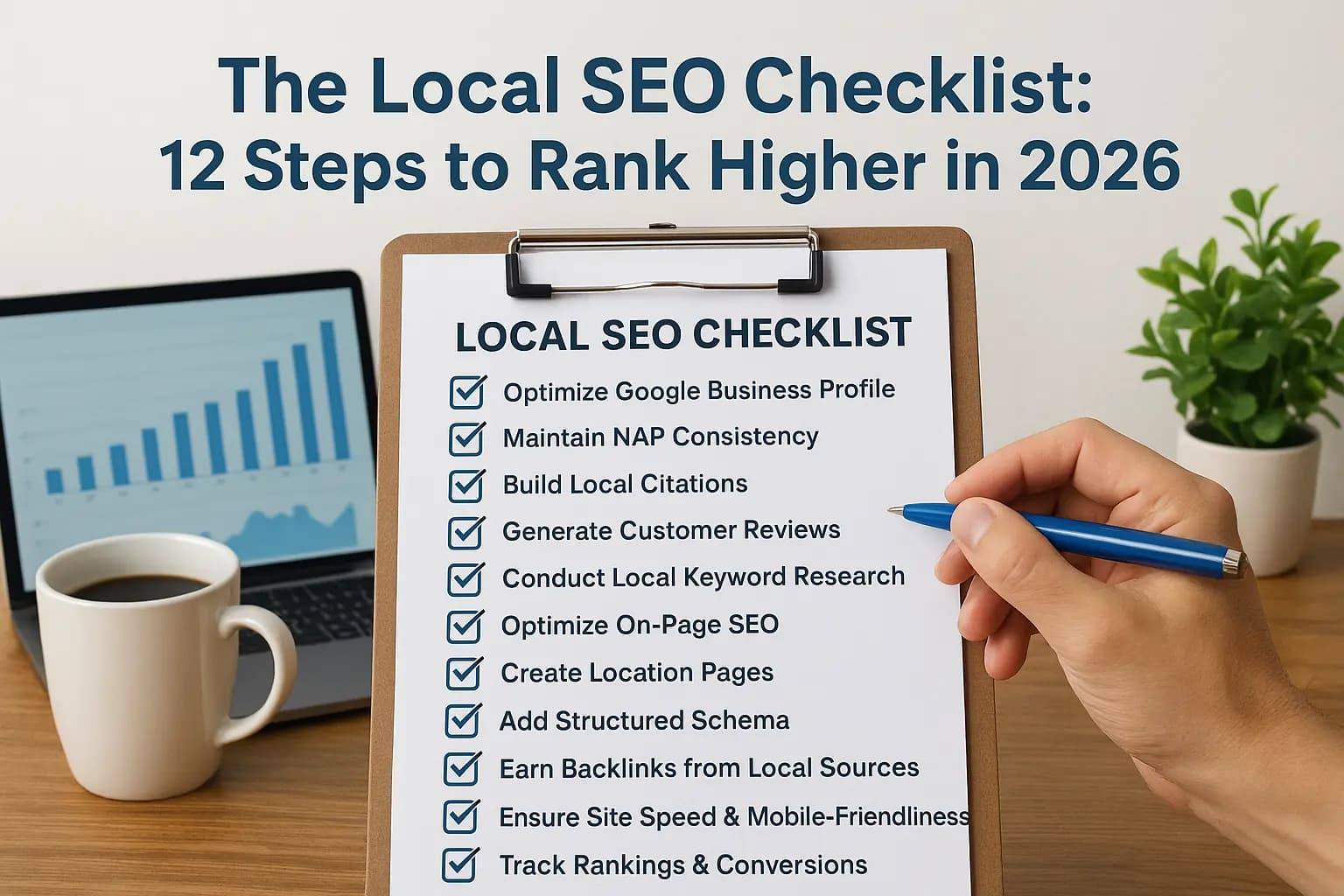
If your business isn't showing up when someone in Costa Mesa web design and digital marketing territory or Irvine searches "near me," you're handing customers to competitors who ranked before you. That's the entire game with local search: show up on page one, or don't show up at all. This local seo checklist walks through exactly what Google looks at when deciding which businesses deserve those top spots, including the local SEO ranking factors behind local pack placement, so you can stop guessing and start fixing the things that actually move rankings.
You don't need a marketing degree to fix local SEO, but you do need the right order of operations. Skip your Google Business Profile setup and jump straight to backlinks, and you'll waste months. Get your NAP consistency wrong across directories, and Google won't trust your listing enough to rank it.
We built this checklist from what actually works for small businesses across Orange County, the same 12 steps we run through with clients before touching a single ad campaign. You'll get on-page fixes, citation strategies, review tactics, and technical checks you can start today, whether you're managing this yourself or deciding what to hand off to a team.
1. Optimize your Google Business Profile
Your Google Business Profile (GBP) is the single biggest lever you have in local search, and it's usually the first thing we check when a new client comes to us frustrated about invisible rankings. This free listing is what shows up in the local map pack, in Google Maps, and often at the top of a mobile search before any website even loads. If yours is thin, unclaimed, or outdated, you're losing the fight before it starts.

What it involves
Optimizing your profile means claiming it, verifying it, and then filling in every field Google offers, not just the basics. That includes your business categories (a primary category plus relevant secondary ones), complete and accurate hours, a written business description, service areas, attributes like "wheelchair accessible" or "free Wi-Fi," and a steady stream of photos. Google also lets you publish posts, list products or services with prices, and answer questions in the Q&A section, all of which signal an active, well-maintained business.
Why it matters for rankings
Google's local algorithm weighs three things when deciding who ranks in the map pack: relevance, distance, and prominence. Your profile directly feeds the first and last of those. A complete profile with the right categories tells Google exactly what you do and who should see you, while consistent activity (fresh photos, responses to reviews, regular posts) builds the prominence signal that separates a thriving business from a dormant listing. According to Google's own guidance on ranking local results, businesses that provide detailed and accurate information are more likely to match relevant searches.
A half-finished Google Business Profile is the fastest way to stay invisible in your own neighborhood.
Missing or inconsistent categories are one of the most common reasons a business simply never appears for searches it should easily win, even when the website itself is solid.
How to get it right
Run through this list once now, then revisit it every quarter:
- Claim and verify your listing through Google directly if you haven't already, following the steps to get your listing verified.
- Choose one primary category that matches your core service exactly, plus up to nine secondary categories.
- Fill in hours, phone number, website, and service area completely, and keep them current during holidays.
- Upload new photos monthly: exterior, interior, team, and completed work.
- Publish a Google post every week or two highlighting offers, updates, or projects.
- Respond to every review, positive or negative, within 48 hours.
- Answer questions in the Q&A section proactively before customers have to ask.
This is exactly the kind of setup work we handle as part of our Google Business Profile optimization services, since most small business owners simply don't have the hours to keep this updated on top of running their actual business.
2. Keep your NAP information consistent everywhere
Name, address, and phone number, or NAP, sounds simple until you start auditing your own listings and find three different phone numbers floating around the internet. This step rarely gets the attention it deserves in a local seo checklist, but small mismatches quietly cap how high you can rank, no matter how good the rest of your site looks.
What it involves
Ensuring NAP consistency means your business name, address, and phone number appear identically across your website, Google Business Profile, Yelp, Facebook, industry directories, and every citation site that mentions you. "Suite 200" on one listing and "Ste 200" on another might look harmless to you, but Google's systems read these as potential mismatches. The same goes for using a tracking number on your website while directories list your main line.
Why it matters for rankings
Google cross-references your NAP data across the web to verify your business actually exists at the location you claim and to build trust in your listing. Inconsistent data weakens that trust signal and can hold your Google Business Profile back in the map pack, even when everything else is optimized.
Small NAP mismatches add up to big trust problems in Google's eyes.
Think of it as Google double checking your homework. The more sources agree, the more confident it gets, and confidence translates into rankings.
How to get it right
Start with an audit before you touch anything else:
- Search your business name plus city to find every existing listing, including old ones you forgot about.
- Pick one exact format for your name, address, and phone number, and use it everywhere, down to abbreviations and suite numbers.
- Update your website footer and contact page first, since that's your source of truth.
- Fix directories one by one, starting with Google, Yelp, Facebook, and Bing.
- Recheck every 90 days, since directories sometimes revert to old scraped data.
We run this exact audit for clients as part of broader website design and SEO work, because a beautiful site still underperforms if your listings contradict it.
3. Build strong local citations
A local citation is any online mention of your business name, address, and phone number, whether or not it links back to your site. Think Yelp, Yellow Pages, Chamber of Commerce directories, industry-specific listings, and data aggregators like Data Axle. Building these out is one of the more tedious items on this local seo checklist, but skipping it leaves gaps that competitors with fuller citation profiles will happily fill.
What it involves
Citation building means getting your business listed on the directories that matter for your industry and location, then keeping that NAP data locked in from step two. Some citations are general (Yelp, Bing Places, Apple Maps), while others are niche, like a roofing directory or a local Orange County business association. Data aggregators feed dozens of smaller sites automatically, so submitting to the right aggregator can multiply your reach with one submission.
Why it matters for rankings
Citations act like votes of confirmation for Google. Each accurate mention reinforces that your business exists, operates where you say it does, and is worth surfacing in local results. Volume matters, but accuracy matters more.
A citation with the wrong phone number does more harm than no citation at all.
Businesses in competitive Orange County niches, think dentists, HVAC companies, and attorneys, often need broader citation coverage just to stay level with rivals who've been building theirs for years.
How to get it right
Approach citations methodically rather than chasing every directory you find:
- Start with the core four: Google Business Profile, Yelp, Facebook, and Bing Places.
- Submit to a major data aggregator to seed dozens of smaller sites at once.
- Add industry-specific directories relevant to your service.
- Join local organizations like your city Chamber of Commerce for a locally relevant link and mention.
- Audit quarterly for duplicate or outdated listings, since duplicates confuse Google rather than help it.
Our team handles local citation support as part of ongoing SEO service, tracking every listing so nothing slips out of sync months later, and it's worth comparing the best local SEO services for small businesses if you'd rather hand it off.
4. Generate and manage customer reviews
Reviews are the trust signal customers see first and the prominence signal Google weighs heaviest after your Google Business Profile itself. A business with 90 reviews averaging 4.8 stars beats a competitor with 6 reviews almost every time, even if that competitor's website is more polished. This step of the local seo checklist is less about chasing five-star ratings and more about building a steady, believable pattern of feedback.

What it involves
Managing customer reviews means actively asking happy customers to leave feedback, responding to every review that comes in, and handling negative reviews without getting defensive. It also means spreading reviews across platforms, not just Google, since Yelp and Facebook reviews still factor into how customers judge you before they ever search.
Why it matters for rankings
Google treats review signals, meaning quantity, quality, recency, and diversity of keywords used in the review text, as a direct input into local ranking. A steady flow of new reviews tells Google your business is active and trusted right now, not just years ago.
A business that stopped collecting reviews two years ago looks dead to Google, no matter how good the work still is today.
Responses matter too. Google has said publicly that replying to reviews shows you value customer feedback, which builds trust with both searchers and the algorithm itself.
How to get it right
Build review generation into your actual workflow, not an afterthought:
- Send a review request link by text within 24 hours of finishing a job, while the experience is fresh.
- Never offer incentives for reviews, since Google's policies prohibit paying for or gating them.
- Respond to every review within 48 hours, thanking positive reviewers by name and addressing negative ones calmly and specifically.
- Aim for a steady trickle of new reviews monthly rather than a burst followed by silence.
Our workflow automation services can trigger review requests automatically after a job closes, so this never depends on someone remembering to ask.
5. Research the local keywords your customers use
Guessing at keywords wastes money on pages nobody searches for. This step of the local seo checklist forces you to find out what your actual customers type into Google before they call you, not what you assume they type.
What it involves
Local keyword research means digging up the exact phrases people in your service area use when they need what you offer, then sorting them by intent. "Emergency plumber Santa Ana" and "plumbing company near me" pull different searchers at different stages, and both deserve a spot in your strategy. Tools like Google Keyword Planner, Google Search Console, and even the autocomplete suggestions in Google itself will surface phrases you'd never think to include on your own.
Why it matters for rankings
Google can only match you to searches if your content actually contains the language people use. Skip this research and you'll optimize for terms with zero local search volume while missing the ones driving real traffic to competitors down the street. Search volume data tells you where the effort pays off, and search intent tells you what kind of page to build for it.
If your keywords don't match how customers actually search, your rankings won't matter because nobody's typing what you optimized for.
How to get it right
Build a working keyword list before you touch a single page:
- Pull "queries" data from Google Search Console if your site already has traffic, since it shows exactly what's bringing people in.
- Add your city and neighborhood names to core service terms, not just your business name.
- Separate keywords by intent: informational, commercial, and ready-to-buy searches each need different pages.
- Check what competitors rank for using free tools, then find the gaps they've missed.
We fold this research into every SEO service engagement, and most SEO services built for local businesses should do the same, because guessing at keywords is the fastest way to burn a marketing budget on the wrong words entirely.
6. Optimize your website's on-page SEO
Your keyword research only pays off if the pages on your site actually use that language where Google expects to find it. This step of the local seo checklist turns raw keyword data into the titles, headers, and copy that convince Google your page deserves to rank for a specific search in a specific city.
What it involves
On-page SEO covers every element you control directly on a page: title tags, meta descriptions, header tags, body copy, image alt text, and internal links. For local businesses, this means weaving your city and service terms naturally into your title tag and H1, writing a meta description that reads like an invitation rather than a keyword dump, and structuring your content so both readers and Google can scan it quickly. A plumber's homepage should say "Santa Ana emergency plumber" somewhere real, not bury it in hidden text.
Why it matters for rankings
Title tags and headers remain some of the strongest relevance signals Google reads on a page. Without them clearly stating what you do and where you do it, Google has to guess, and it won't rank you for a guess when a competitor spells it out. Thin, generic copy that could describe any business in any city gives Google nothing to match against a local search.
Generic copy describes any business in any city, which means it ranks for none of them.
How to get it right
Work through these on-page basics on every important page:
- Write a unique title tag under 60 characters that includes your primary service and city.
- Craft a meta description that states the benefit and includes a call to action.
- Use one H1 per page that matches search intent, plus H2s that break up sections logically.
- Add alt text to images describing the work shown, not just "IMG_2024."
- Link internally between related service pages so Google understands your site structure.
Our small business website design process, step by step, builds these fundamentals in from the first draft, not as an afterthought bolted on later.
7. Create dedicated location and service pages
One homepage trying to rank for every city and service you offer is asking too much of a single URL. This step of the local seo checklist is about giving Google a dedicated page for each combination of location and service, so it has something specific to match against a specific search instead of forcing one generic page to cover Costa Mesa, Irvine, and Santa Ana all at once.
What it involves
Building out location pages means creating local landing pages that rank and convert, a unique URL for each city or neighborhood you serve, each with its own content, not a copy-pasted template with the city name swapped out. Service pages work the same way: a roofer offering repairs, replacements, and inspections needs three separate pages, each targeting the specific keywords tied to that service. A business serving five Orange County cities with three core services could reasonably need fifteen distinct pages, each one written for the person searching that exact combination.
Why it matters for rankings
Google rewards page-level relevance. A page built specifically around "kitchen remodeling Tustin" will consistently outrank a homepage that mentions Tustin once in a footer. Thin or duplicated location pages do the opposite: they can trigger Google's duplicate content filters and actually suppress every page involved.
One strong page beats ten thin copies of the same page with different city names swapped in.
How to get it right
Build each page with real, local substance instead of a template shortcut:
- Write unique content for every location page, referencing actual neighborhoods, landmarks, or service details specific to that area.
- Include a local phone number, embedded map, and testimonials from customers in that city when you have them.
- Target one primary keyword per service page and avoid overlapping terms between pages.
- Link location and service pages together internally so Google's crawlers can map your full service area.
We build this exact page structure into every Orange County web design project, since it's often the difference between ranking in one city and ranking across an entire region.
See how we structure our Tustin SEO and digital marketing page around unique local services, search intent, and city-specific content.
8. Add local business schema markup
Most site owners never touch schema markup because it's invisible to visitors, but Google reads it constantly. This step of the local seo checklist is about speaking Google's language directly instead of hoping it correctly interprets your homepage copy.

What it involves
Local business schema is structured data code, usually JSON-LD, that you add to your website's HTML to explicitly label your business name, address, phone number, hours, price range, and service area. Instead of Google guessing at these details from your page text, schema hands them over in a format search engines parse instantly. Google's own structured data documentation outlines the exact properties it recognizes for local businesses, including review ratings and service areas.
Why it matters for rankings
Schema markup doesn't guarantee a ranking boost on its own, but it removes ambiguity, and ambiguity is what keeps businesses out of rich results and knowledge panels. A page with clean structured data is more likely to earn star ratings in search results, accurate map pack details, and voice search pickups when someone asks their phone for a business "near me."
Schema markup won't rank you by itself, but it removes every excuse Google has to misread your business details.
Sites without it force Google to infer details from scattered text, and inference introduces errors that hurt trust.
How to get it right
Add this JSON-LD snippet to your homepage's <head>, adjusting every field to match your actual business:
{
 "@context": "https://schema.org",
 "@type": "LocalBusiness",
 "name": "Your Business Name",
 "address": {
 "@type": "PostalAddress",
 "streetAddress": "123 Main St",
 "addressLocality": "Costa Mesa",
 "addressRegion": "CA",
 "postalCode": "92626"
 },
 "telephone": "+1-714-555-0100",
 "openingHours": "Mo-Fr 08:00-17:00"
}
Test it with Google's Rich Results Test before publishing, and repeat this on every location page you built in step seven. This is standard groundwork in our website design and development builds, since skipping it leaves an easy win on the table.
If your business offers specific services, you can also describe those offerings with Service structured data. Use our free Service Schema Generator to create JSON-LD markup for your service pages without writing the code manually.
9. Earn backlinks from local sources
Schema tells Google what you are, but backlinks tell Google that other websites vouch for you. This step of the local seo checklist shifts focus outside your own site, toward the local relationships and mentions that actual authority is built on.
What it involves
Local link building means earning links from sources tied to your city or region: the Chamber of Commerce, local news sites, community blogs, sponsorships, and other businesses you partner with. Sponsoring a Little League team, getting quoted in a local paper about a project, or partnering with a complementary business for a joint promotion all generate links that a national directory never could. Quality here beats quantity by a wide margin. Ten links from real Orange County organizations outperform a hundred links from spammy link farms.
Why it matters for rankings
Backlinks remain one of Google's strongest authority signals, and local links carry extra weight because they confirm you're an actual part of the community you claim to serve. A plumber with links from the Costa Mesa Chamber of Commerce and a local news feature signals real presence in a way that generic directory listings can't match.
A single link from your local Chamber of Commerce often carries more weight than fifty links from unrelated national sites.
Google's algorithms weigh relevance heavily, so a link from a site with zero geographic or topical connection to you does far less work than one rooted in your actual market.
How to get it right
Treat link building as relationship building, not a checklist to rush through:
- Join your local Chamber of Commerce or business association for a natural, relevant link.
- Sponsor community events, sports teams, or charity drives that link back to sponsors.
- Pitch local news outlets or bloggers when you complete a notable project or launch something new.
- Partner with complementary businesses for cross-promotion and mutual linking.
- Avoid paid link schemes, since Google penalizes manipulative link patterns quickly and can tank your rankings overnight.
We help clients identify these opportunities as part of our broader SEO service, since local relationships often produce links faster than any cold outreach campaign ever will.
10. Make sure your site is fast and mobile-friendly
Over 60% of local searches happen on a phone, often from someone standing in a parking lot deciding which business to call right now. This step of the local seo checklist matters because a slow, clunky site loses that person before they ever see your phone number, no matter how well you ranked to get them there.

What it involves
Site speed and mobile usability cover how fast your pages load, how easily someone can tap through your menu on a small screen, and whether your forms and buttons work without pinching and zooming. Google measures this directly through Core Web Vitals, which track loading speed, visual stability, and how quickly a page responds to a tap or click. A site built years ago on a bulky theme often fails these checks without the owner ever knowing, and there are usually a handful of clear reasons a website loads slowly and how to fix it.
Why it matters for rankings
Google uses mobile-first indexing, meaning it evaluates the mobile version of your site as the primary version, not your desktop layout. Google's own page experience guidance confirms that speed and usability factor into ranking, and slow pages also hurt conversions even when they do rank.
A local searcher who bounces off a slow site never sees your rankings, your reviews, or your phone number.
How to get it right
Run these checks quarterly, not once and forget:
- Test your site with Google PageSpeed Insights and fix anything flagged red.
- Compress and resize images before uploading rather than after, using an image optimization workflow for faster pages.
- Choose a lightweight theme or hosting plan built for speed, not just looks.
- Confirm buttons, forms, and menus work cleanly on an actual phone, not just a resized browser window.
- Remove unused plugins and scripts that quietly slow load times.
Our website design and development work always starts with speed and mobile behavior in mind, since a beautiful site that loads slowly still loses the customer.
11. Track your local rankings and results
Everything in this local seo checklist works better when you can actually measure whether it's working. Businesses that skip tracking often keep doing tasks long after they've stopped paying off, or abandon tactics that just needed another month to show results.
What it involves
Tracking local performance means monitoring where you rank for target keywords in your specific city, watching Google Business Profile insights for calls, direction requests, and website clicks, and reviewing Google Search Console for which queries actually bring people to your site. It also means checking conversion data: how many of those visitors called, filled out a form, or walked through your door. Rankings alone tell you almost nothing if they're not connected to actual leads.
Why it matters for rankings
Google's algorithm updates constantly, and a tactic that worked last year might quietly stop moving the needle this year. Without tracking, you won't notice a ranking drop until a competitor mentions they're getting more calls than you. Rank tracking data also tells you which of the previous ten steps deserve more attention, since a business with a stagnant Google Business Profile ranking might need more reviews, while one stuck on service pages might need better on-page copy.
If you're not tracking rankings and leads together, you're optimizing blind and hoping it works.
How to get it right
Set up a simple, repeatable tracking routine:
- Check Google Business Profile insights monthly for calls, direction requests, and profile views.
- Use Google Search Console to see which queries drive clicks and impressions to each page, and filter them faster with a Search Console regex generator.
- Track rankings for your top 10-20 target keywords using a rank tracking tool, checked weekly or biweekly.
- Connect conversion tracking on your site so form fills and calls tie back to specific pages and keywords.
- Review the data monthly and adjust whichever checklist item is underperforming.
Our clients get monthly reporting that ties rankings directly to calls and form submissions, so nobody's guessing whether the work is paying off.
12. Bring in local SEO experts when you need support
Eleven steps in, and you've probably noticed a pattern: this work never really finishes. Rankings shift, competitors adjust, and Google updates its algorithm several times a year. This last item on the local seo checklist isn't a failure to admit if you can't do it all yourself. It's a recognition that some businesses need a local SEO expert managing the details while the owner focuses on running the actual business.
What it involves
Bringing in outside help means handing off some or all of the previous eleven steps to a team that does this daily, whether that's citation cleanup, review generation, technical fixes, or full monthly SEO management. Good agencies don't disappear after launch. They monitor rankings, adjust strategy as Google changes, and report back in language you actually understand, not vague jargon meant to justify a bill.
Why it matters for rankings
Local SEO changes constantly, and staying current takes hours most small business owners simply don't have between running jobs, answering phones, and managing staff. A dedicated team catches algorithm shifts, fixes technical issues before they tank rankings, and keeps citations and reviews flowing without depending on someone remembering to do it between other tasks.
The businesses that outrank you every month usually have someone watching their SEO every week, not once a year.
Owners who try to handle everything solo often let this checklist slide during busy seasons, exactly when competitors keep pushing forward.
How to get it right
Look for a partner who fits how small businesses actually operate, and it helps to compare the local SEO agencies serving Orange County before you commit:
- Ask for transparent pricing instead of vague custom quotes with no breakdown.
- Confirm they provide monthly reporting tied to calls and leads, not just ranking screenshots.
- Check that they understand your specific city and industry, not a generic national template.
- Start with one service, like SEO or web design, before committing to a full package.
Our SEO services start at $499.99 monthly, built specifically for Orange County small businesses that need results without enterprise-agency pricing.
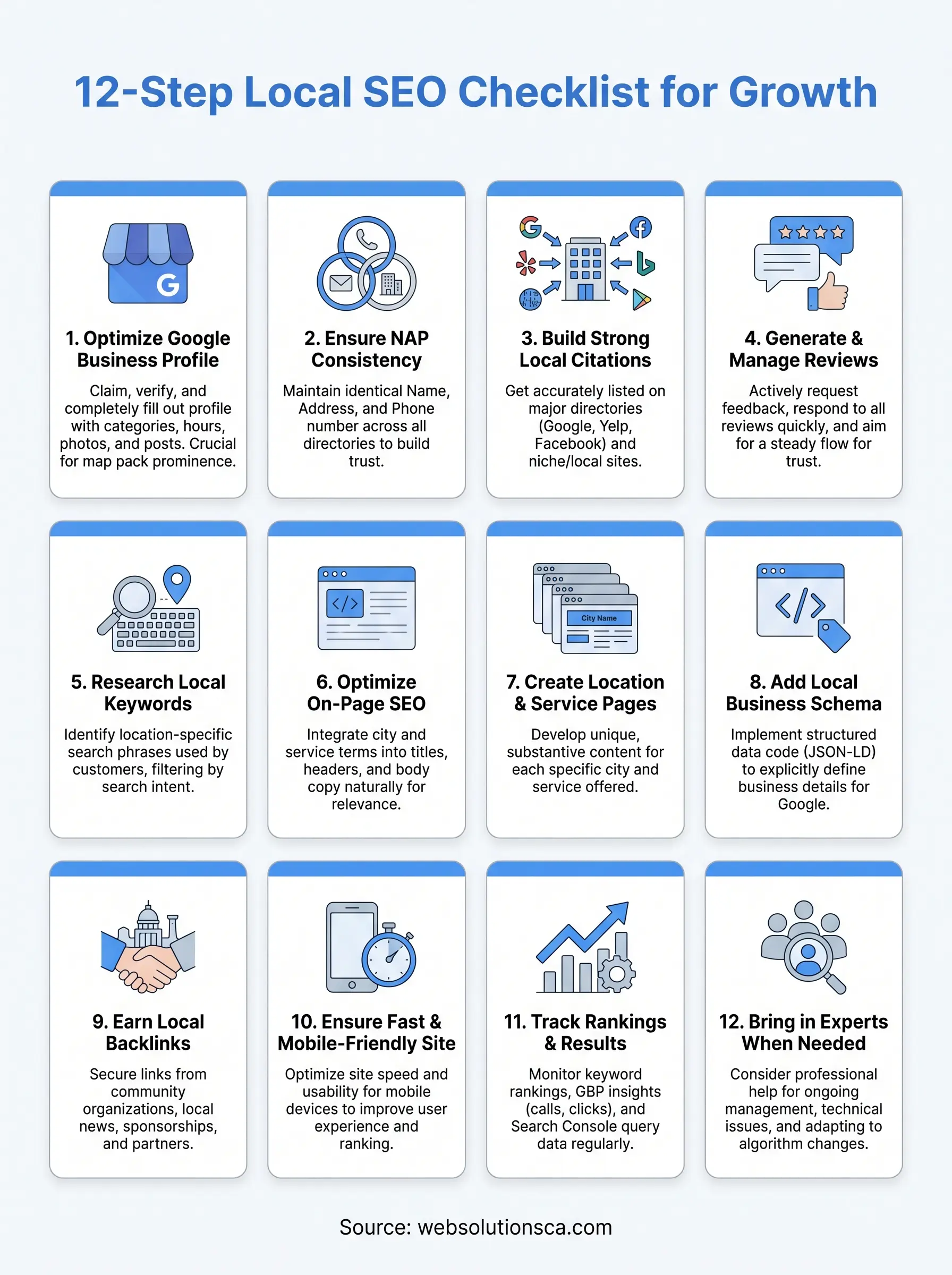
Turning this checklist into real local growth
Twelve steps sound like a lot until you realize most of them reinforce each other. A complete Google Business Profile feeds your review signals, consistent NAP data strengthens every citation you build, and solid on-page work makes your location pages actually rank. None of this works in isolation, and none of it works if you tackle it once and walk away. This local seo checklist is a starting point, not a one-time project you check off and forget.
Real local growth comes from treating these steps as ongoing maintenance, the same way you'd handle payroll or inventory. Some business owners knock out this list themselves over a few weekends. Others realize their time is worth more spent on customers than on schema markup and citation cleanup. If that's you, see how our Local SEO services for Orange County businesses can build and manage this checklist for you, so you're ranking while you're busy running things.