

You've probably gotten three quotes for local SEO and they don't even come close to matching. One agency wants $300 a month, another wants $2,500, and a third won't give you a number until you sit through a sales call. That gap makes it nearly impossible to know if you're about to overpay or about to hire someone who won't move the needle. Local seo cost varies this much because providers bundle different things under the same label, and plenty of them price based on what they think you'll pay rather than the work involved.
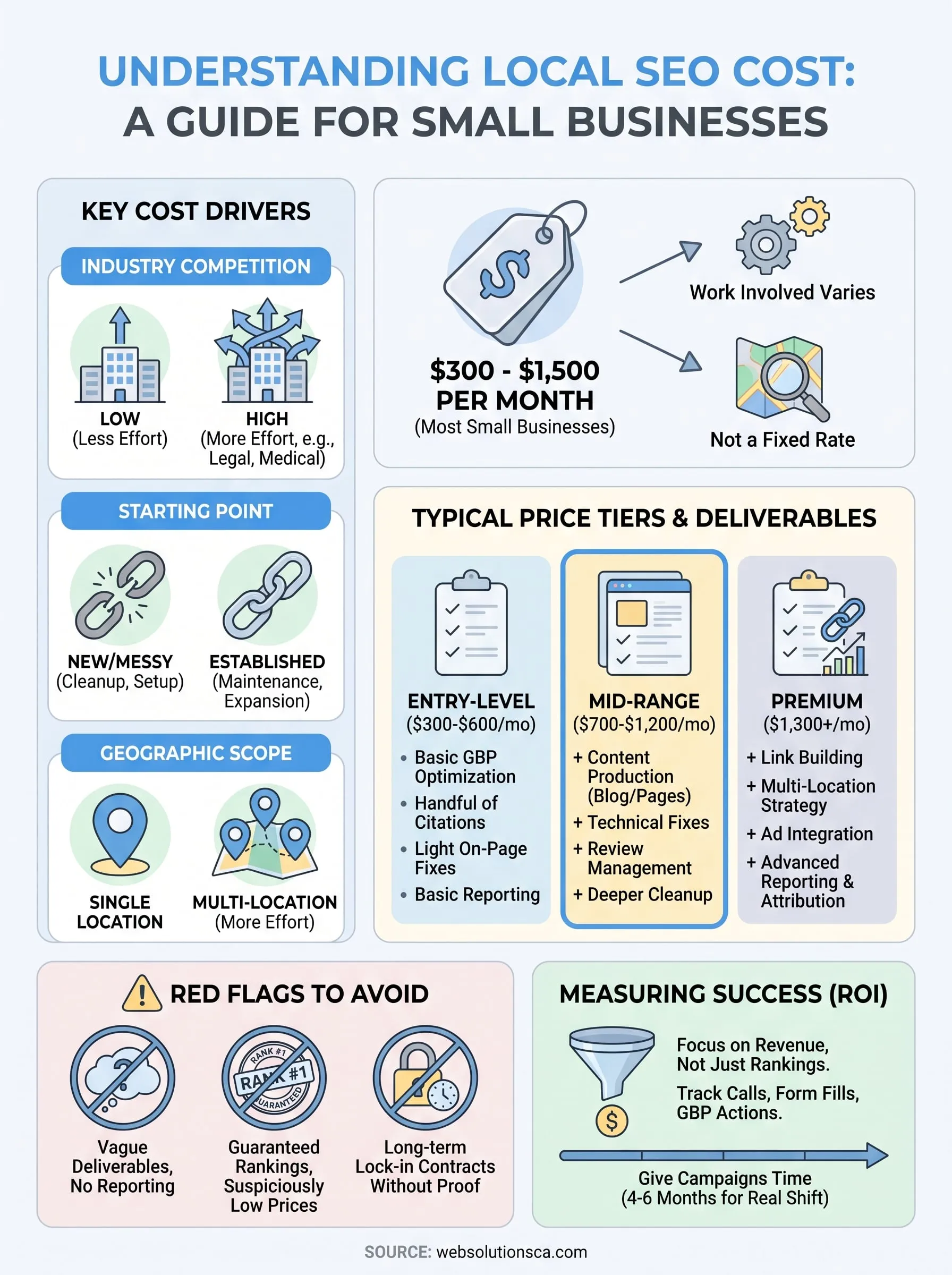
Here's the direct answer: most small businesses should expect to pay between $300 and $1,500 per month for ongoing local SEO, with one-time setup or audit work running separately. Where you land in that range depends on your industry, how competitive your city is, and how much hands-on optimization your Google Business Profile and website actually need.
In this guide, we'll break down what drives those numbers, from local keyword research and citation building to technical fixes and monthly reporting, so you can compare quotes with actual confidence instead of guessing.We'll also flag red flags that signal an agency is overcharging or underdelivering.
Why local SEO costs vary so much between businesses
Ask five agencies for a quote and you'll get five different numbers, and none of them are lying to you. Local SEO pricing shifts because the work itself shifts. A dentist in a suburb with two competitors needs far less effort than a personal injury attorney fighting for rankings in downtown Los Angeles. The scope of work, not some fixed industry rate, is what actually determines the cost of local SEO services for any given business.

Industry competition drives the biggest swings
Competitive industries force agencies to do more work just to keep pace, and that work costs money. Legal services, medical practices, and home services in dense metro areas often require aggressive link building, ongoing content production, and constant citation cleanup because a dozen other firms are chasing the same three map pack spots. A window repair company in Fountain Valley, on the other hand, might rank well with a clean Google Business Profile, a handful of local directory citations, and a few optimized service pages. That difference alone can separate a $400 monthly retainer from a $2,000 one.
The real driver of local SEO cost isn't the industry label, it's how many competitors are already doing the work well.
Your starting point changes the workload
Starting from scratch always costs more than refining what's already there. If you have never claimed your Google Business Profile, your website has duplicate listings scattered across old directories, and you have zero reviews, an agency has to spend real hours untangling that before any ranking gains show up. Compare that to a business with an established site and a decent review count, where the work is mostly maintenance and expansion. Agencies that quote a flat rate without auditing your current setup first are guessing, and that guess usually isn't in your favor.
Geographic scope multiplies the effort
Expanding your service area sounds simple, but each additional city or neighborhood you target usually means separate landing pages, separate citation work, and separate tracking. A single-location plumber in Tustin needs one strong, well-optimized profile and site. A multi-location HVAC company serving Irvine, Santa Ana, and Anaheim needs three (or more) coordinated local SEO efforts running at once, which is why SEO for multiple locations naturally pushes monthly SEO cost higher.
What actually drives the price tag
Here's a quick comparison of how these factors typically move the number on your invoice:
| Cost Driver | Lower Cost Scenario | Higher Cost Scenario |
|---|---|---|
| Competition | Few competitors actively optimizing | Crowded market with aggressive local competitors |
| Starting point | Existing GBP and site with some history | No online presence, duplicate listings, no reviews |
| Locations served | Single city or neighborhood | Multiple cities or service areas |
| Website condition | Fast, mobile-friendly, few technical issues | Outdated CMS, broken pages, poor site speed |
| Content needs | A handful of service pages | Ongoing blog and location page production |
Once you see these factors laid out, the wide range in agency quotes makes a lot more sense. A provider offering a flat $299 website build with a bare-bones SEO add-on isn't necessarily cutting corners, they might just be pricing for a low-competition, single-location business. A firm charging $2,500 a month might be entirely justified if they're managing citations, content, and links across five cities in a market full of aggressive competitors. Understanding where your business actually falls on this spectrum is the first step before you even start comparing numbers, which is exactly what the next section walks through.
How to set a realistic local SEO budget for your business
Before you compare a single quote, figure out what a new customer is actually worth to you. If a closed job nets you $800 in profit and you close one out of every five leads, you can afford to spend $160 per lead and still break even, and probably double that if you want real growth. This math turns local SEO budgeting into a business decision instead of a guessing game where you just pick whatever number feels safe.
A local SEO budget that isn't tied to your customer value is just a guess with a dollar sign in front of it.
Match your spend to your growth stage
Startups and businesses with almost no online presence usually need a heavier first three to six months to build citations, clean up listings, and fix technical issues, then the monthly spend can taper. Established businesses looking to defend rankings or expand into new cities can often budget a flatter, predictable amount because the foundational work is already done. Knowing which stage you're in keeps you from either underfunding a rebuild or overpaying for maintenance you don't need yet.
Set a range, not a single number
Give yourself a floor and a ceiling instead of chasing one exact figure. A simple framework looks like this:
- Tight budget: $300 to $600 per month, best for single-location businesses in low-competition markets
- Standard budget: $700 to $1,200 per month, fits most Orange County service businesses with moderate competition
- Aggressive budget: $1,300 to $2,500+ per month, needed for crowded markets, multiple locations, or fast timelines
Factor in one-time costs separately
Don't fold SEO audit services, website fixes, or citation cleanup into your monthly number, because that muddies what you're actually paying for ongoing work versus a one-time push to fix a broken foundation. Websites with major technical issues, for instance, often need a separate lead-generating website redesign or optimization project before monthly SEO work can even show results, and that's a different budget line entirely. Web Solutions CA structures its plans this way, with website design starting at $299.99 and monthly SEO service starting at $499.99, so you can see exactly what you're paying for at each stage rather than one blended number that hides the details. Treating these as separate line items also makes it far easier to spot which part of an agency's quote is inflated when you're comparing offers side by side.
What a local SEO package typically includes at each price tier
Once you know your budget range, the next question is what you actually get for that money. Local SEO packages aren't standardized, but most agencies bundle deliverables into predictable tiers based on price, and knowing what belongs in each tier helps you spot when a quote is thin on substance. Below is a realistic breakdown of what you should expect at each level.

Entry-level packages ($300 to $600 per month)
Budget-tier packages usually cover the basics: basic profile optimization work, a handful of local citations, basic keyword tracking, and light on-page fixes to your existing service pages. Content is minimal at this level, often just a monthly post or update to your profile, and link building is rare or nonexistent. This tier works fine for a single-location business in a market with light competition, but it won't move the needle for a business trying to outrank ten established competitors downtown.
Mid-range packages ($700 to $1,200 per month)
Mid-tier packages add real content production, usually one to two blog posts or location pages built for each city per month, plus more thorough citation cleanup and review management support. Technical SEO fixes become part of the scope here too, things like fixing broken links, improving page speed, and cleaning up duplicate listings that entry-level plans skip. This is where most Orange County service businesses land, since it covers both maintenance and growth without the cost of an aggressive link-building campaign.
The price tier tells you the budget, but the deliverables list tells you if that budget is actually being spent on your business.
Premium packages ($1,300 and up per month)
Premium tiers bring in building links from local sites, multi-location coordination, deeper competitor analysis, and often paid ad management layered on top of organic SEO. Reporting becomes more granular too, tracking not just rankings but calls, form fills, and revenue attribution back to specific pages or campaigns.
| Tier | Monthly Range | Typical Deliverables |
|---|---|---|
| Entry-level | $300–$600 | GBP optimization, basic citations, light on-page fixes |
| Mid-range | $700–$1,200 | Content production, technical fixes, review management |
| Premium | $1,300+ | Link building, multi-location work, ad integration, advanced reporting |
Asking a provider to walk through exactly which line items apply to your quote, rather than accepting a vague monthly number, is the fastest way to confirm you're paying for the right tier.
Red flags that signal you're overpaying or being misled
Spotting a bad local SEO quote is often easier than spotting a good one, because the warning signs tend to repeat across the industry. Once you know what to look for, you can walk away from a bad deal before signing anything, instead of finding out three months in that you paid for work nobody actually did.
Vague deliverables and no reporting
Quotes that list "SEO optimization" or "ranking improvements" without naming specific tasks are a problem. A legitimate provider can tell you exactly how many citations they'll build, which pages they'll optimize, and what your monthly report will include before you ever pay a dollar. If an agency can't answer "what will you actually do this month" in plain terms, that's your signal to keep shopping.
If an agency can't list what they'll do this month, you're paying for a guess, not a strategy.
Guaranteed rankings or suspiciously low prices
Nobody can guarantee a #1 Google ranking, not even Google itself, since rankings depend on hundreds of factors outside any single agency's control. Promises like this usually mean an agency is either inexperienced or planning to use tactics that risk a penalty down the line. On the flip side, a $99 monthly SEO package almost never includes real citation work, content, or technical fixes, it's usually a placeholder retainer designed to upsell you later, which is why it pays to know what genuinely cheap local SEO services actually deliver.
Contracts that lock you in without proof
Watch for long-term contracts that don't allow you to exit if results never materialize. A confident provider is comfortable with month-to-month terms or a short initial commitment, because they expect the work to speak for itself.
Here's a quick checklist to run through before signing any local SEO agreement:
- Does the quote list specific tasks, not just vague phrases like "optimization"?
- Will you receive monthly local SEO reporting showing rankings, traffic, and leads, not just activity logs?
- Does the contract allow you to leave without penalty after a reasonable trial period?
- Can the agency explain how their price compares to your industry and competition, not just a flat rate?
- Are they avoiding guaranteed rankings and unrealistic promises entirely?
Working through this list before you commit protects your budget far better than negotiating price alone, since the cheapest quote and the most expensive one can both be a bad deal if the deliverables don't match what your business actually needs.
How to measure the return on your local SEO spend
Spending $800 a month on local SEO means nothing if you can't tie it back to actual phone calls and booked jobs. Return on investment is the only number that matters in the long run, and you calculate it by comparing what you spent against what those closed deals actually generated. Local seo cost only makes sense once you can hold it next to real revenue instead of a screenshot of rising rankings.
A ranking report that doesn't show up in your revenue is just a vanity metric with a monthly invoice attached.
Track the metrics that actually tie to revenue
Rankings and traffic matter, but treat them as leading indicators rather than the finish line. Call tracking and Google Business Profile actions that feed local search performance, like direction requests and click-to-call taps, predict revenue weeks before it hits your bank account, so ask your provider to report on:
- Phone calls generated through a tracked number
- Form submissions and where each one came from
- Google Business Profile actions (calls, direction requests, website clicks)
- Rankings specifically for keywords with buying intent, not just brand terms
- Lead-to-customer conversion rate once your sales process takes over
Give the work time before you judge it
Most local SEO campaigns need four to six months before rankings and leads shift in a way you can actually measure, since Google needs time to trust newly built citations, fresh content, and profile changes. Judging a campaign at the 60-day mark almost always ends in a premature cancellation, right before the compounding effect would have kicked in. If your provider can show steady movement in citations, reviews, and impressions during that window, even without a dramatic ranking jump yet, that's a sign the foundation is being built correctly.
Calculate your true cost per lead
Divide your monthly spend by the number of qualified leads it produced, and you get a cost-per-lead figure you can compare directly against referrals or what Google Ads management costs each month.
| Channel | Typical Cost Per Lead | Notes |
|---|---|---|
| Local SEO (mature campaign) | $20–$80 | Lower over time as rankings compound |
| Google Ads | $40–$150 | Immediate but stops when spend stops |
| Local SEO (first 3 months) | Higher, less predictable | Reflects setup and citation work |
Once that number settles below what paid ads cost you per lead, you've got proof the monthly retainer is earning its keep, not just holding a spot on your invoice.
Putting your local SEO budget to work
At this point, you have a real framework instead of a guessing game. Local seo cost should match your competition, your starting point, and what a new customer is actually worth to you, not just whatever number an agency throws out on a sales call. A tight-budget plan can work for a single-location business in a quiet market, while a crowded city with five competitors chasing the same map pack spots needs a heavier monthly investment to show results.
Use the ranges, checklists, and red flags above to compare quotes on substance, not just price. If you'd rather skip the guesswork and get a plan built around your actual business, competition, and budget, see what Google Maps and local search help for Orange County businesses includes, and start spending with confidence instead of doubt.