

If you run a local business in Orange County and your website isn't showing up when people search for your services, the problem might not be your site at all. Local citations are one of the most overlooked ranking factors in local SEO, and Google uses them to decide whether your business is trustworthy enough to show in the map pack and local results.
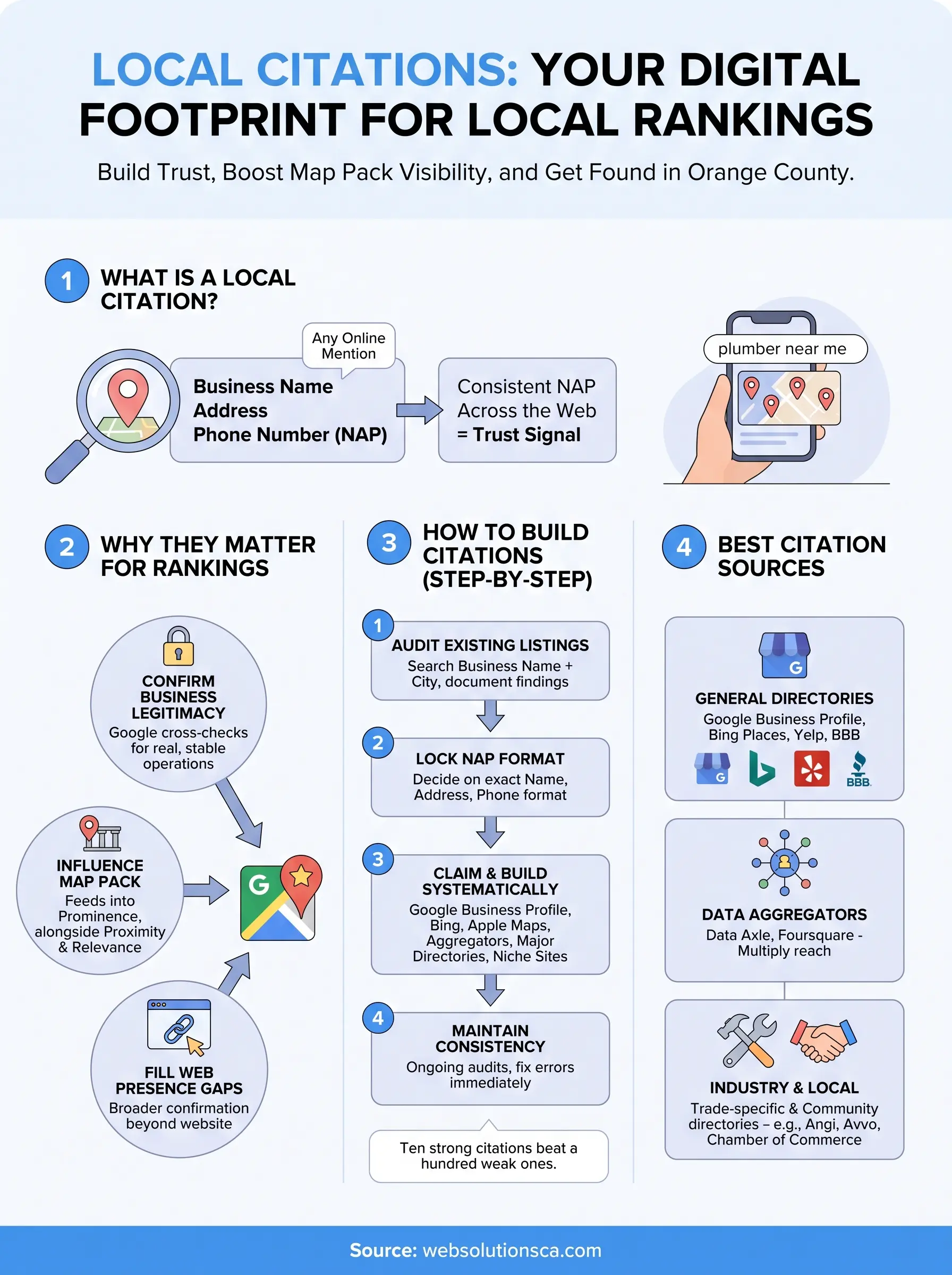
A local citation is any online mention of your business name, address, and phone number, commonly called NAP, on directories, review sites, or industry platforms. Google cross-checks these mentions to verify your business is real and legitimate. When your NAP information is consistent across the web, you build the kind of trust signal that helps you rank higher for searches like "plumber near me" or "tax prep in Costa Mesa."
In this article, we'll break down exactly what counts as a citation, why inconsistent listings quietly hurt your rankings, and where to build citations that actually move the needle, from Google Business Profile to niche directories specific to your industry. By the end, you'll know how to clean up your existing listings and build new ones the right way, and where citations fit into the wider 12-step local SEO checklist.
Why local citations matter for your search rankings
Google can't walk into your shop and check your hours, so it relies on patterns scattered across the web to decide if you're legitimate. When the same business name, address, and phone number shows up on dozens of sites, that repetition acts as a trust signal, telling Google's algorithm you're a stable, real operation rather than a listing thrown together yesterday. This is exactly why local search rankings hinge so heavily on citation volume and consistency, especially for the map pack results that appear when someone searches "plumber in Irvine" or "HVAC repair Huntington Beach."
Citations confirm you're a real, findable business
Ranking algorithms weigh dozens of factors that decide local pack placement, but few carry as much practical weight as citation consistency across trusted directories. Think of each accurate listing as a vote of confidence. Yelp, Better Business Bureau, and your Google Business Profile aren't just places customers browse, they're data sources Google actively crawls to cross-reference your identity.
A business that shows up the same way everywhere online looks trustworthy. One that shows up differently everywhere looks suspicious, and Google treats it that way.
They directly influence who shows up in the map pack
Proximity, relevance, and prominence are the three pillars Google uses to rank local results, and citations feed directly into prominence. More consistent, high-quality mentions across the web tell Google your business deserves visibility, which pushes you closer to that coveted map pack spot above your competitors' listings, especially when paired with the other tactics that help you rank higher on Google Maps.
They fill in gaps your website can't cover alone
Regardless of how polished your website looks, it only represents one data point. Directories, review platforms, and industry-specific sites give Google dozens of additional confirmation points, and many of them double as ways to earn links from other local websites, giving potential customers a chance to discover you somewhere other than a Google search, whether that's browsing Yelp for a plumber or checking an industry association's member directory for a licensed contractor.
Without that broader web presence, even a beautifully designed site can struggle to rank, because Google has fewer reasons to trust that your business exists where you say it does.
How to build local citations step by step
Building citations isn't complicated, but it does require discipline. Consistency matters more than volume, so before you create a single new listing, decide on the exact format you'll use for your business name, address, and phone number, then use that same format everywhere. Skipping this step is why so many businesses end up with three versions of their own address floating around the internet.
Get your NAP format locked down before you build a single listing, or you'll spend twice as long fixing mistakes later.
Start with an audit of what already exists
First, search your business name plus city on Google to see what's already indexed. You'll often find old listings from a previous address, a misspelled business name, or a phone number you stopped using years ago. Document every listing you find in a simple spreadsheet with columns for the site name, URL, and whether the citation accuracy checks out.
Then build and claim listings systematically
Once you know what's out there, work through this order:
- Claim and fully complete your Google Business Profile, including hours, categories, and photos (here's the full Google Business Profile setup process for California businesses).
- Claim your Bing Places and Apple Maps listings.
- Set up profiles on major aggregators like Data Axle and Foursquare, which feed data to dozens of smaller directories.
- Add listings on Yelp, Better Business Bureau, and Angi.
- Search for industry-specific directories relevant to your trade.
Running this process manually eats up hours fast, which is why many Orange County business owners hand it to our SEO team instead of doing it themselves.
Where to find the best local citation sources
Not every directory holds the same weight with Google, so chasing hundreds of low-quality listings wastes time you don't have. High-authority directories carry far more trust than random niche sites nobody visits, and a handful of the right listings will do more for your rankings than fifty weak ones.

Ten strong citations beat a hundred weak ones every time.
General directories that carry weight
Start with the platforms Google itself trusts most: your Google Business Profile, Bing Places, Apple Maps, Yelp, and the Better Business Bureau. These general business directories show up constantly in local search results, and completing every field, from business hours to service categories, gives Google more reasons to trust your listing.
Data aggregators that multiply your reach
Aggregators like Data Axle and Foursquare feed your NAP details to dozens of smaller directories automatically, saving you from manually claiming each one. Submitting to these data aggregators early in the process means your information spreads correctly across the web instead of getting scraped inconsistently from whatever outdated listing shows up first.
Industry-specific and local directories
Beyond the general platforms, look for directories built around your trade or your Orange County community, since these signal relevance on top of trust.
| Business type | Good citation source |
|---|---|
| Contractors | Angi, HomeAdvisor |
| Legal/tax services | Avvo, local bar or CPA association |
| Restaurants | OpenTable, TripAdvisor |
| Healthcare | Healthgrades, Zocdoc |
Combining these local citation sources with general directories rounds out a citation profile that looks real from every angle, not just the obvious ones.
Keeping your NAP information accurate and consistent
Once your citations are live, the work isn't over. NAP consistency has to be maintained over time, because business details change more often than owners expect. Suite numbers get dropped, phone numbers get ported to new providers, and old listings from a previous location keep floating around long after you've moved. Google's algorithm doesn't forgive these small mismatches easily, so treat citation upkeep as an ongoing task, not a one-time project.

Why small inconsistencies slow you down
Even a minor difference, like listing "St." on one site and "Street" on another, can confuse Google's matching systems enough to weaken the trust signal you've built. Multiply that across a dozen directories and you've got a fragmented online presence that looks like several different businesses instead of one.
A dropped suite number on one directory can undo the trust you built with ten accurate listings.
How to audit and fix errors before they spread
Set a recurring reminder, quarterly works well, to run through this checklist:
- Search your business name and city to catch new or duplicate listings
- Compare every live citation against your master NAP format
- Update your Google Business Profile first, since it influences how fast changes ripple elsewhere
- Flag and correct any aggregator-fed listings before they multiply the error
- Remove or merge duplicate Google Business Profile listings that compete with your main listing
Handling this manually across dozens of directories gets tedious fast, especially once your business has multiple locations or service areas. That's the exact kind of ongoing maintenance our SEO services are built to handle, so your listings stay clean without eating up your week every few months.
Putting local citations to work for your business
Getting local citations right isn't glamorous work, but it's one of the few SEO tasks with a direct, measurable payoff. Clean, consistent NAP details across the right directories tell Google your business is real, established, and worth showing to nearby customers searching for exactly what you offer. Skip this step, and even the best-designed website struggles to earn the map pack visibility that actually drives calls and foot traffic.
Tackling every directory, aggregator, and quarterly audit on top of running your business is a lot to juggle alone. If you'd rather hand off the spreadsheets and cleanup to people who do this daily for Orange County businesses, Web Solutions CA builds and maintains citation profiles as part of our Orange County SEO services with a clear monthly plan, so your listings stay accurate while you focus on serving customers instead of chasing directory errors.