
You've probably burned through a chunk of budget on Google Ads with little to show for it. Maybe you got a few clicks, no calls, and a bill that made you question the whole thing. That's usually not a Google problem, it's a google ads ppc management problem, and it's the difference between guessing and running a real, measurable strategy.
So what does PPC management actually involve? At its core, it's the ongoing work of building, monitoring, and adjusting your ad campaigns so every dollar pushes toward a lead or a sale instead of a wasted click. That means keyword targeting, Google Ads bidding strategies, ad copy testing, and conversion tracking all working together, not a campaign you set up once and forget.
In this article, we'll break down exactly what Google Ads PPC management covers, how the process typically works from setup to optimization, and what separates campaigns that generate real calls and leads from ones that just spend money. Whether you're deciding to run ads yourself or hire someone in Orange County to manage them for you, you'll walk away knowing what to expect and what to ask for.
Why google ads ppc management matters for small businesses
Small business owners often treat Google Ads like a slot machine. You throw in a budget, pull the lever, and hope for leads. Without proper google ads ppc management, that's exactly what happens, and it's why so many Orange County business owners tell us they "tried Google Ads once and it didn't work." The truth is, Google Ads rarely fails on its own. It fails when nobody's watching the account closely enough to catch wasted spend, poor targeting, or broken tracking.
The cost of an unmanaged account
Budgets disappear fast when campaigns run on autopilot. Google's own algorithms are built to spend your daily budget, not necessarily to spend it wisely, and if you're not reviewing search terms, adjusting bids, and pausing underperforming ads, you're paying for clicks that never should have happened. A local window and door company we worked with was spending $40 a day on clicks from people searching "window repair jobs" and "how to install a window yourself," neither of which had anything to do with their actual service. That's a common pattern: without active PPC campaign management, irrelevant searches quietly drain the budget every single day.
A Google Ads account without active management is just an expensive way to find out which keywords don't convert.
Why small budgets can't afford guesswork
Enterprise brands can absorb inefficient ad spend because their budgets are large enough to average out. Small businesses don't have that luxury. If you're spending $1,000 a month, every wasted click is a real dent in what you can afford to invest in growth. Effective Google Ads campaign management narrows your targeting, sharpens your ad copy, and directs spend toward the searches most likely to turn into a phone call or a form submission. That's the entire point of hiring someone to handle PPC advertising management instead of letting the campaign run itself: it turns a fixed budget into a predictable stream of leads rather than a monthly gamble.
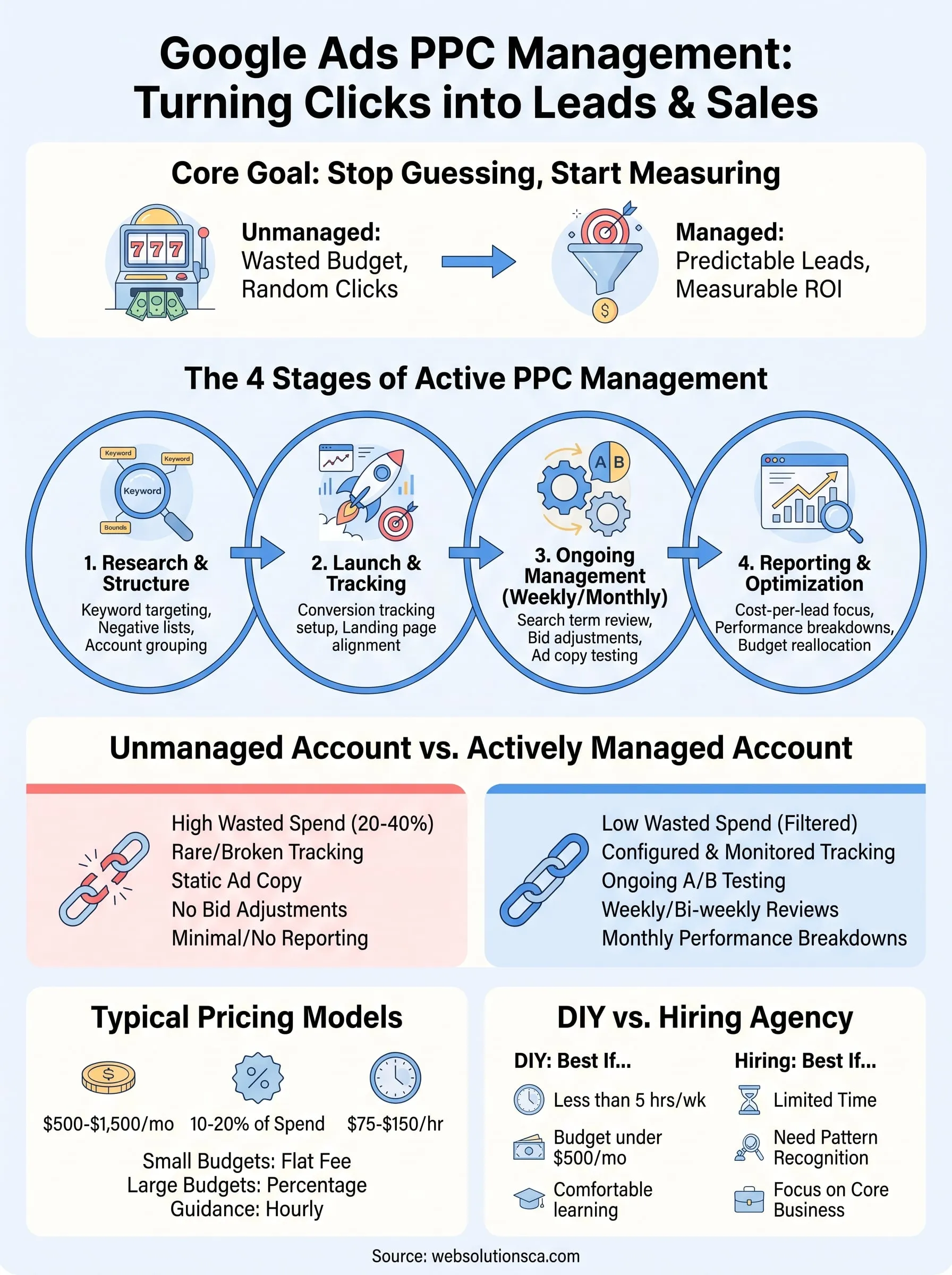
Here's a quick comparison of what typically happens with managed versus unmanaged accounts over a similar budget:
| Factor | Unmanaged Account | Actively Managed Account |
|---|---|---|
| Wasted spend on irrelevant clicks | High, often 20-40% of budget | Low, filtered through negative keywords |
| Conversion tracking | Rarely set up correctly | Configured and monitored monthly |
| Ad copy testing | Static, set once | Ongoing A/B testing |
| Bid adjustments | None | Weekly or bi-weekly reviews |
| Reporting | Minimal or none | Monthly performance breakdowns |
Competing in a crowded local market
Orange County is saturated with businesses bidding on the same handful of high-intent keywords, whether you're one of the businesses in Irvine, Santa Ana, or Newport Beach. That competition drives up cost-per-click for anyone who isn't actively refining their targeting. Managed campaigns respond to that pressure by finding lower-competition long-tail keywords, adjusting bids by time of day and location, and testing ad variations that pull cheaper clicks without sacrificing quality. Left alone, your ads keep bidding on the same expensive terms as every competitor down the street, which is exactly why small businesses benefit so much from working with a team that handles this daily instead of checking in once a quarter.
Getting this right matters more than most business owners expect. If you want to see how a properly managed account performs against one running on default settings, our team at Web Solutions CA's Google Ads management services walks new clients through a step-by-step Google Ads audit before touching a single setting, so you know exactly where your current budget is leaking before we fix it.
How google ads ppc management works step by step
Once you understand why management matters, the next question is what actually happens behind the scenes. Google Ads PPC management follows a fairly predictable sequence, even though the specific keywords, bids, and ad copy change from one business to the next. Knowing this sequence helps you evaluate whether an agency (or your own efforts) are doing the work that actually moves the needle.
Research and account structure
Before a single ad goes live, the work starts with keyword research and campaign structure. This means mapping out which search terms your customers actually use, grouping them into tightly themed ad groups, and building out negative keyword lists so you're not paying for irrelevant traffic. A tax preparation client we worked with initially wanted to target "tax help," a term so broad it pulled in students searching for homework answers. Narrowing that to service-specific terms like "small business tax preparation Orange County" cut wasted spend within the first two weeks.
Launch and conversion tracking
With the structure in place, the account goes live, but not before setting up Google Ads conversion tracking correctly. This step gets skipped more often than you'd think, and it's the one that quietly sinks entire campaigns.
If you can't measure which clicks turn into calls or leads, you're not managing a campaign, you're just watching numbers move.
Tracking should capture phone calls, form submissions, and any other action that counts as a real lead, not just clicks or impressions.
Monitoring, testing, and reporting
Once ads are running, the real management begins. This phase typically includes:
- Reviewing the search terms report weekly to catch and block irrelevant queries
- Testing two or more ad variations against each other to see which copy pulls better click-through and conversion rates
- Adjusting bids based on device, location, and time of day performance
- Pausing keywords and ads that spend money without producing leads
- Sending monthly reports that show cost per lead, not just cost per click
This cycle repeats continuously. Campaigns that get set up once and left alone tend to plateau or decline as competitors adjust their own bids and copy. Ongoing PPC campaign management is what keeps an account improving month over month instead of slowly bleeding budget on outdated targeting.
What's included in a professional PPC management service
Most agencies bundle a lot of vague language into their pricing pages, so it helps to know exactly what you should get for your money before you sign anything. A real PPC management service covers everything from initial account audits to ongoing bid adjustments, not just a one-time campaign build. Knowing this list gives you a checklist to hold any agency, including us, accountable to.
Setup work you should expect
Before any ads run, a professional service handles keyword research, ad group structure, negative keyword lists, and landing page review. Landing pages matter more than most business owners realize. Sending paid traffic to a slow homepage instead of a landing page designed for that specific search term is one of the fastest ways to burn budget on clicks that never convert. Conversion tracking setup belongs here too, wired into calls, form fills, and any other action that counts as a real lead.
Ongoing tasks that separate management from maintenance
Once campaigns launch, the work shifts to weekly and monthly tasks that keep performance improving instead of flatlining:
- Search term review to catch and block irrelevant queries
- Bid adjustments by device, location, and time of day
- Ad copy testing with at least two variations running at once
- Landing page tweaks based on conversion data
- Budget reallocation toward the campaigns and keywords producing leads
Agencies that skip these steps are usually just monitoring the account, not managing it.
Ad management without weekly search term review is just expensive babysitting.
Reporting you should actually receive
Reporting ties everything together, and it should tell you more than clicks and impressions. A solid Google Ads campaign management service reports on cost per lead, which keywords are producing calls, and where budget got wasted that month. Transparent reporting also means access to your own account, not one locked inside an agency's internal dashboard you can't see without asking. If a report can't answer "how many actual leads did we get and what did each one cost," it isn't doing its job. Our own PPC management process at Web Solutions CA includes exactly this kind of monthly breakdown, built so Orange County clients can see precisely where their spend is going and why.
How much does google ads ppc management cost
Pricing for google ads ppc management varies more than most business owners expect, mostly because agencies bundle their fees differently, so it helps to see what Google Ads management costs in 2026 before comparing quotes. Some charge a flat monthly rate, some take a percentage of your ad spend, and some charge by the hour for a more hands-off consulting arrangement. Before you compare quotes, separate two numbers in your head: the management fee you pay the agency, and what you'll pay Google per click, lead, and month in actual ad spend. Confusing the two is how business owners end up shocked by their first invoice.
Typical pricing structures
Here's how the most common fee models break down, along with where each one tends to make sense:
| Pricing Model | Typical Range | Best Fit |
|---|---|---|
| Flat monthly fee | $500 to $1,500/month | Small budgets under $3,000/month ad spend |
| Percentage of ad spend | 10% to 20% of monthly spend | Larger budgets over $5,000/month |
| Hourly consulting | $75 to $150/hour | Businesses running ads in-house needing occasional guidance |
Flat fees work best for small businesses because the cost stays predictable no matter how your ad spend fluctuates month to month. Percentage-based models can get expensive fast once your budget grows, since the agency's fee climbs right alongside your spend even if the extra work involved doesn't scale the same way.
What drives the cost up or down
Geography, industry competitiveness, and account complexity all push pricing around. A single-service local business in Fountain Valley with one campaign costs far less to manage than a company running Search, Display, and Shopping campaigns across multiple locations. Landing page work, ongoing conversion tracking adjustments, and how often an agency actually touches your account also factor into the price. Cheap monthly retainers often mean fewer hours spent inside your account, not a better deal.
A management fee that seems too low usually means nobody's actually watching your campaigns.
At Web Solutions CA, our monthly SEO and PPC packages start at $499.99, built specifically for Orange County small businesses that need active Google and Meta ads management without the enterprise-level fees larger agencies charge. That starting point covers real weekly oversight, not a set-it-and-forget-it retainer disguised as management.
DIY vs hiring a google ads management agency
Running your own Google Ads PPC management is possible, especially if you have time to spend inside the platform every week and a genuine interest in learning how it works. Google's own Skillshop courses can teach you the mechanics of bidding, keyword match types, and conversion tracking. But mechanics aren't the hard part. The hard part is knowing which of the twenty things you could adjust actually moves your cost per lead, and that judgment only comes from managing dozens of accounts across different industries.
When DIY actually makes sense
Handling your own campaign works best in specific situations, not as a default. Consider going the DIY route if:
- You have fewer than 5 hours a week to dedicate to the account consistently
- Your monthly ad budget is under $500, where agency fees would eat too much of the spend
- You're comfortable reading a search terms report and spotting irrelevant queries
- You're testing the waters before committing to a larger campaign
Outside of those conditions, most business owners end up spending more time fighting the platform than growing their business.
When hiring makes more sense
Businesses that end up comparing Google Ads management agencies usually do it for one reason: time. Between running the actual business and everything else on your plate, weekly bid adjustments and ad copy testing fall to the bottom of the list, and that's exactly when budgets start leaking. An agency also brings pattern recognition from managing accounts across industries, so they catch problems in week one that a business owner might not notice for three months.
The real cost of DIY isn't the money you save, it's the leads you never got while you were still figuring out the platform.
Factor in opportunity cost too. If you bill $75 an hour for your own work and spend six hours a week inside Google Ads, that's $450 a week you're not earning elsewhere, often more than an agency's flat monthly fee. Comparing DIY versus hiring isn't really about whether you're capable of learning PPC advertising management. It's about whether your time is better spent running your business while someone else runs the ads. If you're leaning toward handing it off, Web Solutions CA's PPC management services start with a free account audit so you can see exactly what's being missed before committing to anything.
Making the right call for your business
Google Ads PPC management isn't complicated once you know what to look for: real keyword research, active weekly monitoring, honest reporting on cost per lead, and someone paying attention every week, not once a quarter. Whether you run campaigns yourself or hand them off, the goal stays the same. Every dollar should chase a lead, not just a click.
Most Orange County business owners we talk to didn't fail at Google Ads. They failed at managing it, which is a fixable problem, not a reason to give up on paid search entirely. If your account has been running on autopilot, or you're starting from scratch and don't want to burn budget figuring things out, get a second set of eyes on it before spending another dollar.
Ready to see where your budget is actually going? Take a look at our Google Ads management in Orange County for a straightforward review of what's working, what's not, and what a properly managed account could do for your leads.