If you run a small business in Orange County, you've probably asked yourself the google ads vs seo question at least once while staring at your marketing budget. Both promise more calls and more customers, but they work in completely different ways, on completely different timelines, and picking wrong can waste months and thousands of dollars you don't have to spare.
Here's the short answer: Google Ads gets you leads today, while SEO builds an asset that keeps paying you back for years. Ads put you at the top of search results the moment you launch a campaign, but the traffic stops the second you stop paying. SEO takes longer, often three to six months, but it compounds, driving free traffic long after the work is done.
In this article, we'll break down exactly how each option performs on cost, speed, and long-term value, using real numbers from campaigns we've run for local service businesses across Costa Mesa, Irvine, and Santa Ana. You'll walk away knowing whether Google Ads, SEO, or a combination of both fits your budget and your growth timeline right now.
Why choosing the right strategy matters for your growth
Small business owners in Orange County often treat this decision like a coin flip, and that's where the trouble starts. Picking the wrong channel first doesn't just waste ad spend, it delays the moment your phone starts ringing with qualified leads. A window and door company we worked with in Tustin spent four months running Google Ads with no landing page strategy and no tracking in place, burning through $6,000 before realizing they had no idea which keywords were converting. That's the real risk here: not that Google Ads or SEO fails, but that you launch either one without a clear plan for what happens after someone clicks.
The cost of guessing wrong
Guessing wrong on this google ads vs seo decision usually shows up in one of two ways. Either you overspend on ads chasing clicks that never convert because your website isn't built to close the sale, or you invest in SEO content that never ranks because you skipped keyword research and competitive analysis. Both mistakes are expensive, but they're avoidable once you understand how each channel actually behaves.
The businesses that grow fastest aren't the ones that pick the "best" channel, they're the ones that match the channel to their timeline and budget.
How each channel affects your cash flow
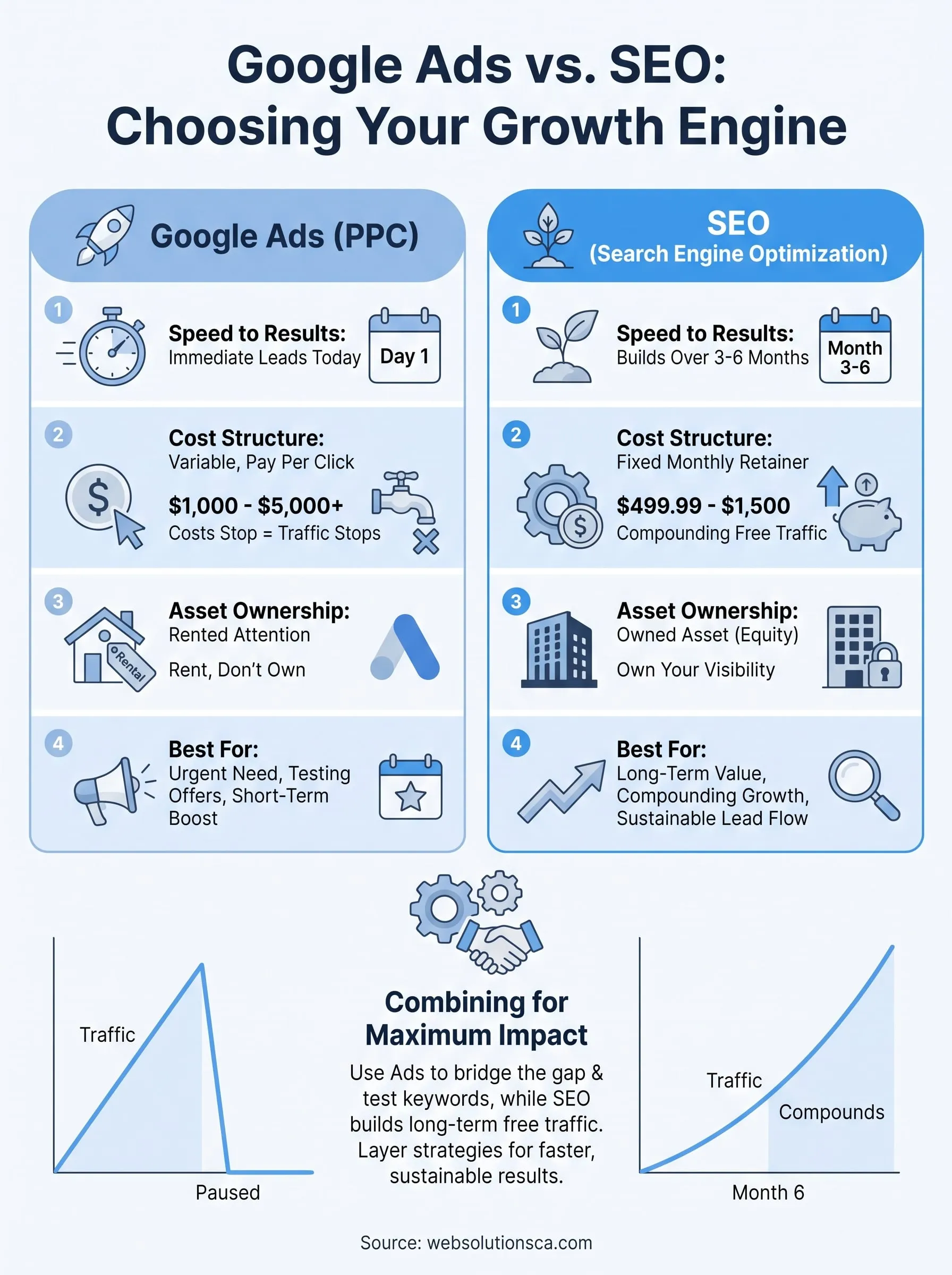
Here's a quick side-by-side of how the two strategies pull on your budget differently over the first year:
| Factor | Google Ads | SEO |
|---|---|---|
| When traffic starts | Same day | 3 to 6 months |
| Monthly cost predictability | Variable (depends on clicks) | Fixed monthly retainer |
| What happens if you stop paying | Traffic stops immediately | Rankings persist for months |
| Best for | Immediate lead flow, testing offers | Long-term, compounding visibility |
Understanding this table matters because it changes how you budget. If you need five new customers this month to make payroll, Google Ads solves an urgent problem. If you're building a business you want to still be running in five years, SEO builds equity you own, not rented traffic you lose the moment you pause a campaign.
Matching strategy to your business stage
Newer businesses with almost no online presence often lean too hard into ads because they feel more urgent, then panic when the cost per lead climbs during a slow month. Established businesses sometimes ignore SEO entirely because it feels slower, then watch competitors quietly take over the first page of Google over a couple of years. Neither approach is wrong on its own, but the timing has to match where your business actually is right now, not where you wish it was. That's the gap most small businesses fall into, and it's exactly why the next section walks through a practical way to decide.
How to decide between Google Ads and SEO
Start with your timeline, not your budget. Ask yourself how fast you need customers walking through the door, because that single answer eliminates half the guesswork in the google ads vs seo decision. If you need revenue in the next 30 days, whether that's a new location opening in Newport Beach or a slow season you need to fill, PPC campaign management is the only option that can deliver traffic before the month ends. SEO simply can't move that fast, no matter how good the content is.
Next, look at how competitive your market already is. Searching your main service plus your city, like "immigration consultant Santa Ana," tells you a lot. If the first page is packed with paid ads and established sites with hundreds of reviews, ranking organically will take longer and cost more in content and links. In that case, running ads while you build SEO in the background protects you from months of zero visibility.
If you can't afford to wait for results, pay for them. If you can wait, build them instead.
A quick decision checklist
Run through these questions before committing a dollar:
- Do you need leads within 30 days? Lean toward Google Ads.
- Is your website already converting visitors into calls or forms? If not, improve your conversion rate first, regardless of channel.
- Is your local market saturated with paid competitors? Consider SEO as a longer-term escape from rising click costs.
- Do you have at least 6 months of runway to invest before expecting organic results? SEO needs that patience.
- Is your monthly budget under $1,000? Ads can eat that fast; SEO often stretches further at that price point.
Finally, be honest about your team's bandwidth. Google Ads requires ongoing bid and keyword management, while SEO demands consistent content and technical upkeep. Owners who try to run either strategy as an afterthought usually see mediocre results from both, which is exactly why so many Orange County businesses end up outsourcing one or the other once they've tested the waters themselves.
Cost, timeline, and ROI compared side by side
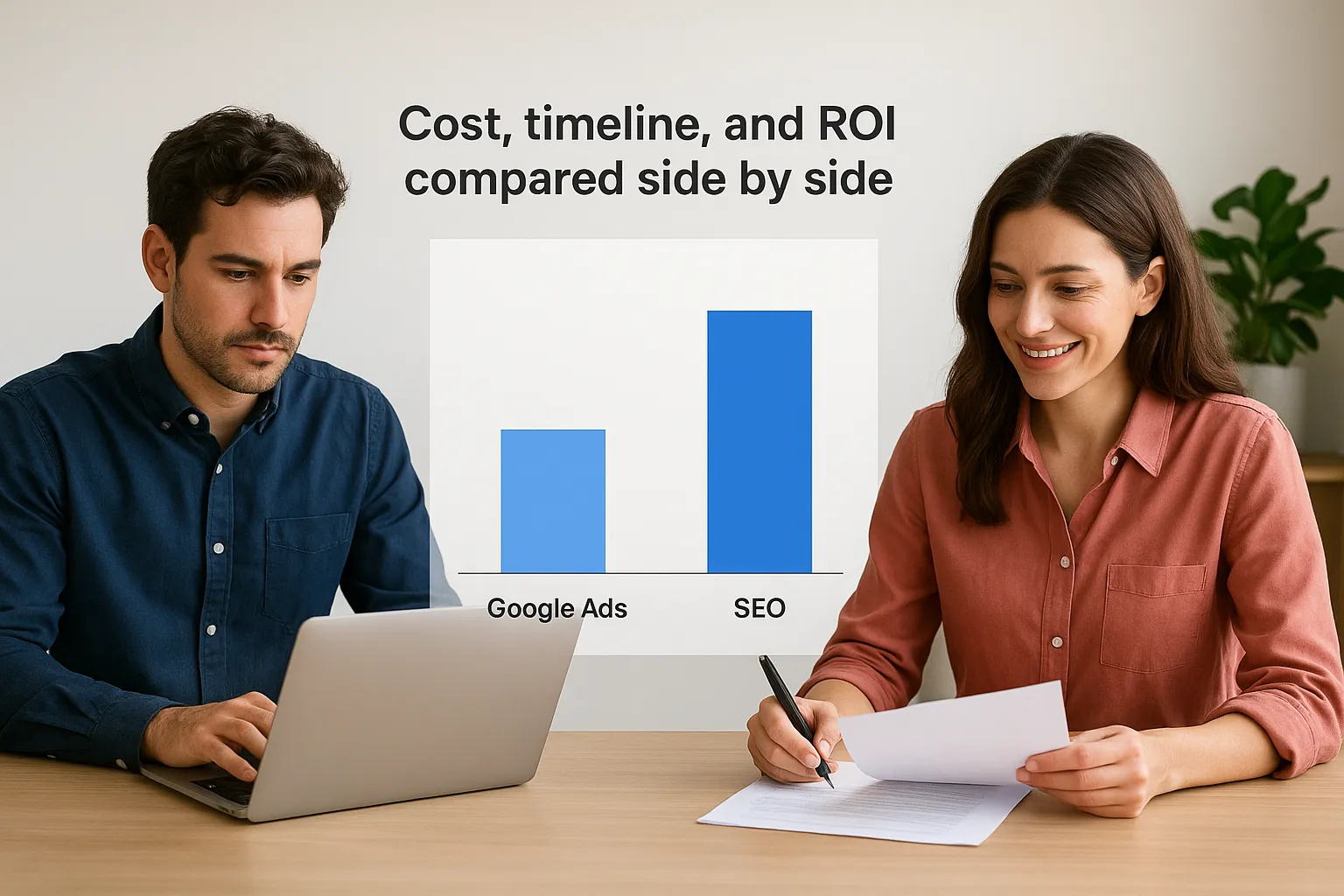
Numbers make this decision easier than opinions ever will. Average cost-per-click for local service keywords in Orange County runs anywhere from $8 for niche trades to $35 for competitive fields like personal injury or immigration law, meaning a modest $1,000 monthly ad budget might only buy you 30 to 100 clicks, which is worth checking against what Google Ads costs per click, lead, and month. SEO, by comparison, typically starts around $499.99 a month for a small business retainer, and while it won't produce a single click in week one, it doesn't disappear the moment your invoice is late.
What the first 12 months actually look like
Laying the two side by side over a full year shows how differently they behave once the initial excitement wears off.
| Metric | Google Ads | SEO |
|---|---|---|
| Time to first lead | 1 to 7 days | 90 to 180 days |
| Typical monthly spend | $1,000 to $5,000+ | $499.99 to $1,500 |
| Cost per lead trend | Stays flat or rises with competition | Drops as rankings climb |
| Traffic after 12 months if paused | Zero | Often persists for 6+ months |
| Ownership of the asset | Rented (platform-dependent) | Owned (your domain, your content) |
Ads rent you attention. SEO builds you an asset that still works after the invoice is paid.
Where ROI actually flips in your favor
Google Ads almost always wins on speed, but SEO usually wins on cost-per-lead once you cross the six-month mark, because you're no longer paying per click for traffic you already earned. A tax preparation client in Garden Grove we support pays roughly the same monthly amount for ongoing SEO work in Orange County as they once spent on ads, but now pulls three times the leads because those rankings never switch off between January and April.
Understanding this crossover point is the whole game. Businesses that only look at month-one numbers assume ads are cheaper, and businesses that only look at year-two numbers assume SEO always wins. The real answer depends on how long you plan to stay in business, which is a question only you can answer honestly.
How to combine SEO and Google Ads for faster results
Most small businesses treat the google ads vs seo debate like an either/or decision, but the fastest-growing companies we work with in Costa Mesa run both at the same time, just with different jobs. Ads cover the gap while your organic rankings climb, and once SEO kicks in, you shift ad spend toward testing new offers or seasonal promotions instead of carrying your entire lead flow.
Use ads to fund and validate your SEO strategy
Running both channels together also gives you data you can't get any other way. Paid search data tells you which keywords actually convert into calls or form submissions within days, not months, so you're not guessing which pages to build out for SEO. A document preparation service in Anaheim we support used three months of ad data to identify their two highest-converting services, then built dedicated landing pages around those exact terms for organic ranking, cutting their guesswork down to almost nothing.
Let your ad campaigns tell you what to write about, then let SEO make that traffic free.
Layer the two channels by search intent
Once you have that data, split your budget by intent instead of running both channels on identical keywords:
- Bid on high-intent, bottom-funnel terms with Google Ads ("emergency window repair Irvine") where you need to own the top spot immediately.
- Target broader, informational terms with a local SEO content strategy ("how to choose replacement windows") that builds authority without ongoing cost.
- Pull back ad spend gradually on terms once your organic ranking holds steady in positions 1 through 3 for at least 60 days.
Eventually, this overlap becomes your safety net. Overlapping the two means a Google algorithm update or a rising cost-per-click never leaves you with zero visibility, because one channel is always covering for the other. If you want help mapping out which keywords deserve ad dollars versus content investment, our team builds that plan as part of every SEO and managed paid search and social campaigns package we run for Orange County clients.
Common mistakes small businesses make when choosing
Every Orange County business owner we've worked with has made at least one of these errors, usually because nobody explained the tradeoffs before they signed a contract or clicked "launch campaign." Recognizing these patterns early saves you the exact mistakes that cost the Tustin window company those four wasted months.
Turning off ads or SEO too soon
Owners often pull the plug on Google Ads the moment a slow week hits, or cancel an SEO retainer after ninety days because rankings haven't moved yet. Quitting before the crossover point means you never see the payoff either channel was built to deliver. SEO especially punishes impatience, since content published in month two often doesn't rank until month five.
The businesses that fail at this aren't bad at marketing, they just quit one move before the payoff.
Sending paid traffic to a broken website
Running ads without a conversion-ready landing page is the fastest way to burn a budget. Clicks arrive, but a slow site, a missing phone number, or a form buried three scrolls down kills the sale before it starts, which is how most websites quietly lose their visitors.
Ignoring local search signals entirely
Businesses obsessed with national keyword volume often skip dialing in every field on their Google Business Profile and local citations, the exact signals that decide who ranks for "near me" searches in Irvine or Mission Viejo.
A few other patterns show up again and again:
- Choosing a channel based on what a competitor does, not what your own timeline requires
- Assuning cheap ad clicks mean cheap leads, when unqualified traffic costs more in wasted calls
- Skipping Google Ads conversion tracking setup, so nobody actually knows which channel is working
- Treating SEO as a one-time project instead of ongoing maintenance
- Running Google Ads and SEO on identical keywords instead of splitting by intent
Avoiding these five mistakes matters more than picking the "perfect" strategy on day one, because a mediocre channel executed well still beats a great channel executed poorly.
Finding the right mix for your business
There's no universal winner in the google ads vs seo debate, only what fits your timeline, budget, and how long you plan to stay in business. Businesses that need customers this week should lean on ads. Companies playing a longer game should start SEO now, even if the payoff sits months away. Owners who want both speed and staying power should run them together, letting paid data guide your content and organic rankings eventually take the weight off your ad spend.
Most Orange County businesses we've worked with land somewhere in the middle, and that's normal. Your specific mix depends on how competitive your market is, how fast your website converts, and how much runway you have before results need to show up.
If you'd rather stop guessing and get a plan built around your actual numbers, request a free consultation with Web Solutions CA and we'll map out the right combination for you.