

If your Orange County business ranks nowhere near the top when someone searches "near me" for what you sell, your website content is probably the reason. A solid local seo content strategy isn't about stuffing your city name into every page. It's about creating the right pages, in the right structure, that answer what your actual neighbors are typing into Google before they call you.
This guide gives you the actionable steps to build that strategy from scratch, whether you're starting with zero content or trying to fix pages that aren't converting. You'll learn how to research location-specific keywords, structure service and city pages so Google understands your service area, and create content that pairs with your Google Business Profile instead of competing against it.
We work with small businesses across Costa Mesa, Irvine, Santa Ana, and the rest of Orange County every day, and the pattern is always the same: businesses with a clear content plan outrank competitors with bigger budgets but weaker pages. By the end of this guide, you'll have a repeatable process for turning your website into a local lead-generation tool instead of a digital brochure.
Why local SEO content needs its own strategy
Most small business owners write content the same way regardless of who's searching. They publish a blog post about "tips for choosing a window installer" and hope it ranks. But local search results don't work like general search results, and what Google weighs when ranking local results is a different set of signals entirely. Google is trying to answer a different question entirely: not "what's the best answer to this topic" but "which business near this exact location can solve this problem right now." If your content doesn't speak to that intent, it doesn't matter how well-written it is. It simply won't surface for the searches that actually bring you customers.
Generic content answers the wrong question
Think about the last time you searched for a plumber, dentist, or tax preparer. You typed something like "emergency plumber Santa Ana" or "tax preparer near me," not "how does plumbing work." Location-based search carries built-in urgency and proximity. Google's own guidance on local ranking factors confirms that relevance, distance, and prominence are the three pillars it uses to decide who shows up (see Google's explanation of local ranking factors). A generic service page that never mentions your city, your service area, or the specific neighborhoods you cover gives Google nothing to match against those signals.
A website that never mentions where it serves customers is invisible to the algorithm that decides who's nearby.
What a fragmented approach actually costs you
Skipping a dedicated local strategy usually shows up as one of two problems. Either you have one homepage trying to rank for every city in Orange County at once, which confuses Google and dilutes your relevance for all of them, or you have scattered blog posts with no structure connecting them to your service pages. Neither approach builds the kind of topical authority that search engines reward. We've audited plenty of Orange County sites that had decent traffic numbers but almost zero calls, and the root cause was always the same: content built for search engines instead of for the person standing in their kitchen with a leaking pipe, phone in hand.
Comparing generic content to local-first content
The difference becomes obvious once you lay it out side by side. Here's how the two approaches typically compare:
| Element | Generic SEO Content | Local SEO Content Strategy |
|---|---|---|
| Page focus | Broad topic or service | Service tied to a specific city or neighborhood |
| Keywords targeted | "best window installation" | "window installation Costa Mesa" |
| Trust signals | General reviews, no location | Local reviews, address, service area map |
| Google Business Profile link | Absent or generic | Directly reinforces GBP categories and posts |
| Conversion path | Contact form | Click-to-call, directions, local phone number |
Understanding this gap matters because it changes how you plan everything downstream, from keyword research to page structure to internal linking. Your goal isn't to create more content. It's to create content that maps directly to how people search when they're standing in Orange County looking for a business exactly like yours, right now, ready to book. Once you accept that local search behaves differently, every decision in the next four steps gets easier to make because you're building toward a specific outcome instead of guessing.
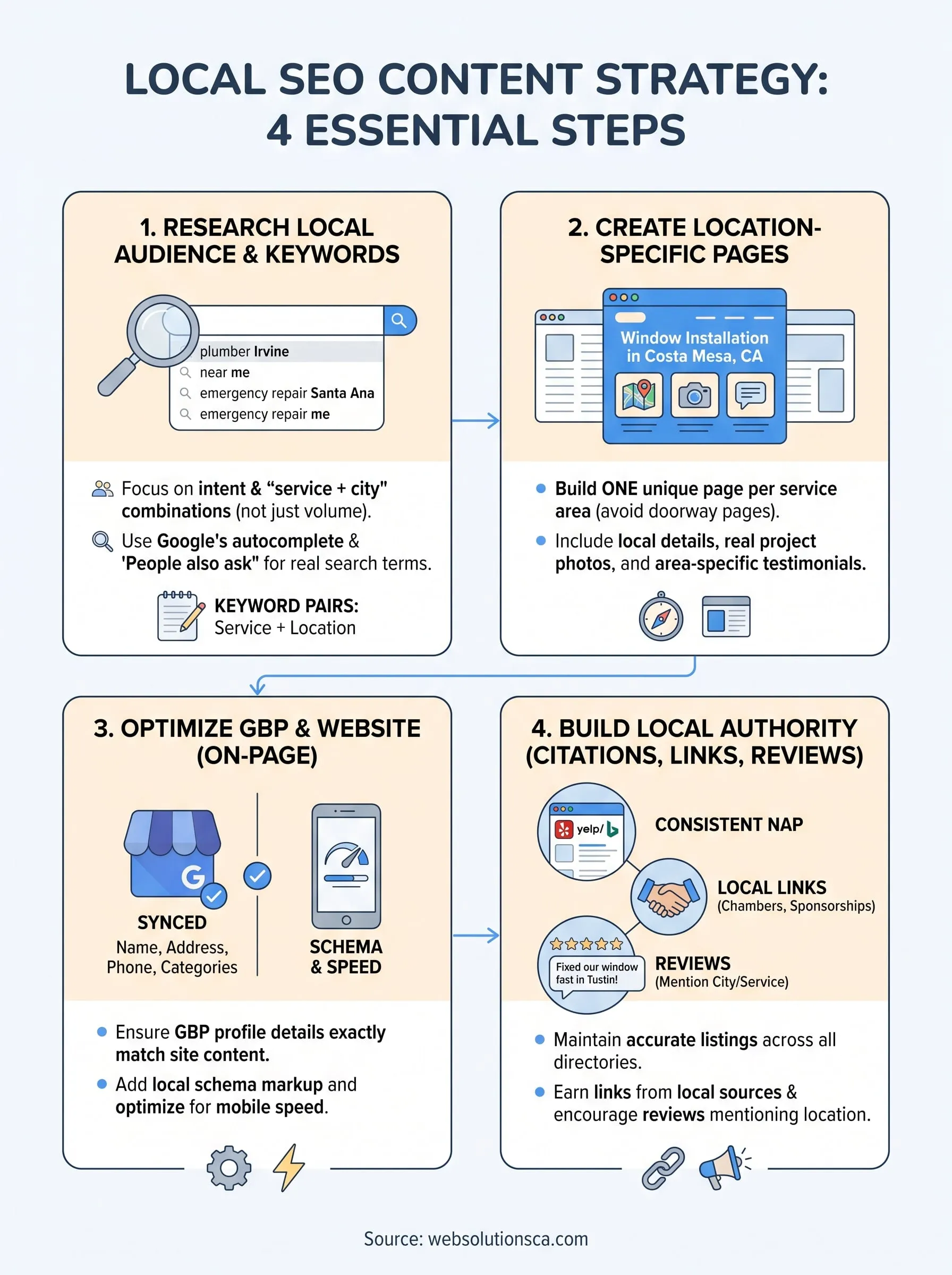
Step 1. Research your local audience and keywords
Before you write a single page, find out how people in your service area actually phrase their searches. Keyword research for local SEO looks different than general keyword research because you're not just hunting for search volume, you're hunting for intent tied to a neighborhood. Start by typing your core services into Google and watching the autocomplete suggestions and the "People also ask" box for your target cities. Those free signals tell you exactly what your neighbors type before they pick up the phone.
Find out how your neighbors actually search
Pull up Google Search Console if your site has any history, and check which queries already bring in impressions, even at low positions. Then supplement that with a few practical research habits:
- Search your main service plus each city you serve ("roof repair Anaheim," "roof repair Tustin") and note who ranks
- Check the "nearby" results Google shows on mobile searches for your industry
- Read the questions customers ask in your Google Business Profile Q&A and reviews
- Look at competitor service pages ranking in your area to see what topics they cover
If you don't know the exact phrase your customer typed, you can't build a page that answers it.
Map keywords to service + location combinations
Once you have a raw list, organize it into service-plus-location pairs rather than one long keyword dump. This step is where local keyword targeting actually turns into a content plan instead of a spreadsheet nobody uses. A simple way to structure it:
Service: Window Installation
Cities: Costa Mesa, Irvine, Santa Ana, Newport Beach
Keyword pairs:
- window installation Costa Mesa
- window replacement company Irvine
- emergency window repair Santa Ana
- vinyl window installers Newport Beach
Repeat that grid for every core service you offer. Small businesses often stop after listing two or three obvious keywords, but the pairs that convert best are usually the specific ones, like "same day window repair Fountain Valley" rather than just "window repair." Volume matters less here than match, a low-volume phrase that exactly matches your customer's need will outperform a high-volume phrase that's too broad. If keyword research feels like a full-time job on top of running your business, our team handles this exact groundwork as part of our SEO services in Orange County, so you get the target list without losing a week to spreadsheets.
Step 2. Create location-specific pages and content
Once you have your keyword pairs organized, the next move is building actual pages around them, not stuffing every city into your homepage footer. Each city you genuinely serve deserves its own page with unique content, not a copy-paste template with the city name swapped out. Google's own guidance on doorway pages warns against creating near-duplicate pages designed only to rank for different locations (see Google's policy on doorway pages), so the content on each page needs to reflect something real about that location, whether it's a nearby landmark, a specific neighborhood you cover, or a project you completed there.

Build one page per service area, not one page for everything
Give every core service its own city-specific landing page instead of trying to make a single service page rank everywhere at once. A window installation company serving four cities should have four distinct pages, each written for that specific market. This is the backbone of any working local seo content strategy, because it gives Google a clean, specific match for every service-plus-location search instead of one diluted page trying to do too much.
One page trying to rank for five cities will lose to five pages each built for one.
Structure each page so it reads like it belongs there
Every location page should include the same core elements, arranged so a first-time visitor and Google both understand exactly what you offer and where:
- A headline naming the service and the city ("Window Installation in Irvine, CA")
- Two or three paragraphs describing the service with local specifics, like permit requirements or neighborhoods you cover
- A short section naming nearby areas you also serve, the same way a well-built service area page does
- Photos from actual jobs in that city, not stock images
- A review or testimonial from a customer in that location
- A clear call-to-action with your phone number and a map or directions link
Let blog content support your service pages, not replace them
Blog posts still matter, but their job is to feed authority back to your location pages, not compete with them. Write posts that answer specific local questions, like "how much does window replacement cost in Orange County" or seasonal topics tied to your service area, then link from those posts directly to the relevant city page. Supporting content built this way strengthens the pages that actually generate calls instead of sitting isolated on your blog with no path to conversion.
Step 3. Optimize your Google Business Profile and website
Location pages only work if they connect to a strong Google Business Profile, and most Orange County businesses treat the two as separate projects when they should reinforce each other, even though a profile built for local SEO does half the work for them. Your profile is often the first thing a searcher sees, before they ever click through to your site, so the categories, services, and posts you add there need to match the language on your location pages word for word. Mismatched information, like a profile listing "window contractor" while your site says "window installation company," confuses Google's matching system and weakens the relevance signal you worked to build in Steps 1 and 2.
Sync your profile with your website content
Go through your Google Business Profile and check it against your live site using this quick list:
- Business name, address, and phone number match exactly across your profile and every page footer
- Primary and secondary categories reflect the actual services described on your location pages
- Service area settings match the cities you've built pages for, not a vague county-wide radius
- Weekly Google Business posts link back to a specific city or service page, not your homepage
- Photos uploaded to the profile match the ones used on your corresponding location page
Your Google Business Profile and your website should read like they were written by the same person on the same day.
Fix the on-page basics that support local rankings
Beyond the profile itself, your website needs a handful of on-page fixes that most templates skip entirely. Title tags and meta descriptions should include both the service and the city, structured data that tells search engines who and where you are should be added to every location page so Google can pull your address and hours directly into search results, and your site needs to load fast on mobile, since most local searches happen on a phone standing in a driveway or parking lot. Google's own guidance on page experience confirms that speed and mobile usability directly affect how content gets surfaced (see Google's page experience documentation). None of this replaces good content, but weak technical SEO quietly caps how far your local seo content strategy can climb, no matter how well the pages are written. If your site is slow or hasn't been touched in years, our Orange County web design team can rebuild it with these fixes built in from day one rather than bolted on later.
Step 4. Build local authority with citations, links, and reviews
Content and technical fixes only get you halfway there. Google still needs outside confirmation that your business actually exists and serves the areas your pages claim. That confirmation comes from listings of your business across local directories, backlinks from other local sites, and a steady stream of reviews mentioning your service area. Without these trust signals, even a perfectly built location page can stall in the rankings while a less polished competitor with stronger citations pulls ahead.

Get your citations consistent everywhere
Start with the directories that matter most for Orange County businesses: Yelp, Apple Maps, Bing Places, and industry-specific directories like Angi or Houzz if you're in home services. Every listing needs the exact same name, address, and phone number you use on your website and Google Business Profile. Inconsistent citations are one of the quietest ways businesses sabotage their own local content marketing efforts, because Google reads mismatched details as a signal that it can't fully trust your location data.
A citation with the wrong suite number does more damage than no citation at all.
Earn links from businesses that are actually local
Backlinks from national blogs rarely move the needle for local rankings. What works is getting linked from sources tied to your actual city:
- Local chambers of commerce and business associations
- Sponsorships for community events, youth sports teams, or school fundraisers
- Guest posts or interviews on local news sites covering Orange County business
- Partner pages from suppliers, contractors, or vendors you work with regularly
Each of these links tells Google your business has real roots in the community, not just a website claiming to serve it.
Turn reviews into a location signal, not just a trust badge
Reviews do double duty in a local strategy. They build trust with potential customers, but they also reinforce your location relevance when customers naturally mention the city or neighborhood where you helped them. Ask happy customers directly, right after the job is done, and make it easy with a text or email link straight to your Google Business Profile review page. Encourage specifics without scripting them, a review that says "fixed our window fast in Costa Mesa" carries more local weight than a generic five-star rating with no context. Building this steady mix of citations, community links, and location-tagged reviews is what turns an already solid page structure into a page that consistently outranks competitors with bigger ad budgets but thinner local trust.
Putting your local content strategy to work
None of these four steps work in isolation. Your keyword research feeds your location pages, your location pages feed your Google Business Profile, and your citations and reviews confirm to Google that everything you've built is real and rooted in Orange County. Skip one piece, and the rest struggles to gain traction. Treat this as a local seo content strategy you revisit quarterly, not a project you finish once and forget, since new competitors, new reviews, and algorithm updates keep shifting what "nearby and relevant" actually means.
Start small if you need to. Pick your busiest service, build one strong location page, sync it with your Google Business Profile, and earn a handful of real local links before moving to the next city. Progress beats perfection here. If you'd rather hand the whole process to a team that already knows Orange County search behavior, take a look at our local SEO and Google Maps services for Orange County businesses and let's build the pages that actually bring in calls.