

The best car dealer SEO services fix your Google Business Profile, build real pages for the vehicles and services you sell, and report on calls and leads instead of rankings alone. An independent lot on a tight budget fits a local small business agency such as Web Solutions CA. Franchise stores usually end up with platform vendors, and large groups lean toward dealer-specialist agencies. A lot with one salesperson and a free weekend may only need a cleanup and a checklist.
The hard part is that every provider pitches the same promises: "more leads," "page one," "full service." You end up comparing slogans instead of work. A wrong choice costs you six months in a channel that moves slowly.
This guide fixes that. It first explains what dealer SEO work includes, then compares seven provider types on deliverables, fit, cost, and risk. Web Solutions CA is a Costa Mesa, California agency that builds websites and runs SEO for small businesses, so it appears first, with its limits stated plainly. You finish with a vetting checklist you can use on any quote.
What car dealer SEO services include
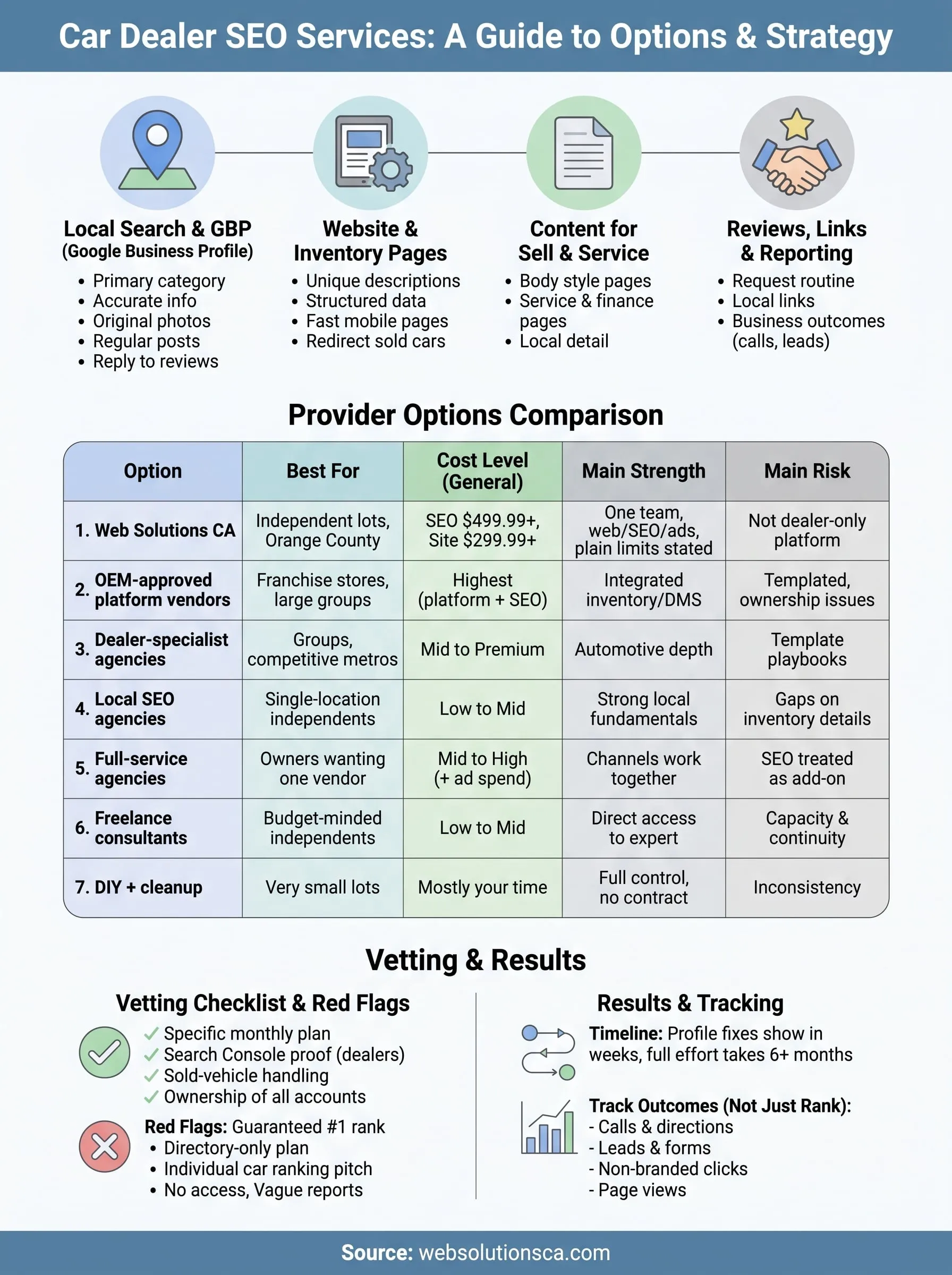
Car dealer SEO services cover four jobs: local search, website and inventory pages, content for what you sell and service, and reviews, links, and reporting. Every proposal you receive should map to those four. If one is missing, ask why before you sign.
Local search and Google Business Profile
Local search decides who shows up in the map results when someone types "used cars near me." For most dealers, the Google Business Profile does as much work as the website. A provider should set the right primary category, fill every field, and keep the profile active. They should also make your name, address, and phone number identical everywhere your dealership is listed.
A solid profile setup includes:
- A primary category that matches what you mostly sell, such as Used Car Dealer, plus relevant secondary categories
- Accurate hours, including holiday hours
- Original photos taken on your own lot
- Regular posts about inventory, financing, and service offers
- Replies to every review, good or bad
Car dealer SEO starts with local search, because that is where "near me" buyers decide.
Website, inventory pages, and technical fixes
Inventory is the hardest part because it changes daily. Good providers write unique vehicle descriptions instead of pasting the same manufacturer copy that hundreds of other lots use. They add structured data that follows Google's vehicle listing documentation and keep pages fast on phones.
They also need a plan for sold vehicles. A sold car's page should redirect to the closest category page or stay up with similar inventory. Otherwise your site fills with dead ends that waste crawl attention.
Content for what you sell and service
Specific make-and-model pages disappear when the car sells. Body style and service pages stay useful, so they make better long-term targets. A real finance page that explains your process, shows reviews that mention financing, and ends with a clear next step beats an embedded credit form with no text around it.
If you have a service department, each service you offer needs its own page with local detail. A "brake repair" page for your city can draw drivers who have never considered buying from you.
Reviews, links, and reporting
Providers should set up a review request routine, such as a QR code on the paperwork or a text after delivery. They should also pursue local links from chambers of commerce, school sponsorships, and community events. Reporting should show business outcomes, not just keyword positions.
Use this table to audit any proposal:
| Deliverable | What good looks like | How you can check |
|---|---|---|
| Google Business Profile | Right categories, photos, posts, replies to reviews | Open your profile and compare |
| Citations | Same name, address, phone everywhere | Search your phone number |
| Inventory pages | Unique copy, structured data, sold-vehicle handling | Run a page through Google's Rich Results Test |
| Finance and service pages | One page per service with local detail | Click through your own site |
| Local links | Sponsors, chambers, community sites | Ask for the list of earned links |
| Reporting | Calls, directions, leads, non-branded clicks | Ask for a sample report |
1. Web Solutions CA, a local agency for independent lots
What you get

Web Solutions CA is a Costa Mesa, California agency that builds the website and runs the SEO on top of it, so one team fixes both. Its SEO service covers the core local work a dealership needs, and it can add paid ads and automation when you want leads faster.
- Keyword research built around your city, body styles, and financing terms
- On-page optimization for your key pages
- Google Business Profile optimization
- Technical SEO fixes and speed work
- Local citation support
- Monthly reporting
- Google Ads, Facebook Ads, and Instagram Ads management
- Automation for form submissions and lead follow-ups
Who it suits
Independent lots and small dealer groups in Orange County tend to get the most from this model. That includes Costa Mesa, Irvine, Santa Ana, Newport Beach, and Anaheim. The typical case is a dated site, thin finance and service pages, and a half-filled Google profile.
It also suits owners who want one accountable contact and a plain explanation of what each dollar does. The agency's process starts with understanding your business, then plans pages around conversions before any design begins.
Cost and terms
Monthly SEO starts at $499.99, and website design starts at $299.99. Custom packages combine web, SEO, ads, and automation when you need more than one piece. Starting prices are published, so you can budget before you call, and the agency replies within 24 hours. As with any vendor, confirm scope and term length in writing.
Watch-outs
Web Solutions CA is a small business agency, not a dealer-only platform. Deep inventory-feed or DMS integration is specialist work, so say so on the first call if you need it. If your current site is locked inside a platform vendor's system, ask what can actually be changed before you commit.
No provider, this one included, can promise a number one ranking.
A generalist can match a specialist on local fundamentals, but not on inventory plumbing.
2. OEM-approved dealer platform vendors
What you get
These vendors sell the dealer website platform itself, with an SEO package layered on top. The platform usually connects to your inventory feed and DMS, which keeps vehicle pages current without manual work. The SEO team works inside that system, handling metadata, content updates, and Google Business Profile support.
You get one vendor for the site, the inventory pages, and the search work. Franchise dealers often have to use a platform their manufacturer has approved, which narrows the choices before you compare a single price.
Who it suits
Franchise stores and large groups get the most from this option. Brand standards, compliance rules, and integrated inventory pages matter more to them than customization. A new-car store with hundreds of vehicles and a dedicated marketing manager can use the bundle well.
An independent used lot rarely needs it. You would pay for features built for franchise compliance that you cannot use.
Cost and terms
This is usually the most expensive option, because you pay for the platform and the SEO package together. Platform fees are often separate from the SEO line item, so ask for the total monthly figure. Ask about term length too.
The question that matters most is what happens to your site, content, and domain if you leave. Get the answer in writing before you sign.
Watch-outs
The SEO inside a bundle is often templated across hundreds of dealerships. Pages can look alike from one market to the next, which gives Google little reason to prefer yours.
Check who owns the domain and who owns the content you paid for. Also ask whether you can add custom pages, such as body style pages for your town, or whether the template locks you out.
Convenience is the real product here, so make sure it does not cost you ownership.
3. Dealer-specialist SEO agencies
What you get
These agencies work only with dealerships. They know inventory pages, fixed operations marketing, manufacturer requirements, and the way buyers search for cars, financing, and service. Many work across platforms, so you can keep your existing site.
A good one audits your site, profile, and inventory pages first, then proposes a plan that covers local search, content, and reporting. Their edge is speed. They have seen your problems before and skip the learning curve.
Who it suits
Dealer groups and franchise stores that want SEO managed separately from the website platform are the natural fit. Independents with a larger budget and heavy competition in a big metro can also benefit.
If you run several rooftops, a specialist can apply one consistent playbook across all of them. That consistency is hard to get from a generalist.
Cost and terms
Expect a mid-range to premium monthly retainer, often with an ongoing minimum term. Prices vary by market and scope, so request written quotes from two or three agencies and compare deliverables line by line.
Ask what changes if your inventory size changes, and whether reporting is included or an add-on.
Watch-outs
"Dealer experience" can mean one template applied to every client. Ask for Search Console proof from a store like yours, with before and after numbers.
Be skeptical of any pitch that leads with ranking individual vehicles. You may stock one of a given model for a week. Body style and local service pages keep earning after the car sells.
Ask for proof from a store your size, not a logo wall.
4. Local SEO agencies without an automotive focus
What you get
General local SEO agencies handle the fundamentals that decide map results: Google Business Profile work, citations, reviews, and local landing pages. Those skills transfer directly to dealerships, because a car lot is still a local business competing for "near me" searches.
You also get experience across many industries, so they may spot tactics that dealer-only vendors overlook.
Who it suits
Single-location independents, buy-here-pay-here lots, and dealers with strong service departments get good value here. If your biggest gap is a weak profile, scattered listings, and few reviews, a local specialist can fix most of the problem at a lower cost than a dealer-only vendor.
It is a weaker fit for a store with thousands of inventory pages and a complex feed.
Cost and terms
Retainers are usually lower than dealer-specialist agencies, and plans are often built around a fixed set of monthly tasks. Look for a clear task list, a reporting schedule, and a term you can leave without penalty.
Prices differ widely by agency, so compare scopes, not just totals.
Watch-outs
The gap is automotive detail. Ask how they handle sold-vehicle pages, vehicle structured data, and Google Business Profile categories for dealers. If the answers are vague, pair them with someone who understands your inventory system.
Test them with a plain question: "What would you fix first on a used car dealer's profile?" A good answer mentions categories, photos, reviews, and consistent listings.
General local skills carry over to dealers, but inventory details need an answer before you hire.
5. Full-service digital marketing agencies
What you get
Full-service agencies sell SEO as one part of a bundle that can also include paid search, social media, email, and creative. One team plans and reports across channels, so your SEO work can line up with your ad campaigns and promotions.
That helps when you run monthly sales events. Landing pages, ads, and social posts can all point at the same offer.
Who it suits
Dealers who want one vendor for everything and have the budget for it get the most from this model. A busy owner who wants to hand off marketing, not manage three vendors, will value the single point of contact.
It suits less well if SEO is your only need. You may pay for services you never use.
Cost and terms
Retainers are typically larger than SEO-only plans, and ad spend is a separate cost on top. Ask for the agency fee and the media budget as two lines so you can judge what you actually pay for SEO.
Review the contract for term length, cancellation notice, and who owns the ad accounts.
Watch-outs
SEO can become the junior add-on to a paid-ads relationship. Ask who actually does the SEO work, how many dealerships they have done it for, and which reports you will see.
Insist that ad accounts, analytics, and Search Console are set up under your own login, not the agency's.
In a bundle, ask who does the SEO and what they have done before.
6. Freelance SEO consultants
What you get
A freelancer gives you a direct line to the person doing the work. Many offer audits, profile cleanups, content writing, and monthly retainers. Some specialize in automotive, which gives you specialist skill without agency overhead.
A one-time audit is a smart way to start. You get a prioritized list of fixes, and you decide who carries them out.
Who it suits
Small independents that want hands-on help at a lower price fit well. It also suits dealers who already have a capable website manager and need an expert to point the way.
A freelancer is a good test project before a long contract. Start with a defined audit, then expand if the work holds up.
Cost and terms
Pricing models vary: hourly, per project, or a monthly retainer. Project pricing works best for audits and cleanups, while retainers suit continuing content and profile work.
Ask what is included, how many hours a month you get, and how quickly they respond. Agree on deliverables, not just hours.
Watch-outs
Capacity is the risk. One person can fall behind, get sick, or leave the field. Make sure you own every account: your domain, Google Business Profile, Search Console, and analytics should all be in your name, with the freelancer added as a user.
Also ask for references and sample reports. Without a team behind them, the proof is the work itself.
With a freelancer, the quality of the person matters more than any package.
7. DIY with free tools and a one-time cleanup
What you get
You can handle much of car dealer SEO yourself with free tools. Google Business Profile runs your map presence. Google Search Console shows what buyers type before they find you and which pages get clicks. Bing Places covers the rest of the basics. Add a paid cleanup or audit once and you have a solid foundation.
The ongoing work is steady and unglamorous: update your profile, ask for reviews, and add a page when you have something worth saying.
Who it suits
Very small lots, owner-operators, and new dealers with limited budgets are the right fit. It also fits someone who wants to learn the basics before hiring, so they can judge a vendor's claims.
It does not suit a dealer who cannot spend a couple of hours a week on it. SEO done in bursts rarely compounds.
Cost and terms
The cost is mostly your time. Free tools cover tracking and profile management, and a one-time audit or setup from a consultant or agency can fill the technical gaps.
There is no contract, which is a real advantage. The trade-off is that nobody holds you accountable for the schedule.
Watch-outs
Inconsistency kills DIY efforts. A profile that was perfect in March and ignored through August sends mixed signals. Set a weekly routine: one post, replies to new reviews, and one inventory photo update.
Set a review date, too. If three months of steady effort show no movement in calls or direction requests, bring in help.
DIY works when it is a routine, and fails when it is a project.
How the seven options compare
Side-by-side comparison
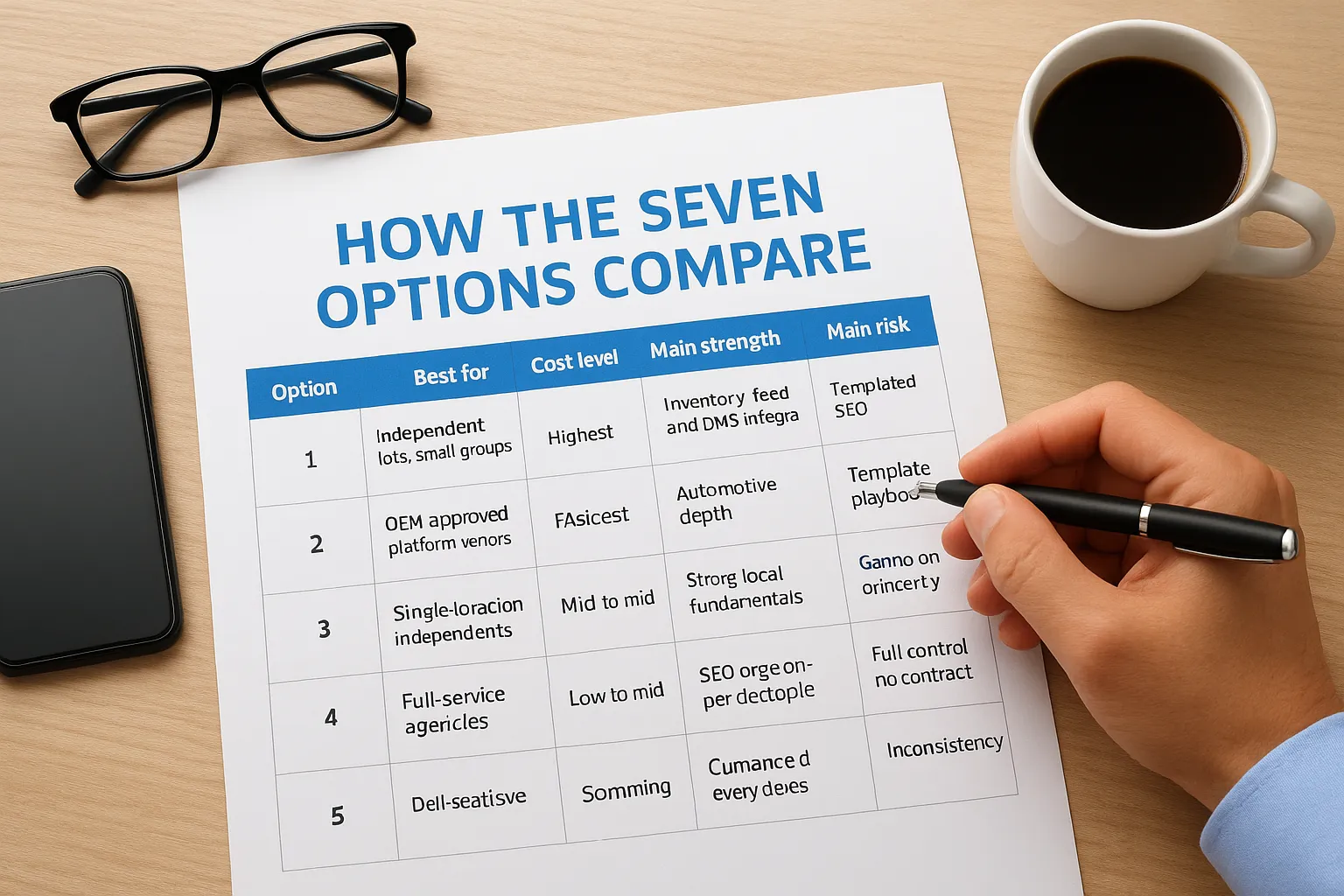
The table below summarizes who each option fits and where it tends to go wrong. Cost levels are general tendencies, not quotes. Only Web Solutions CA's starting prices are published figures. For everything else, request written quotes.
| Option | Best for | Cost level | Main strength | Main risk |
|---|---|---|---|---|
| 1. Web Solutions CA | Independent lots, small groups, Orange County | SEO from $499.99/mo, site from $299.99 | Web, SEO, ads, and automation from one team | Not a dealer-only platform |
| 2. OEM-approved platform vendors | Franchise stores, large groups | Highest | Inventory feed and DMS integration | Templated SEO, ownership questions |
| 3. Dealer-specialist agencies | Groups, competitive metros | Mid to premium | Automotive depth | Template playbooks |
| 4. Local SEO agencies | Single-location independents | Low to mid | Strong local fundamentals | Gaps on inventory details |
| 5. Full-service agencies | Owners who want one vendor | Mid to high, plus ad spend | Channels working together | SEO treated as an add-on |
| 6. Freelance consultants | Budget-minded independents | Low to mid | Direct access to the expert | Capacity and continuity |
| 7. DIY plus a cleanup | Very small lots | Mostly your time | Full control, no contract | Inconsistency |
Match the option to your dealership
Start with how many rooftops you run and whether you control your own website. That decides more than budget. Then check how much time you can give the effort each week.
- Franchise store on a mandated platform: Option 2, often combined with a dealer-specialist agency for SEO.
- Multi-rooftop independent group: Option 3 for consistency across locations.
- Single-lot independent in a competitive area: Option 1 or 4, with a clear scope and monthly reporting.
- Dealer who wants ads and SEO handled together: Option 5, or Option 1 with paid ads added.
- New or very small lot: Option 7 first, with Option 6 for a one-time audit.
Your site control and rooftop count narrow the field faster than price does.
How to vet a car dealer SEO provider before you sign
Questions to ask on the first call

Good providers answer specific questions with specific work. Vague answers about "optimization" are your cue to keep looking. Ask these on every call:
- What will you do in the first 30 days, and what will you do every month after?
- Which of your clients are dealerships, and can you show Search Console results for one?
- How do you handle sold-vehicle pages and duplicate manufacturer descriptions?
- How will you build local links, and which sources do you use?
- Which reports will I get, and do they include calls and lead forms?
- Who owns the domain, Google Business Profile, Search Console, and analytics?
Ask the same questions of every vendor. Compare the answers side by side, not by who sounds most confident.
Red flags
Several warning signs show up repeatedly in poor dealer SEO pitches. A guaranteed number one ranking is the clearest. Google's own guidance on choosing an SEO provider says no one can guarantee a top spot.
Other red flags:
- The plan consists only of directory submissions
- A pitch built around ranking individual vehicles that will sell within weeks
- Blog articles offered as the whole strategy, with no local or service pages
- No access for you to your own accounts
- Vague reports that show rankings but not calls, directions, or leads
What a good monthly report shows
A useful report connects the work to money. It should show calls and direction requests from your Google Business Profile, form leads from the site, and clicks from non-branded searches. It should also say what the provider did that month and what comes next.
Pay attention to the split between branded and non-branded clicks in Search Console. Many dealers find most of their traffic comes from people who already know the name. Growth in non-branded clicks is the clearer sign that SEO is working.
A report that cannot tie work to calls and leads is a status update, not proof.
What results to expect from car dealer SEO services
How long it takes
Profile and listing fixes can show effects first, often within weeks to a few months. Website and content work takes longer, so plan for at least six months before judging the whole effort. Competitive metros take longer than small markets.
Treat any timeline as a range, not a promise. A provider who gives you an exact date for page one is guessing.
Which numbers to track
Track outcomes that connect to sales, not just positions. Pull them monthly, from the same sources, so you can compare month to month.
- Phone calls from your Google Business Profile
- Direction requests
- Lead form submissions and chat inquiries
- Non-branded clicks and impressions in Search Console
- Views of vehicle detail, finance, and service pages
Rankings are a useful side metric. They are not the goal.
Is SEO still worth it in 2026
For most dealers, yes. Buyers still research before they visit, and AI answers and map results pull from the same sources: your Google profile, reviews, and site content. Consistent listings and strong reviews help in both.
SEO also builds something you own. Paid listing platforms stop sending leads when you stop paying, while a well-built site and profile keep working. The catch is patience, which is why SEO suits dealers who commit for months, not weeks.
Pick the provider that fits your lot
The right choice depends on your size, your website, and your time. Franchise stores lean toward platform vendors, groups toward specialists, and tiny lots toward DIY with a cleanup. Whichever you choose, insist on named deliverables, ownership of your accounts, and reports that show calls and leads.
If you run an independent lot in Orange County or nearby and want one team for the site, the profile, and the ongoing SEO, talk to Web Solutions CA's Orange County SEO team about your dealership. Bring your current site and Google profile, and ask for a plain list of what should be fixed first.