The best Moz Local alternatives are BrightLocal, Whitespark, Yext, Semrush Local, SE Ranking, and Local Falcon, plus a free manual route through Google, Bing, and Apple. BrightLocal fits agencies and owners who want audits, citations, and rank tracking in one place. Whitespark fits people who care most about citation quality. Yext fits large multi-location brands. Semrush Local and SE Ranking fit teams that already pay for an SEO suite. Local Falcon fits anyone who needs Google Maps rank data. If you would rather not run a tool at all, Web Solutions CA does the work for you.
Moz Local solves a real problem. Wrong phone numbers and old addresses on directories cost you calls and trust. But it is a paid subscription tied to each location, it focuses on listings more than rankings, and it does not suit every budget or business size. This article compares eight options on what they do, who they suit, and what they cost.
We run local SEO for small businesses in Orange County, California. We regularly find the same listing problems, from a forgotten suite number to a duplicate profile left behind by a previous owner. The advice below comes from fixing those problems.
What to look for in a Moz Local alternative
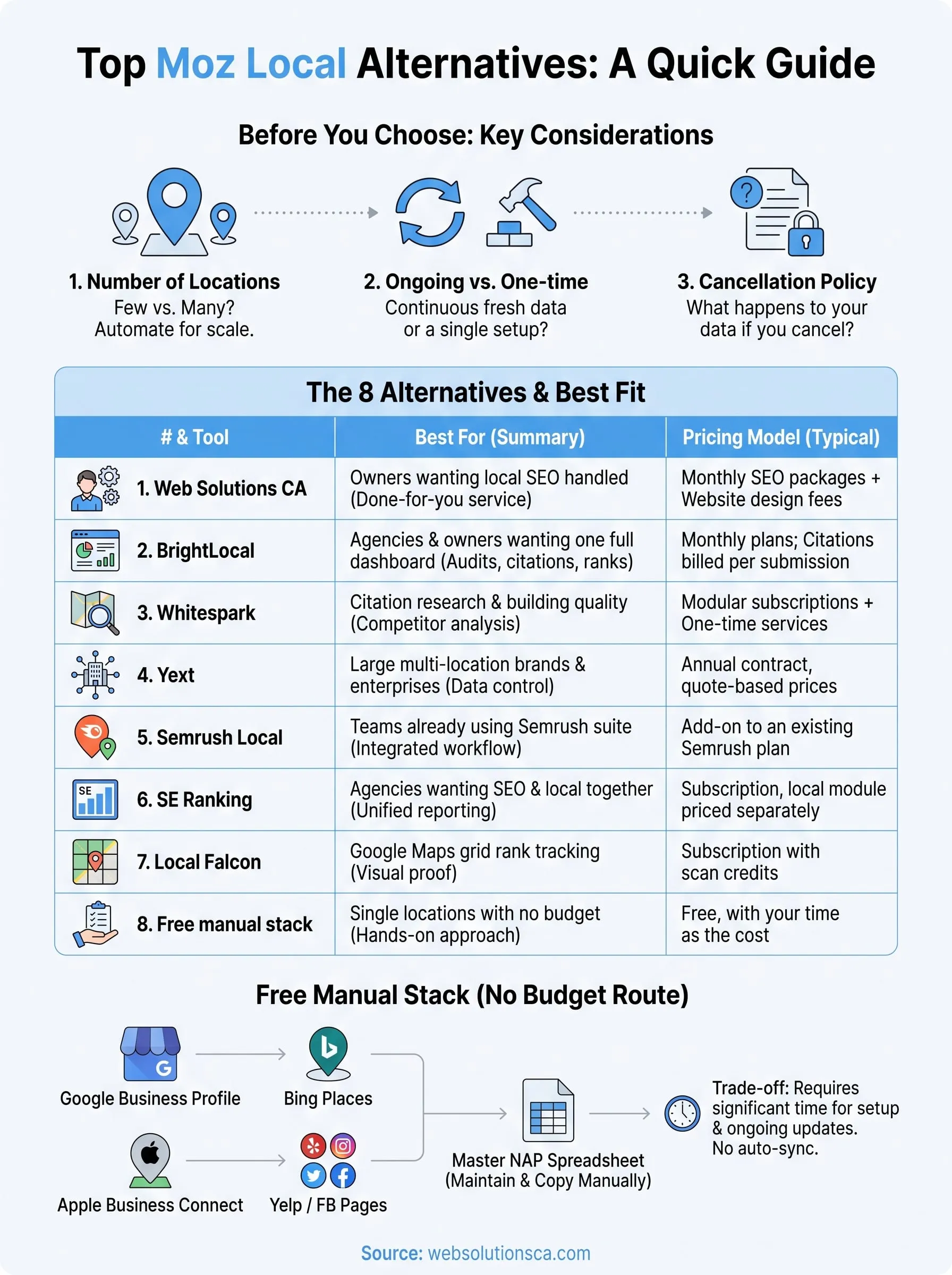
The right Moz Local alternative matches your number of locations, your budget, and how much work you want to hand off. Settle those three things first, then compare features.
What Moz Local does and what you need to replace
Moz Local pushes your business name, address, and phone number (NAP) to directories and search engines, then keeps them in sync. It also flags duplicates and supports reviews and posting. That is a listing management job, so the core thing to replace is automated sync and cleanup.
Is it worth it? For a business with several locations that changes hours or numbers often, yes, because automatic updates save real hours. For a single location that rarely changes, you can do the same work by hand for free, and a paid subscription is hard to justify. Moz Local is priced per location, so the cost grows with every address you add.
Pay for automation only when your location count or rate of change makes manual updates a chore.
Five questions that narrow the list
Answer these before you open a single pricing page:
- How many locations do you manage? One location rarely needs enterprise software. Twenty usually do.
- Do you want ongoing sync or a one-time build? Subscriptions keep data fresh. One-time citation builds cost less over time but need rechecking.
- What happens to your listings if you cancel? Ask the vendor in writing before you pay.
- Do you need rank tracking? Listing tools and map-ranking tools solve different problems.
- Who will do the work? Software only helps if someone logs in and acts on what it finds.
Questions two and three cause the most regret. Owners often learn what happens at cancellation only after they cancel, and a subscription-based listing may then lapse or revert to old data.
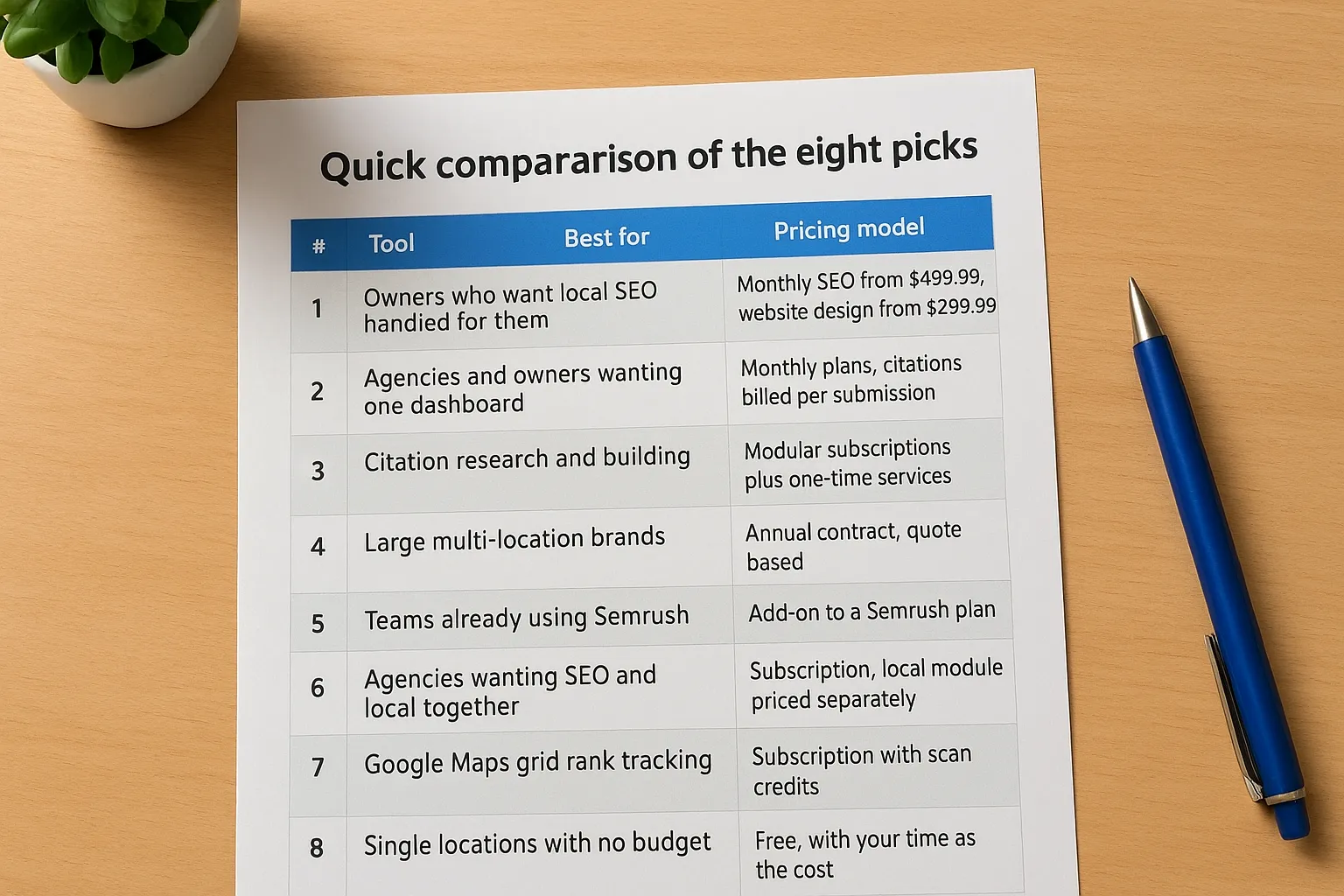
Quick comparison of the eight picks
The table below sets the picks side by side. The pricing model column shows how each vendor typically charges, so confirm current rates on the vendor's site before you buy.
| # | Tool | Best for | Pricing model |
|---|---|---|---|
| 1 | Web Solutions CA | Owners who want local SEO handled for them | Monthly SEO from $499.99, website design from $299.99 |
| 2 | BrightLocal | Agencies and owners wanting one dashboard | Monthly plans, citations billed per submission |
| 3 | Whitespark | Citation research and building | Modular subscriptions plus one-time services |
| 4 | Yext | Large multi-location brands | Annual contract, quote based |
| 5 | Semrush Local | Teams already using Semrush | Add-on to a Semrush plan |
| 6 | SE Ranking | Agencies wanting SEO and local together | Subscription, local module priced separately |
| 7 | Local Falcon | Google Maps grid rank tracking | Subscription with scan credits |
| 8 | Free manual stack | Single locations with no budget | Free, with your time as the cost |
1. Web Solutions CA
Web Solutions CA is the done-for-you Moz Local alternative. You hand off the listing work, and we handle it alongside the rest of your local visibility.
What you get
Our monthly SEO service covers keyword research, on-page optimization, Google Business Profile optimization, technical SEO fixes, and local citation support. You also get monthly reporting, so you see what changed and what it did for your calls and traffic.
That replaces the listing work Moz Local automates. It also covers what a listing tool never touches, such as the website those listings point to. If a directory links to a slow, outdated page, accurate NAP data only does half the job. We work in four steps: understand the business, plan for conversions, design, develop, and launch, then measure and improve.
A listing tool distributes your data, but a local SEO partner makes sure your listings, profile, and website all tell the same story.
Who it suits
This option suits small businesses, local service providers, and startups that lack the time or in-house expertise to run listing software. Most of our clients are in Orange County, including Costa Mesa, Irvine, Santa Ana, Newport Beach, Huntington Beach, Anaheim, Orange, Tustin, Fountain Valley, Garden Grove, Mission Viejo, and Laguna Beach. We also work with clients elsewhere.
It fits best when you are unsure where to start. Many owners we meet do not know whether they need a new website, better listings, or ads first. We sort that out with you and build a plan around your budget instead of selling a fixed package.
Cost and trade-offs
Monthly SEO starts at $499.99, and website design starts at $299.99. Custom packages can combine web, SEO, ads, and automation for lead handling. We respond within 24 hours.
The trade-off is plain. This is a service, not a software login, so it costs more per month than a $39 tool. It also does not make sense for a business that wants to manage hundreds of locations itself. If you enjoy hands-on tools, one of the platforms below is a better match.
2. BrightLocal
BrightLocal is the most common pick for people who want a full local SEO dashboard instead of listing sync alone.
What you get
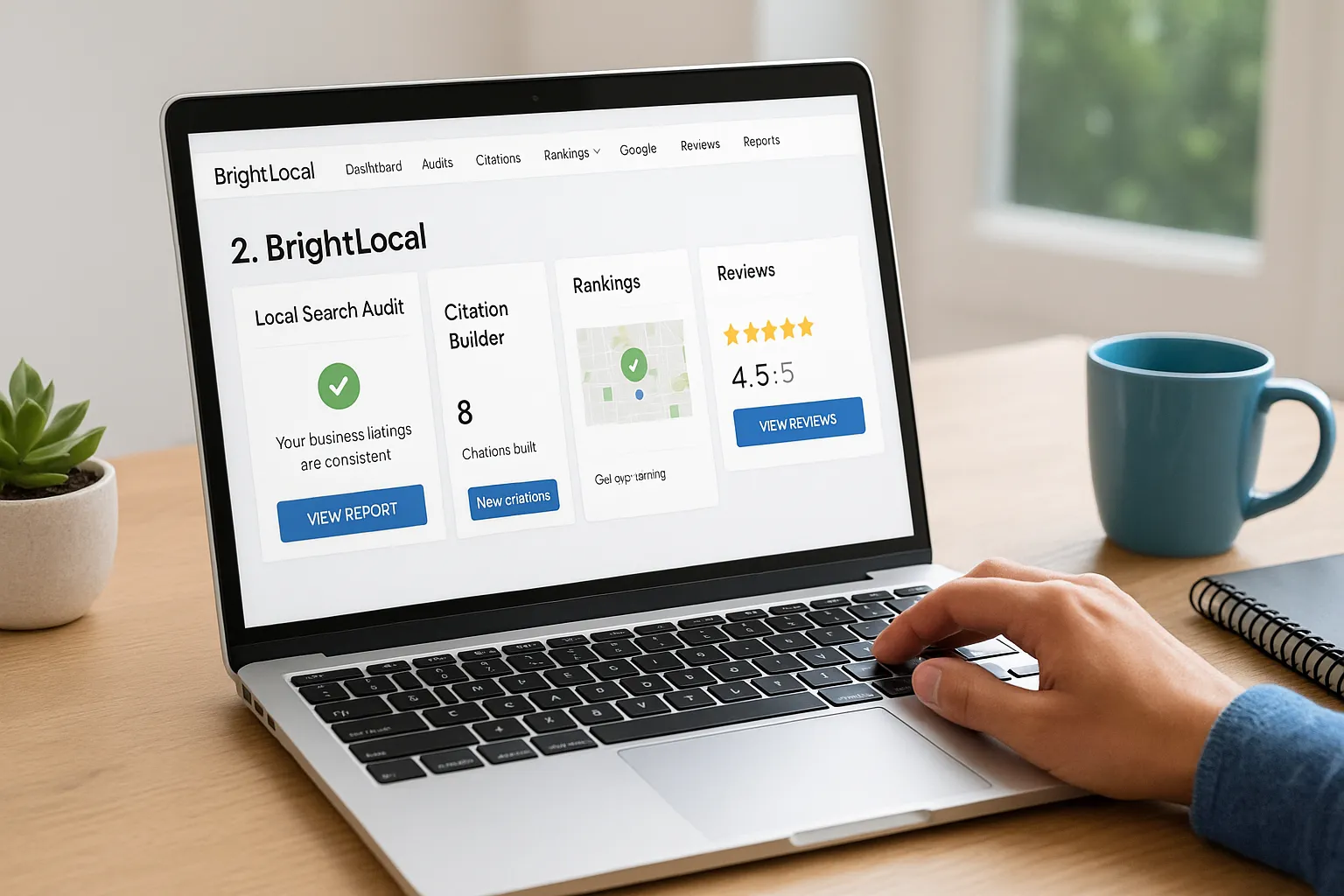
BrightLocal is built around audits, citations, rank tracking, and review monitoring. Its Local Search Audit checks how consistent your listings are. Its Citation Builder submits your business to directories for a fee per citation.
The rank tracker follows your positions in local results, including a grid view of map rankings across your service area. As a Moz Local alternative, it covers far more of the local SEO picture than a pure listing tool does.
Who it suits
BrightLocal suits agencies, freelancers, and owners who want audits, citations, rankings, and reports in one place. Agencies get white-label reporting for client work, which saves hours each month.
Among working local SEOs, BrightLocal and Whitespark are the two names that come up first. If you want one login for most local tasks, BrightLocal is the stronger of the two.
BrightLocal is the closest single-dashboard match when you want more than listing sync.
Cost and trade-offs
BrightLocal offers a 14-day free trial, and entry plans have started around $39 per month for one location. Citation Builder is billed separately per citation. Use the trial to run the audit on your main location, then compare the flagged mismatches against the errors you already know about.
The trade-offs are real. Citation Builder is a paid batch service, not an always-on sync, so you need to recheck listings later. The dashboard feels dense to first-time users, and costs rise as you add locations and tracked keywords.
3. Whitespark
Whitespark is the best Moz Local alternative when citation quality matters more than automation.
What you get
Whitespark is known for its Local Citation Finder, which shows where your top-ranking competitors are listed so you can copy the sources that matter. It also offers a local rank tracker, a citation building service, and review tools.
Its citation sources go well beyond the United States, with lists for the UK, Canada, Germany, France, Singapore, South Africa, Brazil, and more. That helps if you serve customers across borders. It also offers free helpers, such as a Google review link generator that makes review requests easier to send.
Who it suits
Whitespark suits SEOs and agencies that want to choose each citation on purpose. It also suits owners who prefer a one-time citation build over a subscription.
Whitespark gives you the research to decide which listings matter, not just a feed that pushes your data everywhere.
If you work in a competitive niche, such as home services or legal, the competitor-based research is where it earns its fee. You find the directories your rivals rely on and match them.
Cost and trade-offs
Pricing is modular. Citation Finder subscriptions have started around $33 per month and rank tracking around $14 per month, while building services are priced as one-time packages. You pay only for the pieces you use.
The trade-off is that Whitespark is not an automated listing sync. You or your team act on what it finds. Because the products are separate, you also lose the single-dashboard feel that BrightLocal offers. Beginners may need a short learning period.
4. Yext
Yext is the enterprise-grade Moz Local alternative, and it is built for brands with many locations and a real budget.
What you get
Yext syndicates your location data through a large network of publishers, including maps, search engines, and directories. Beyond listings, it offers review management, location pages, search features, and analytics. Changes you make in one place roll out to every connected site.
For a chain with fifty locations, that control matters. One edit to holiday hours updates every listing at once. For a single-location shop, it is more platform than you need.
Who it suits
Yext suits multi-location brands, franchises, and enterprise marketing teams that need strict data control and reporting across many sites. It is not a natural fit for a small business with one or two addresses.
If you manage fewer than ten locations, Yext is usually more platform than you need.
Cost and trade-offs
Yext is quote based and sold on an annual commitment, with cost depending on the package and the number of locations. You will pay more than for most tools on this list, so get a written quote before you compare.
The key trade-off is ownership. Yext delivers your data through its publisher network, so listings are generally tied to an active subscription. Some users report that listings change or disappear after cancellation. Ask directly what happens to your data if you leave, and get the answer in writing.
5. Semrush Local
Semrush Local is the natural Moz Local alternative if you already use Semrush for keyword research and site audits.
What you get
Semrush Local adds listing management, map rank tracking, and review management to the Semrush platform. You can distribute your business data to directories, track how you rank on maps, and respond to reviews without leaving your existing account.
The benefit is a single login. Your keyword data, site audits, and local data sit side by side. For a marketer who already lives in Semrush, that beats learning a separate local tool.
Who it suits
Semrush Local suits in-house marketers, agencies, and consultants who already pay for Semrush and want local work handled in one place. It is less attractive if you would be buying Semrush only for the local features.
Semrush Local makes sense when you already live in Semrush, and costs more than it should when you do not.
Cost and trade-offs
Semrush Local is bought as an add-on to a Semrush plan, and its price depends on how many locations you manage. That means your total bill is the Semrush subscription plus the local add-on, which can be far higher than a stand-alone local tool.
Plan for a learning curve too. Semrush has many tools, and first-time users can find the interface overwhelming. If you only need to fix listings for one or two locations, a lighter option or the free manual route will do the same job for less.
6. SE Ranking
SE Ranking is a strong Moz Local alternative for agencies and small teams that want general SEO and local marketing under one account.
What you get
SE Ranking pairs its core SEO tools with a local marketing module. The module covers Google Business Profile management, listings management, review handling, and local rank tracking. Core features include keyword tracking, site audits, and competitor research.
That combination suits agencies that handle both website SEO and local work for the same clients. Reports for both can come out of the same system, which reduces the time spent stitching data together.
Who it suits
SE Ranking suits agencies, freelancers, and small marketing teams with a mix of local and non-local clients. It also suits a business that wants one login for its own site SEO and its profile management.
SE Ranking works best when local is one job among several, not the only job.
Cost and trade-offs
SE Ranking offers a 14-day free trial. Core SEO plans have started around $65 per month, and the local module is priced separately, so total cost depends on how many locations you add.
The trade-off is depth. SE Ranking covers many tasks well, but it does not specialize in citations the way Whitespark does. Check how many directories the listing feature reaches in your country before you commit. Also confirm the exact plan limits, because project and keyword caps differ by tier.
7. Local Falcon
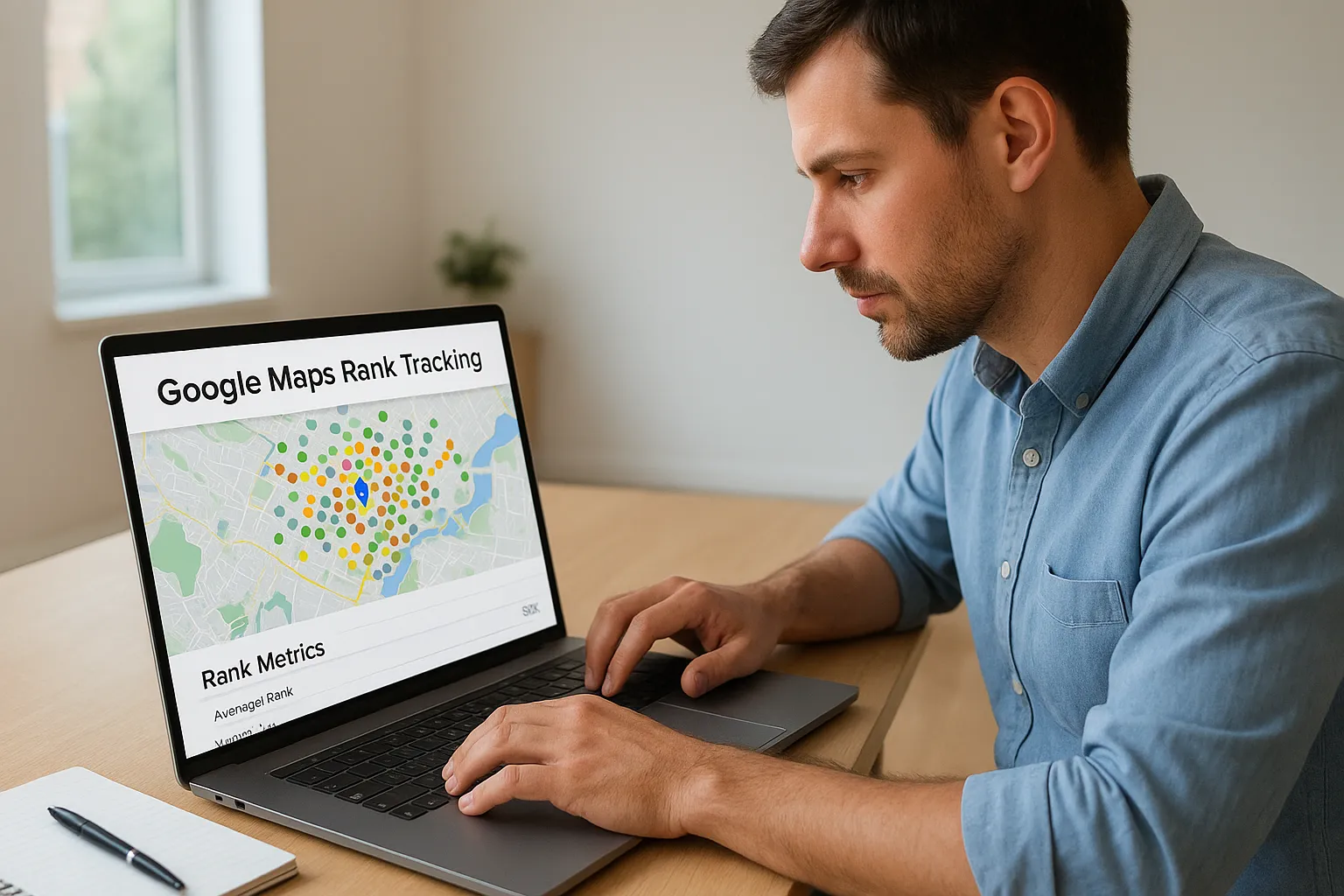
Local Falcon is a Moz Local alternative only in part. It does one job, Google Maps rank tracking, and does it well.
What you get
Local Falcon runs geo-grid scans. It checks where your business appears in Google Maps results from many points around your location, then shows the results on a map. You see exactly which streets and neighborhoods you win and which you lose.
It reports metrics such as average rank and share of local voice, so you can show progress over time. Scans can run on a schedule, which helps you spot a drop soon after it happens.
Who it suits
Local Falcon suits local SEOs and owners who want proof of map visibility. A plumber who ranks first at the shop but disappears two miles away needs this view, and a simple rank report will not show it.
Rankings are not one number in local search, and a grid shows what a single position hides.
Pair it with a listing tool or a free manual routine, since it does not manage listings, citations, or reviews.
Cost and trade-offs
Local Falcon is sold as a subscription with scan credits. Bigger grids and more keywords use more credits, so the cost depends on how often you scan and how large your service area is.
The trade-off is scope. It will not fix a wrong phone number or build a citation. Treat it as the measurement layer on top of the other work, and start with a small grid on your most important keyword to keep credit use down.
8. Free manual stack
The best free Moz Local alternative is a manual routine built on the free profiles each major platform gives you.
What you get
Claim and complete these free listings yourself:
- Google Business Profile, the most important listing for local search.
- Bing Places for Business, which can import your data from Google.
- Apple Business Connect, which controls how you appear in Apple Maps.
- Yelp and your Facebook page, with the same NAP as everywhere else.
Keep one spreadsheet with your exact business name, address, phone number, website, and hours. Copy from it every time, so nothing drifts. Data aggregators such as Data Axle and Foursquare feed many smaller directories, so check your information there too.
Who it suits
This route suits a single-location business with stable details and no budget for software. It also suits a new business that wants to learn how listings work before paying for automation.
It pays to be thorough. Search your phone number and any old addresses in Google. Duplicate or outdated listings often show up within minutes, and a free Moz Local alternative only works if you remove them.
Cost and trade-offs
The listings are free, and your time is the cost. Plan on one setup session of a few hours, then a recheck every quarter or whenever something changes, such as hours, a move, or a new number.
Free tools work for one stable location, and they stop working the moment you add a second.
The trade-off is that nothing syncs automatically. If you move, rebrand, or open a new location, you must update every profile by hand. At that point, paying for one of the tools above starts to look cheap.
Picking the right fit
For one location with stable details, start with the free routine. For several locations, compare BrightLocal, Whitespark, and the suite add-ons against your budget. For large brands, look at Yext. Add Local Falcon when you need map-ranking proof.
Whichever you choose, ask what happens to your listings if you stop paying, and keep your NAP data in one master sheet.
If you would rather skip the software and get a plan built for your business, talk to Web Solutions CA about local SEO for your Orange County business. We will tell you honestly whether you need a service, a tool, or just an afternoon with the free profiles.