

You know your business deserves to rank higher on Google, but three competitors keep showing up above you in the local pack. That's frustrating when you're doing everything you think you should be doing. A local SEO competitor analysis shows you exactly what those businesses are doing that you aren't, so you stop guessing and start closing the gap.
This guide walks you through competitor analysis local seo step by step: how to find your real local competitors (not just the biggest names in your industry), what to look at in their Google Business Profile, website, reviews, and backlinks, and which free and paid tools make the process faster. You'll also get a simple template you can reuse every quarter to track what's changing.
We run this exact process for small businesses across Orange County at Web Solutions CA, and it's usually the fastest way to find quick wins in local rankings. By the end, you'll have a clear, repeatable method for spotting ranking opportunities and building a plan that actually moves your business up in local search results.
What is a local SEO competitor analysis?
A local SEO competitor analysis is the process of studying the businesses that outrank you in Google's local pack, map results, and organic listings for your city or service area, then reverse-engineering why. Instead of guessing why a plumber three miles away shows up above you for "emergency plumber Costa Mesa," you pull apart their Google Business Profile, their website, their reviews, and their backlinks to find the specific factors giving them the edge. It's not about admiring their branding or copying their homepage design. It's about finding measurable gaps you can close.
Understanding how this differs from a generic competitor analysis matters, because most business owners default to comparing themselves against whoever they consider their "real" competition, usually the biggest or most established name in their industry. Local search doesn't work that way. Google ranks businesses for local intent based on proximity, relevance, and prominence, according to its own guidance on how local results are determined. That means a two-person landscaping crew with 80 five-star reviews and a tight service radius can easily outrank a 20-person company with a bigger reputation but a thin Google Business Profile. Your real competitors are whoever occupies the map pack and top organic spots for your target keywords in your actual service area, not necessarily the companies you think of as rivals.
Your local SEO competitors aren't the businesses you compete with for customers. They're the businesses that show up ahead of you on Google.
What you're actually comparing
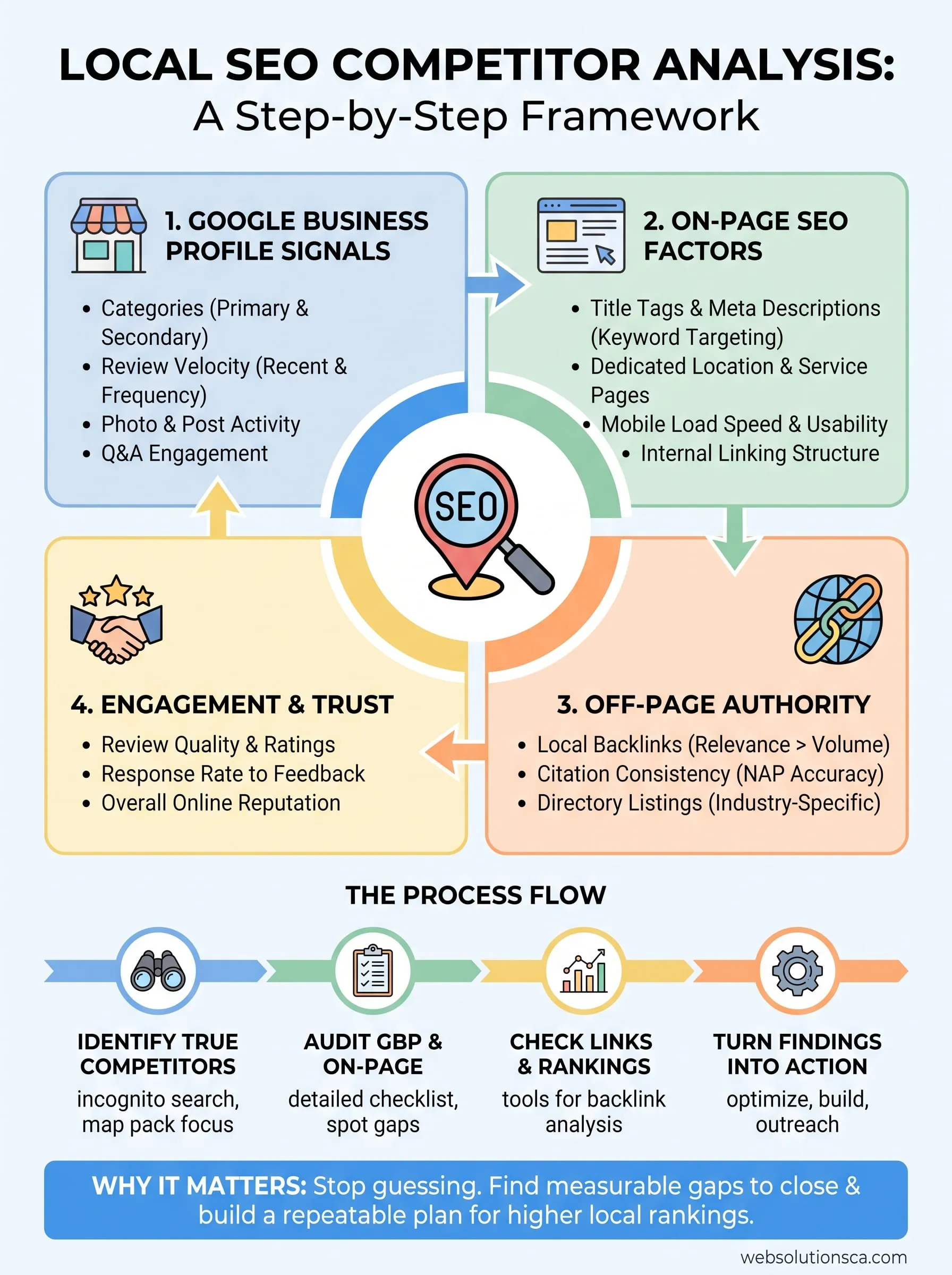
A thorough analysis looks at four categories side by side. Each one maps to the signals behind local pack rankings and tells you something different about why a competitor ranks where they do:
- Google Business Profile signals: category selection, review count and velocity, photos, posts, and Q&A activity
- On-page SEO: title tags, service pages, location pages, and how well the site matches search intent
- Off-page authority: backlinks, local citations, and directory listings
- Engagement and trust: review quality, response rate, and overall reputation across platforms
Running through all four gives you a full picture instead of a partial one. A competitor might win on reviews but be weak on backlinks, which tells you exactly where your opportunity sits.
Why it matters for small businesses
Small businesses often skip this step entirely and jump straight into "more SEO" without knowing what's actually working for the businesses beating them. That's expensive guesswork. A competitor analysis local seo approach flips that around: you spend your limited time and budget fixing the specific gaps that are costing you rankings, rather than chasing generic best practices that may not move the needle in your market. If three competitors all have 150+ reviews and you have 12, you know exactly where to focus first. If none of them have optimized location pages, that's a wide-open opportunity sitting in plain sight.
Treat this analysis as a recurring habit, not a one-time project, and pair it with a step-by-step local SEO audit of your own site. Local rankings shift as competitors add reviews, build links, or refresh their sites, so revisiting your findings every few months keeps your strategy current instead of reacting to changes after you've already lost ground.
Step 1. Identify your true local competitors
Start by opening an incognito browser window and searching Google for the exact terms your customers use, like "HVAC repair Irvine" or "family lawyer near me." Skip your own saved location and browsing history so you see what a first-time searcher sees. Screenshot the three businesses in the local map pack and the top five organic results below it. Those are your real competitors, not the biggest names in your industry.
Google Maps gives you a second angle, and it's where proven Google Maps SEO strategies show their results most clearly. Search your core service terms directly in Maps and note which businesses appear closest to your service area, since proximity carries real weight in local rankings. Repeat this search from a few different neighborhoods if you serve a wide area, because the map pack often changes block by block. A business that dominates results near the beach might barely show up ten miles inland.
Your competitor list should come from search results, not from your own assumptions about who you compete with.
Build a shortlist you can track
Once you've run these searches for your top five to ten keywords, you'll start seeing the same names repeat. Those repeat names are your priority list. Aim for five to eight competitors total, since tracking more than that gets unwieldy and dilutes your focus.
A simple spreadsheet works fine here. Track:
| Competitor | Keywords they rank for | Map pack or organic | Notes |
|---|---|---|---|
| Business A | "emergency plumber Santa Ana" | Map pack | 210 reviews, 4.9 stars |
| Business B | "plumber near me," "drain cleaning" | Organic #2 | Strong blog content |
| Business C | "24 hour plumber" | Map pack | New listing, fast growth |
Refreshing this list every quarter matters because local rankings shift constantly. A competitor that barely registered six months ago might now own the top spot after a review push or a site redesign. Set a recurring reminder so this step doesn't quietly fall off your to-do list.
Step 2. Audit competitors' Google Business Profiles
Open each competitor's Google Business Profile directly from the map pack and work through it like a checklist, not a casual glance, using the same standards you'd apply when mastering profile optimization for your own listing. This single profile often explains more about local rankings than anything else on their website, since Google leans heavily on it for local pack placement. Pay attention to the primary and secondary categories they've chosen, because a plumber listed under "emergency plumber" instead of just "plumber" is telling Google exactly what searches to show up for.
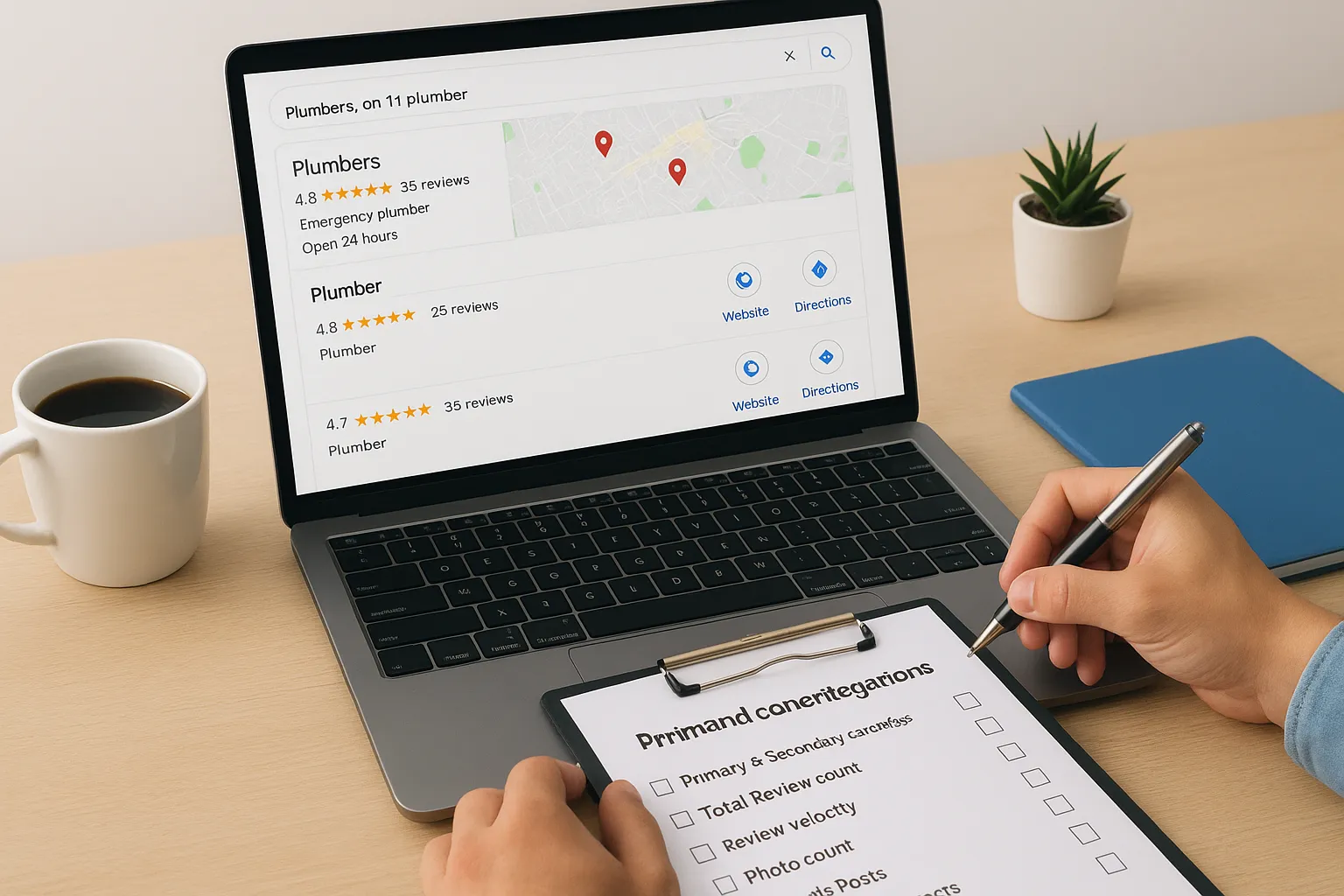
Next, count their reviews and check the dates. A business with 40 reviews spread over three years is a different story than one with 40 reviews collected in the last two months. Recent review velocity signals active engagement to Google, and it's often the fastest lever a competitor pulled to climb the map pack.
A competitor with fewer total reviews but faster recent review velocity is often winning the local pack right now, not because of history, but because of momentum.
What to record for each competitor
Build out a simple tracking sheet so you're comparing the same data points across every business on your list:
- Primary and secondary categories selected
- Total review count and average star rating
- Review velocity: reviews added in the last 30, 60, and 90 days
- Photo count and how recently new photos were added
- Google Posts activity, including frequency and topics
- Q&A section activity and whether the business answers questions
- Business description keywords and services listed
- Response rate to reviews, especially negative ones
Running this list side by side usually exposes a pattern fast. If every competitor beating you posts weekly updates and answers every review within 24 hours, you've found a gap that costs nothing but time to close.
Look for gaps you can exploit
Spotting weak categories matters just as much as spotting strengths. If a competitor's profile is thin on photos or hasn't posted anything in months, that's an opening. Google's own guidance on improving local ranking confirms that complete, active profiles get preference over neglected ones. Treat every gap you find here as a specific, actionable item for your own profile rather than a vague note to "do better."
Step 3. Analyze their website and on-page SEO
Pull up each competitor's homepage and their top service pages, then check whether the page actually targets the keyword it's ranking for. Look at the title tag and H1 first, since a page titled "Emergency Plumber in Santa Ana, CA" is doing more work than a generic "Plumbing Services" page. Check whether they have a dedicated location page for each city they serve, or if they're relying on one thin service area page to cover an entire county. This is usually where the biggest gaps show up, because plenty of local businesses still haven't built out location-specific pages at all.
Speed and mobile usability matter too. Run each competitor's site through Google's PageSpeed Insights and note their mobile score, since most local searches happen on a phone. A competitor with a slow, cluttered site that still outranks you is usually winning on Google Business Profile strength or backlinks instead, which tells you where to focus your own effort.
If a competitor's website is slow and thin but still outranks you, the win is happening somewhere else, usually their profile or their links.
What to check on every competitor page
Go through the same checklist for each business so you're comparing apples to apples:
- Title tags and meta descriptions for target keywords and city names
- Location pages for each service area, not just one general page
- Service pages that match specific searches like "drain cleaning" versus a single "our services" page
- Internal linking between service pages, location pages, and blog content
- Schema markup for local business, reviews, and services (view page source or use a schema checker)
- Mobile load speed and overall usability
Spotting the content gap
Notice which topics competitors cover that you don't. If three of your five competitors have blog posts answering "how much does emergency plumbing cost in Orange County," that's a signal Google rewards that kind of content for your market. Building the page they're missing, rather than copying the one they already have, is usually the faster path to outranking them.
Step 4. Check backlinks, citations, and rankings
Backlinks and local citations are the off-page half of the equation, and they're harder to fake than a Google Business Profile. Run each competitor's domain through a free tool like [Ahrefs' Backlink Checker](https://ahrefs.com/backlink-checker) or Moz's Link Explorer to see their total referring domains and where those links come from. Pay attention to whether the links are local (a chamber of commerce, a local news mention, a sponsorship page) or generic directory spam, because local relevance carries more weight than raw volume, and those same sources are the ones worth targeting in your own local link outreach.

A competitor with 30 locally relevant backlinks usually outranks one with 300 generic directory links.
Citations deserve the same scrutiny, so it helps to know what local citations are and how to build them before you compare listings. Check whether competitors show up consistently on Yelp, Angi, the Better Business Bureau, and industry-specific directories, and whether their name, address, and phone number match exactly across every listing. Inconsistent NAP data confuses Google and quietly costs businesses rankings, so a competitor with clean, matching citations everywhere has an advantage that's easy to overlook.
Build a comparison table
Track these numbers side by side for every competitor on your shortlist:
| Competitor | Referring domains | Top link sources | Citation consistency | Ranking position |
|---|---|---|---|---|
| Business A | 45 | Local news, chamber | Consistent | Map pack #1 |
| Business B | 120 | Directories, blog mentions | Minor mismatches | Organic #3 |
| Business C | 18 | Sponsorships, partners | Consistent | Map pack #2 |
Track ranking movement over time
Set up rank tracking for your priority keywords using Google Search Console or one of the best local rank tracking tools, then log competitor positions monthly alongside your own. Watching the trend line, not just a single snapshot, shows you whether a competitor's backlink or citation work is actually translating into movement. If a competitor's rankings jump right after they earn a new local link, that's a repeatable pattern worth building into your own outreach efforts.
Turning your findings into local rankings
You now have a repeatable framework: find your real competitors, audit their Google Business Profile, pick apart their website, and check their backlinks and citations. The value isn't in the spreadsheet you build once. It's in revisiting it every quarter and acting on what changes. A local SEO competitor analysis only pays off when you turn the gaps you found into actual fixes: a rewritten title tag, a new location page, a review outreach push, a handful of local link requests.
Most small businesses have the time to run this process once, then never look at it again. That's exactly why competitors who stay consistent keep climbing. If you'd rather hand this off to someone who does it every week, see how our Orange County SEO services turn competitor research into a working monthly local SEO plan.