Your website gets traffic, but the phone doesn't ring and the contact form stays empty. That's the moment most Orange County business owners start searching for a conversion rate optimization consultant, someone who can figure out why visitors leave without booking, buying, or calling.
A conversion rate optimization expert studies how real users move through your site, tests changes to your layout, copy, and calls to action, then measures which version actually turns visitors into leads. Hiring one means you stop guessing at redesigns and start making decisions based on data, whether that's fixing a confusing checkout flow or a homepage that buries your phone number.
In this article, you'll learn exactly what a CRO consultant does day to day, the signs your site needs one, what to expect from pricing and process, and the questions to ask before you hire someone to work on your site. We'll also cover how CRO connects to the SEO and web design work already driving traffic to your pages, so you know how the pieces fit together.
Why a conversion rate optimization consultant matters
The gap between traffic and revenue

Most Orange County business owners chase more visitors before they fix what happens once those visitors arrive. You can double your ad spend or climb the Google rankings, but if only 1% of people who land on your site turn into a lead, you're paying for traffic that walks right back out the door. A conversion rate optimization consultant looks at that gap first, because getting more eyeballs on a broken funnel just wastes more money faster. This is the piece most DIY website owners never measure, and it explains why so many sites fail to turn visitors into customers even when traffic looks healthy, yet it's usually the cheapest problem to fix once someone actually looks at it.
Small percentage changes, big dollar swings
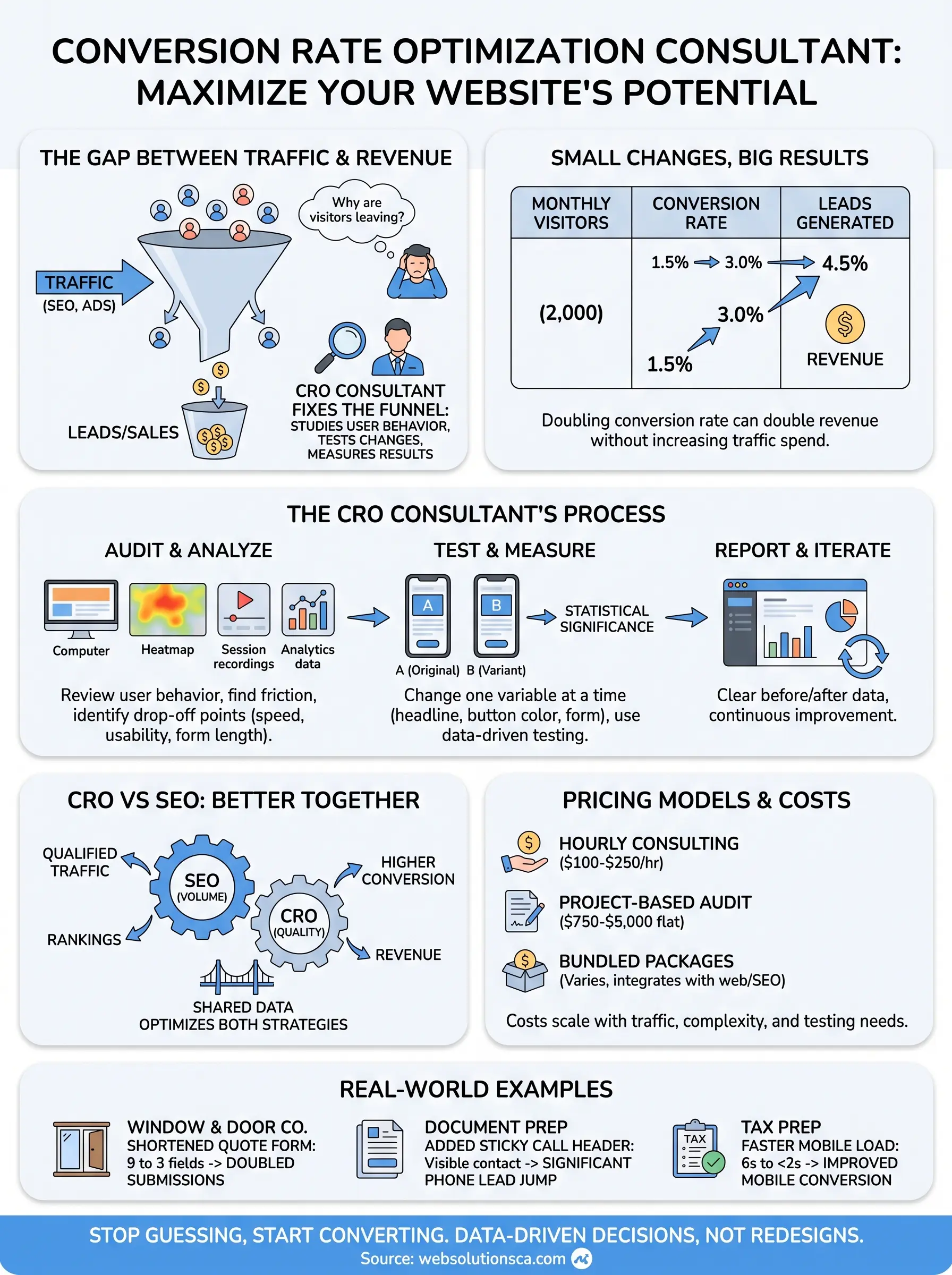
Small shifts in conversion rate produce outsized results because they multiply against traffic you're already paying for. Say your site gets 2,000 visitors a month and converts at 1.5%, that's 30 leads. Push that to 3%, a change that often comes from clearer calls to action and a faster page, not more traffic, and you've doubled your leads without spending another dollar on ads.
| Monthly Visitors | Conversion Rate | Leads Generated | Leads at $500 Avg. Sale Value |
|---|---|---|---|
| 2,000 | 1.5% | 30 | $15,000 |
| 2,000 | 3.0% | 60 | $30,000 |
| 2,000 | 4.5% | 90 | $45,000 |
Doubling your conversion rate can double your revenue without spending another dollar on traffic.
That table isn't hypothetical. It's the exact math a conversion rate optimization expert runs before recommending any change, because it tells you whether a redesign, a new headline, or a shorter form is worth the time it takes to build.
What happens when businesses skip CRO
Skipping this step usually means one of two things happens. Either you keep pouring money into SEO and ads while your leaky funnel absorbs the loss, or you eventually redesign the whole site based on a hunch instead of planning a redesign around conversion uplift, spend thousands of dollars, and end up with a site that looks nicer but converts about the same. Both paths burn budget that a small business can't easily replace. We've seen local service companies in Irvine and Santa Ana with beautiful, modern websites that generate almost no calls, simply because the phone number was buried in the footer or the contact form asked for too much information up front. Nobody tested it. Nobody measured it. It just looked fine to whoever built it.
Why guessing costs more than testing
Guessing feels faster than testing, which is exactly why so many small businesses fall into it. You change the homepage headline because it feels stale, swap a photo because a competitor's site looks sharper, or add a pop-up because you read it works. Without data-driven testing, you have no way to know if that change helped, hurt, or did nothing at all. A consultant replaces that guesswork with a repeatable process: watch how real visitors actually behave using tools for heatmaps and session recordings, form a hypothesis about what's blocking conversions, test one change at a time, and keep only what the data supports. Google's own research on page experience backs this up, showing that factors like load speed and mobile usability directly affect whether visitors stick around long enough to convert, which you can read more about in Google's guidance on page experience.
Why this matters more for small budgets
Budget-strapped businesses actually need CRO more than large companies do, not less. A national brand can afford to run ten campaigns and let the losers fail quietly. A local plumber or immigration consultant in Orange County usually has one website and one marketing budget, so every visitor who leaves without converting represents a real, countable loss. That's the case for treating conversion work as part of your core marketing plan alongside your website design and SEO strategy, not as an afterthought you get to once everything else is done.
How to hire a conversion rate optimization consultant
Finding the right person for this job means looking past a slick pitch, asking for proof of past results, and comparing the CRO consultants worth interviewing before you commit. Anyone can claim they improve conversion rates, but a real conversion rate optimization consultant should be able to walk you through a specific project: what the starting conversion rate was, what they changed, and what the number became after testing. If a candidate can't show you before-and-after data from actual client sites, treat that as a warning sign rather than an oversight.
Ask the right questions upfront
Before you sign anything, get clear on how the consultant actually works, because the process matters as much as the results they claim. Use this checklist during your first conversation:
- What tools do you use for heatmaps, session recordings, and A/B testing?
- How long does a typical test run before you call a winner?
- Will you set up conversion tracking and analytics, or do I need that in place first?
- Can I see a sample report from a past client?
- Do you work on the whole funnel, or just the landing page?
- How often will we talk, and what does that reporting look like?
Hire the consultant who shows you data from past projects, not the one who promises the best guess.
Good answers here reveal whether you're hiring a CRO expert with a repeatable system or someone who's going to eyeball your site and suggest a few tweaks.
Watch for red flags before you commit
Questionable consultants tend to share a few habits that should make you pause. They promise a specific conversion rate increase before ever looking at your analytics, they want to redesign your entire site instead of testing incremental changes, or they can't explain how they'll measure success beyond "it'll look better." Real CRO work is slower and more methodical than that, because testing takes time and small businesses can't afford to gamble their whole site on a hunch.
Match the consultant to your business size
Size matters when you're choosing who to hire. A large agency built for enterprise clients often applies the same playbook regardless of your traffic volume, which can waste your budget if you're a local service business getting a few hundred visitors a month. Look instead for someone used to working with small business budgets in your area, who understands that a plumber in Fountain Valley and a national retailer need very different testing plans. If you're already working with a team on your website design or SEO, or you're still choosing the best web designer in Orange County, ask whether conversion optimization can be folded into that same relationship instead of hiring a third party who doesn't know your site or your customers.
What a conversion rate optimization consultant does
A conversion rate optimization consultant spends most of their time watching, not designing. Before they change a single button or headline, they need to see how real visitors actually use your site, where they hesitate, and where they give up. That means the job looks less like graphic design and more like detective work, built on data instead of opinion.
Auditing your site before touching anything
Every engagement starts with a conversion audit, a deep look at your current funnel from the first click to the final form submission. The consultant reviews:
- Heatmaps showing where visitors click, scroll, and stop
- Session recordings of real visits, including the ones that end in nothing
- Analytics data on bounce rate, time on page, and drop-off points in your funnel
- Page speed and mobile usability, since a slow load kills conversions before anyone reads your headline
- Form length and friction, especially fields that ask for more than the visitor is ready to give
Google's own guidance on page experience confirms that speed and usability directly influence whether a visitor sticks around, which is why a competent consultant checks this before recommending anything cosmetic.
Testing one change at a time
Once the audit turns up likely problems, a conversion rate optimization expert builds a prioritized list of tests, ranked by how much traffic a page gets and how much revenue is riding on it. They change one variable at a time, a headline, a button color, a shorter form, and run it against the current version with real traffic until the results are statistically meaningful. Rushing this step is the most common mistake DIY businesses make, because calling a winner after three days of traffic tells you almost nothing.
A test that isn't measured is just a guess with extra steps.
High-quality testing also covers the parts of your site tied to lead generation directly, like designing a landing page that turns visitors into leads for your contact and quote-request forms, since those pages carry the most weight in whether a visitor becomes a customer.
Reporting and iterating
Finally, the consultant reports back with specifics: what changed, what the conversion rate did as a result, and what test comes next. Good reporting shows the before-and-after numbers plainly, not vague language about "improved engagement." Iteration never really stops, because visitor behavior shifts as your traffic sources, seasons, and offers change, so the winning version from six months ago might not be the winning version today.
CRO vs SEO: how they work together
SEO gets people to your site. CRO gets them to act once they're there. Confusing the two is one of the most common mistakes small business owners make, because a conversion rate optimization consultant and an SEO specialist are solving different problems even though they're both trying to grow revenue. Ranking on page one for "window replacement Irvine" means nothing if the visitors who click through can't find your quote form or bail before it loads.
Different goals, same funnel
Think of SEO as the top of the funnel and CRO as everything after the click. One brings volume, the other brings quality of outcome, and neither replaces the job the other one does.
| Focus Area | SEO | CRO |
|---|---|---|
| Primary goal | More qualified traffic | More conversions from existing traffic |
| Key metrics | Rankings, organic clicks, impressions | Conversion rate, form completions, calls |
| Typical tools | Keyword research, backlinks, Google Business Profile | Heatmaps, session recordings, A/B tests |
| Timeline to results | Weeks to months | Days to weeks per test |
| Common fix | Optimize content and technical structure | Rewrite headline, shorten form, fix CTA |
More traffic without better conversions just means more people leaving your site without buying.
Businesses that only invest in one side of this table tend to plateau, because you either have visitors with nowhere useful to land or a beautifully optimized page nobody finds.
Why the two teams should talk to each other
Working together, SEO and CRO data actually make each other's job easier. Whoever handles your SEO for local businesses knows which pages attract the most organic traffic and which search terms bring in the most qualified visitors, information a conversion rate optimization expert needs to prioritize which pages to test first. There's no point running a two-week test on a page that gets ten visitors a month when your top landing page gets a thousand. In return, CRO data tells your SEO team which pages actually convert once someone lands there, which helps decide where to invest more content and backlink effort.
What this looks like in practice
You don't need two separate vendors juggling two separate reports to make this work. At Web Solutions CA, our Orange County SEO and website design teams already share the same analytics and conversion tracking, so a CRO recommendation about a slow-loading service page gets flagged to the SEO side too, since Google's page experience signals reward the same fixes that help visitors convert. That overlap means fewer wasted hours and a site that both ranks and actually turns clicks into calls, rather than doing well on one measure while quietly failing the other.
How much conversion rate optimization services cost
Pricing for a conversion rate optimization consultant varies more than most small business owners expect, mostly because the work itself scales with how much traffic and complexity your site has. A local service business with a five-page site and a simple contact form pays far less than an ecommerce store running dozens of product pages and a multi-step checkout, where ecommerce conversion rate optimization tactics take more testing time. Knowing the typical ranges before you start shopping around keeps you from either overpaying for basic work or underbudgeting for a project that needs real testing time.
Common pricing models
Different consultants and agencies bill in different ways, and each model fits a different stage of business. Here's what you'll typically run into:
| Pricing Model | Typical Range | Best Fit |
|---|---|---|
| Hourly consulting | $100–$250/hour | One-time audits or specific fixes |
| Monthly retainer | $500–$3,000/month | Ongoing testing and reporting |
| Project-based audit | $750–$5,000 flat | Full site review before a redesign |
| Bundled with web/SEO services | Varies by package | Businesses wanting one team, one bill |
Smaller Orange County businesses usually do best with a monthly retainer or a bundled package, since a single audit without follow-up testing rarely produces lasting results.
What actually drives the price
Several factors push a quote higher or lower, and it helps to know which ones matter before you compare bids. Traffic volume matters because a conversion rate optimization expert needs enough visitors to reach statistically meaningful results in a reasonable timeframe. Site complexity matters too: a five-page service site takes less time to test than a store with a checkout flow and dozens of landing pages. The number of active tests running at once, whether tracking and analytics are already set up, and how often you want reporting all factor into the final number as well.
The right price isn't the lowest bid, it's the one tied to a testing plan you can actually see.
Why bundled pricing often makes more sense
Bundling conversion work with services you already need tends to save money over hiring a separate specialist for every function. Paying for a standalone CRO consultant on top of separate web design and SEO vendors means three invoices, three onboarding calls, and three people who don't talk to each other about your data. At Web Solutions CA, conversion optimization gets folded into our custom packages alongside website design, which starts at $299.99, and monthly SEO, starting at $499.99. Combining the work under one roof means the same team tracking your conversions is also the team building your pages and driving your traffic, so nothing gets lost translating findings from one vendor to another.
Examples of conversion rate optimization in action
Abstract advice only goes so far, so let's look at what a conversion rate optimization consultant actually changes on a real small business site and what happens to the numbers afterward. These examples reflect the kind of work we see across Orange County service businesses, from document prep shops to home improvement contractors, where small fixes moved the needle far more than a full redesign would have.
A window and door company's overloaded quote form
One local window and door company had a quote form asking for nine fields before a visitor could submit anything, including a dropdown for "preferred callback window" nobody wanted to fill out on a phone screen. A conversion rate optimization expert cut the form to three required fields (name, phone, project type) and moved the extra questions to a follow-up call. Visitors stopped abandoning the form halfway through, and submissions nearly doubled within a month of testing.
A homepage that buried the phone number
Another client, a document preparation service, had a clean, modern homepage that scrolled through four sections before showing a phone number or contact button. Session recordings showed visitors scrolling straight past the hero section looking for a way to call, then leaving when they didn't find one quickly. Adding a sticky header with a click-to-call button fixed it. That single change, tested against the old layout with real traffic, produced a jump in phone leads that no amount of extra SEO traffic would have matched on its own.
The fix that moves conversions is rarely the one that makes a site look flashier.
Mobile speed fixes for a tax preparation site
A tax preparation client's site looked fine on desktop but took over six seconds to load on mobile, where most of their seasonal traffic actually landed, a classic case of a slow site and the fixes it needs. Working through an image optimization checklist and removing unused scripts cut load time to under two seconds, and the mobile conversion rate rose noticeably without a single word of copy changing. This lines up with Google's own findings on how load speed affects whether visitors stick around long enough to convert, covered in its page experience guidance.
| Business Type | Change Made | Result |
|---|---|---|
| Window & door company | Shortened quote form from 9 to 3 fields | Submissions nearly doubled |
| Document prep service | Added sticky click-to-call header | Phone leads rose significantly |
| Tax preparation service | Cut mobile load time from 6s to under 2s | Mobile conversion rate improved |
None of these fixes required a full site rebuild. Each came from watching real visitor behavior first, then testing one targeted change, which is the whole point of hiring someone who treats conversion work as a discipline rather than a guess.
Moving forward with conversion optimization
Getting more visitors only pays off once your site actually turns them into leads. A conversion rate optimization consultant finds the friction points costing you calls and forms, then fixes them with tested changes instead of guesses. Whether that's shortening a quote form, moving your phone number above the fold, or speeding up mobile load times, the goal stays the same: turning the traffic you already have into revenue you can count.
Don't wait until you've spent another quarter on ads or SEO before you look at what happens after the click. Small businesses across Orange County lose leads every day to problems that take a week to test and fix. If you're ready to stop guessing and start measuring what actually converts, look at our Orange County web design built to generate leads and let's review your site together.