
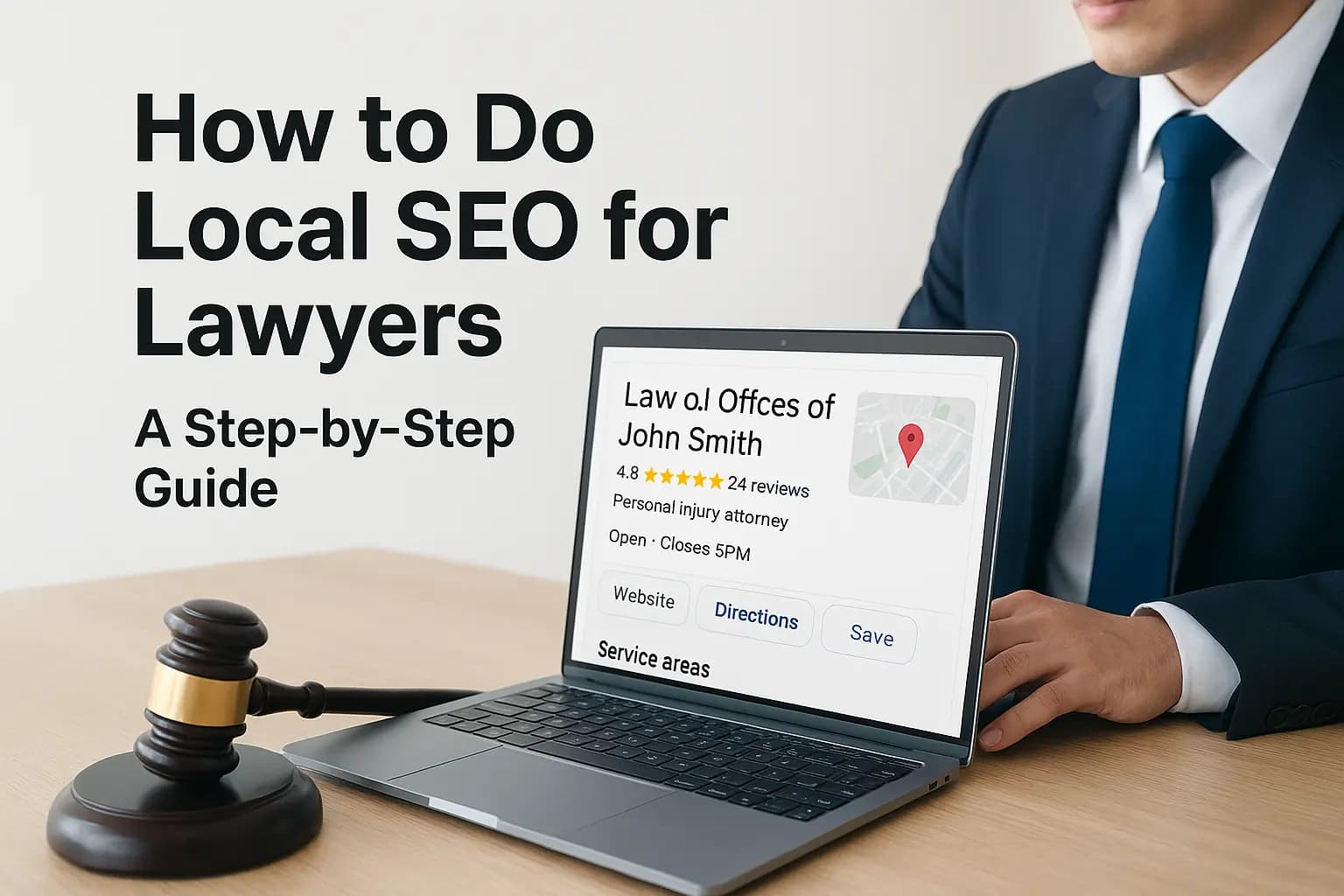
You know the client who searched "personal injury lawyer near me" at 11 p.m. and called the first firm that popped up on Google Maps, not the one with the fanciest website. That's the reality of local seo for lawyers right now. If your firm isn't showing up in the map pack for searches happening in your own city, you're handing cases to competitors who simply set up their listings correctly.
This guide gives you the exact steps to fix that, starting with your Google Business Profile and working through citations, reviews, and location pages that actually rank. No vague theory, just the moves that get a law firm's listing in front of people ready to hire.
We put this together from the same playbook we use for local service businesses across Orange County, from Costa Mesa to Irvine to Santa Ana. Whether you're a solo practitioner or run a multi-attorney firm, these local seo tips for lawyers are built to be done in order, so by the end you'll have a clear, prioritized checklist instead of another list of scattered ideas.
Why local SEO matters for your law firm
Most potential clients never scroll past the top of the results page. When someone types "divorce attorney near me" or "DUI lawyer [city]", Google shows a map pack of three firms above everything else, and that's where the clicks go, which is why earning a spot in Google Maps results matters so much. Studies on local search behavior consistently show the map pack and organic listings just below it capture the vast majority of clicks for these kinds of searches, while page two might as well not exist. If your firm isn't in that top cluster, you're not losing to a better lawyer, you're losing to a better-optimized listing.
The map pack decides who gets the call
Legal services are a classic "near me" category. Nobody searches for a personal injury attorney in another state, they want someone local who can meet in person, show up to court, and answer the phone today. That urgency means local seo for lawyers works differently than SEO for an ecommerce store or a national brand. You're not competing with every law firm in the country, you're competing with the dozen or so firms in your practice area within a 10 to 15 mile radius, and that's a fight you can actually win with the right setup.
If you're not in the map pack for your practice area, you're invisible to the client who's ready to hire right now.
Legal searches carry real financial and life stakes
Google treats legal topics as YMYL, meaning "your money or your life," and holds this content to a higher trust bar than a recipe blog or a product review. That's actually good news for a legitimate, established firm, because it means thin, spammy competitor sites have a harder time ranking. But it also means you can't skip the fundamentals: a real address, a bar-verified attorney name, accurate practice areas, and consistent business information across the web all matter more here than in most other industries. Google's own guidance on E-E-A-T, expertise, experience, authoritativeness, and trust, applies with extra weight to legal content, so cutting corners on your profile or your site copy costs you more than it would in a lower-stakes niche.
What's actually at stake, in numbers
| Factor | Why it matters for law firms |
|---|---|
| Map pack visibility | Captures the majority of clicks on "near me" and city-based legal searches |
| Review count and rating | Directly influences map pack ranking and click-through |
| NAP consistency | Mismatched name, address, or phone across directories erodes trust signals |
| Practice-area pages | Lets you rank for "[practice area] + [city]" instead of just your firm name |
Ranking well isn't about gaming Google, it's about giving the algorithm clean, consistent, verifiable proof that you're a real, trustworthy firm serving a specific area. Once that foundation is in place, the four steps below build on it in the order that gets you results fastest.
Step 1. Target the right local keywords and optimize your site
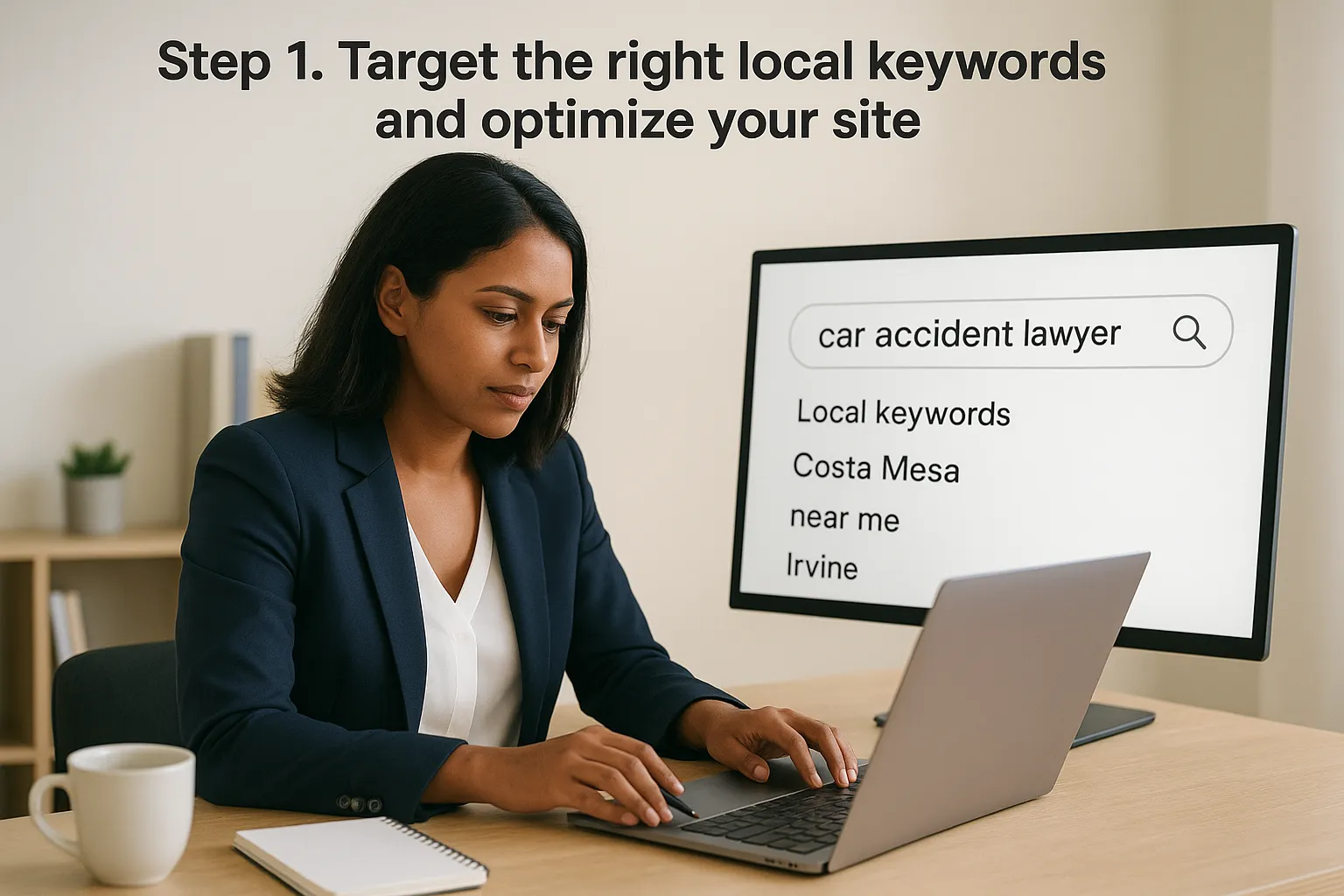
Start by mapping out exactly how a potential client searches, not how you'd describe your own practice. Nobody types "litigation services," they type "car accident lawyer Costa Mesa" or "immigration attorney near me." Pull search volume and variations from Google's free Keyword Planner or a tool like Semrush, then build a list that pairs every practice area with every city or neighborhood you actually serve, the same way you'd approach local keyword research for a small business. This is the foundation of local seo for lawyers, and skipping it means every later step is aimed at the wrong target.
Build a page for every practice area and city combo
Once you have that list, give each meaningful combination its own page instead of cramming everything onto one "Practice Areas" page, using the same structure that makes city pages both rank and convert. A firm working across Orange County might build:
- /personal-injury-lawyer-costa-mesa
- /personal-injury-lawyer-irvine
- /divorce-attorney-santa-ana
- /dui-lawyer-huntington-beach
One well-optimized page per practice area and city beats a single page trying to rank for everything.
Each page needs unique content, not a swapped city name on a template. Reference local courthouses, mention neighborhoods you've served, and answer questions specific to that jurisdiction.
Get the on-page basics right
With the pages built, tighten the technical details that tell Google exactly what each one is about:
- Put the target keyword in the title tag, H1, and first 100 words.
- Add your city and state in the meta description.
- Include your firm's name, address, and phone number in the footer of every page.
- Make sure the site loads fast and displays cleanly on mobile, since most "near me" searches happen on a phone.
If your current site can't support this structure without a rebuild, a custom website redesign built around local pages is usually faster than trying to retrofit an old template. Get this foundation solid before moving to your Google Business Profile in Step 2.
Step 2. Claim and optimize your Google Business Profile
Your Google Business Profile (GBP) is the single biggest lever in local seo for lawyers, because it's what actually populates the map pack. A perfectly optimized website with a thin or unclaimed profile still won't show up when someone searches "attorney near me" from their phone. Claim your listing at google.com/business if you haven't already and walk through the profile creation steps, then verify it by mail, phone, or video, whichever option Google offers for your firm.

Fill out every field, not just the basics
Google rewards complete profiles over sparse ones. Go through every section and fill it in:
- Business name exactly as it appears on your website and signage
- Primary category set to something specific like "Personal Injury Attorney," not just "Lawyer" (how to choose the right category)
- Additional categories for every practice area you handle
- Service area matching the cities you named in Step 1
- Business hours, including holiday hours
- Attorney bios and photos of your office, staff, and signage
A complete, category-accurate Google Business Profile does more for map pack ranking than any other single fix.
Post updates and answer questions regularly
Treat your profile like a living page instead of a set-and-forget listing. Publish short posts about case results, community involvement, or new practice areas roughly once a week, since active profiles get more visibility than dormant ones. Monitor the Q&A section too, because prospective clients often ask about consultation fees or availability there before ever visiting your site, and an unanswered question sitting for months looks bad to anyone browsing.
Running multiple offices complicates this step, since each location needs its own verified profile with distinct, non-duplicated content. If juggling profiles, categories, and weekly posts across several offices sounds like more than your staff can maintain, our hands-on guide to profile optimization and management service covers the setup so nothing goes stale. Once your profile is dialed in, citations and backlinks reinforce everything you just built.
Step 3. Build consistent citations and local backlinks
Citations are mentions of your firm's name, address, and phone number (NAP) on directories like Yelp, Avvo, FindLaw, and the local Chamber of Commerce site. Google cross-checks these mentions against your Google Business Profile to decide whether your firm is legitimate and where it actually sits. Every mismatch, a suite number left off, an old phone line still listed, chips away at that trust, which is why matching NAP details everywhere matters as much as building anything new.
Audit and fix your existing citations first
Before adding new listings, search your firm's name plus city on Google and note every directory that already lists you. Fix these before building anything new:
- Confirm the exact business name matches your GBP, including punctuation.
- Update the address format the same way everywhere (no "Suite 4" on one site and "#4" on another).
- Use one phone number consistently, ideally your main office line, not a tracking number that changes.
- Claim and update legal-specific directories like Avvo, FindLaw, Justia, and Martindale-Hubbell, since these carry extra weight for local seo for lawyers beyond generic business directories.
Inconsistent NAP data across directories is one of the fastest ways to quietly sink a law firm's map pack ranking.
Earn backlinks from sources Google already trusts
With citations cleaned up, shift to backlinks, links from other websites pointing to yours. For a law firm, the strongest local link building opportunities come from your local bar association, chambers of commerce, sponsored community events, and local news coverage of cases or firm milestones. A quote in a local news story about a settlement, with a link back to your practice-area page, does more for local rankings than a dozen paid directory submissions. If citation cleanup and outreach feels like a full-time job on top of running a practice, here's how citation building actually works, and our team handles the audits and directory fixes so your listings stay consistent while you handle clients.
Step 4. Earn reviews and create locally relevant content
Reviews are the last major ranking factor in local seo for lawyers, and they're also the first thing a nervous client reads before picking up the phone. Google weighs both the quantity and recency of your reviews when deciding who earns a map pack spot, and the way Google reviews feed local rankings means a firm with 60 reviews from three years ago loses to a competitor with 20 reviews from last month. Build a simple system rather than hoping happy clients remember to leave feedback on their own.
Ask for reviews at the right moment
Timing determines whether a client actually follows through. Build the ask into your workflow instead of leaving it to chance:
- Send a review request text or email within 24 hours of a case closing, while the outcome is still fresh.
- Include a direct link to your Google Business Profile review page, not just your website.
- Train front-desk staff to mention reviews verbally after a positive consultation.
- Respond to every review, good or bad, within a few days, since Google factors owner responses into local ranking too.
A steady stream of recent, responded-to reviews beats a big pile of old, ignored ones every time.
Publish content that answers local legal questions
Once reviews are flowing, turn your attention to content that a real client would search for in your city. Cover things like "what happens after a DUI arrest in Orange County" or "how long does a personal injury settlement take in California," and answer them in plain language, not legalese. Local news mentions, court process explainers, and FAQ pages tied to specific cities all reinforce the practice-area pages you built in Step 1.
Given the amount of ongoing work reviews and content require, most solo firms fall behind after a few months. Our monthly SEO service folds review requests, content updates, and reporting into one recurring plan, so this step doesn't quietly stall once the initial setup is done.
Turning local searches into new clients
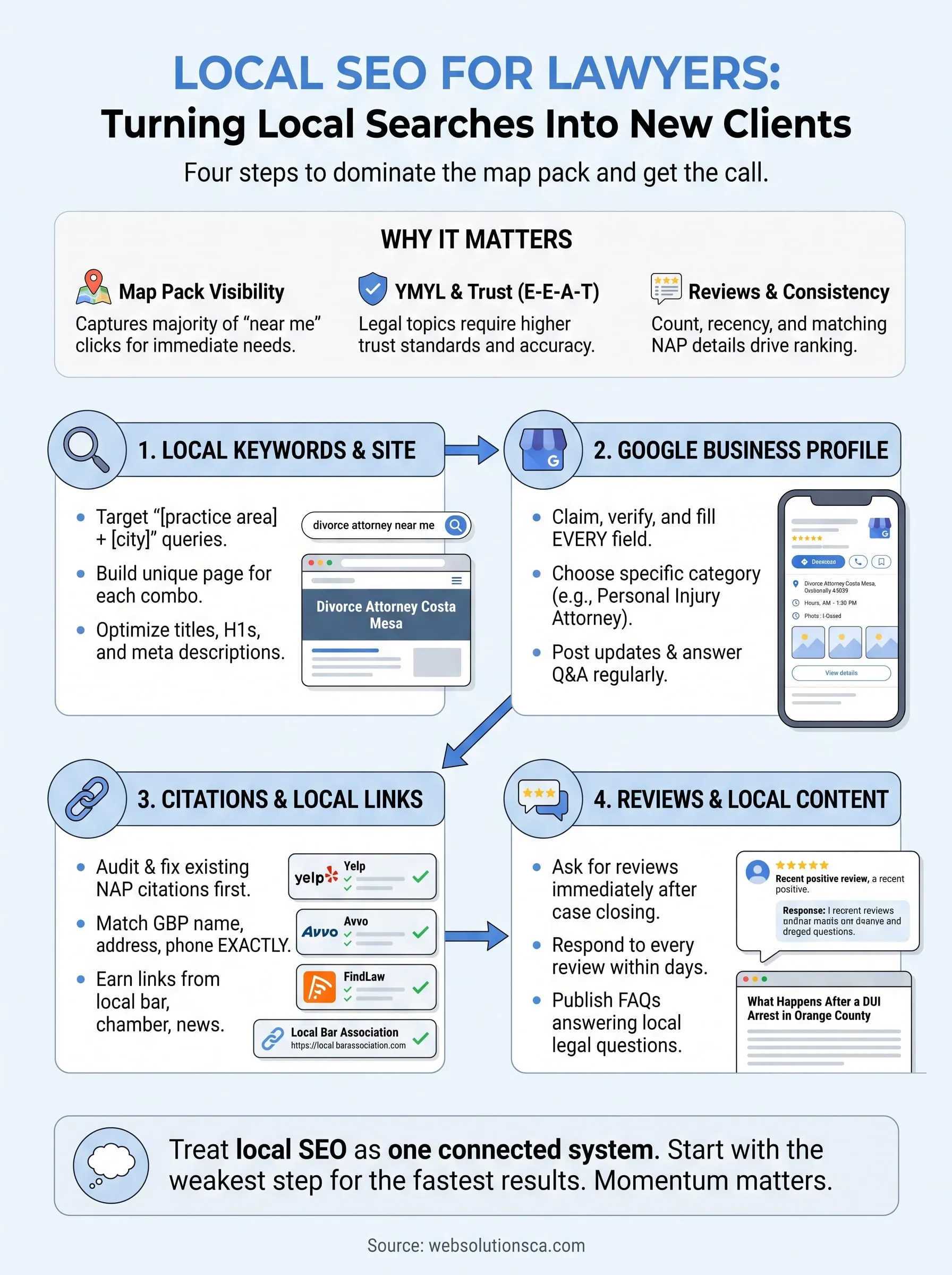
None of these four steps work in isolation. Your Google Business Profile needs the website behind it, your citations need a real address to point to, and your reviews mean nothing if the practice-area page a searcher lands on doesn't answer their question. Treat local seo for lawyers as one connected system, not four separate projects, and the map pack results follow.
Start with whichever step is weakest right now. If your GBP is unclaimed or half-filled, fix that first since it delivers the fastest visibility gain. If your citations are scattered across a decade of address changes, clean those next. Momentum matters more than perfection on day one.
If you'd rather hand this off to people who do it daily for firms across Orange County, explore our Google Maps and local SEO services for Orange County law firms and get a plan built around your practice areas and cities.