

You know local SEO matters, but reading about strategy in the abstract doesn't help when you're staring at your own website wondering what to change first. Most guides tell you to "optimize your Google Business Profile" or "build local pages" without showing what that actually looks like when done well. These local seo examples pull back the curtain on real tactics working for small businesses right now, not theory.
If you run a local service business in Orange County or anywhere else, you need to see what separates a business that ranks from one that's invisible on page three. That means looking at actual city landing pages, real Google Business Profile setups, and review strategies that generate consistent calls, not just guesswork dressed up as advice. Seeing the mechanics behind these wins makes it easier to spot what's missing from your own site.
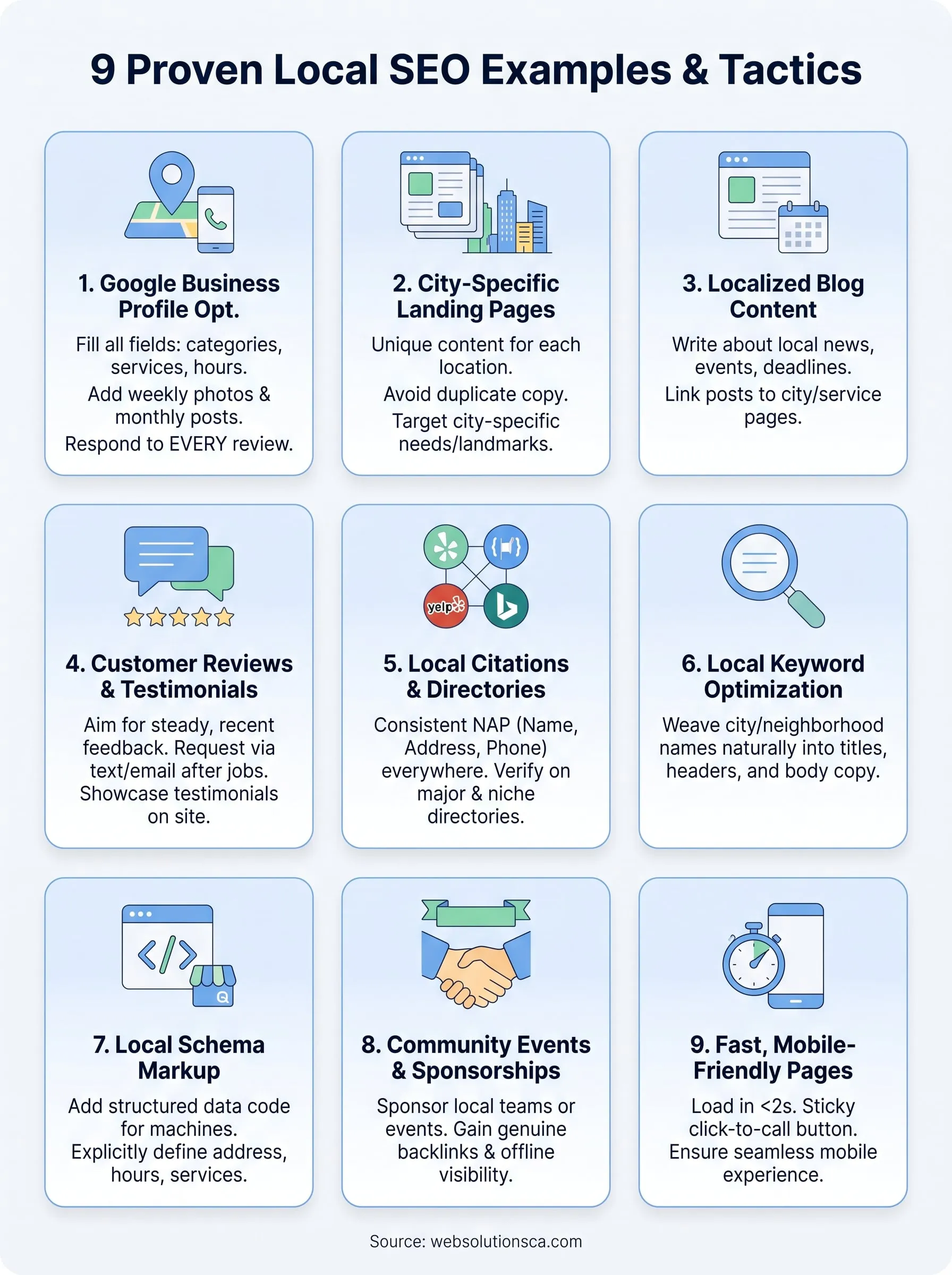
Below, we break down nine examples covering everything from location-specific content to citation building and schema markup. Each one includes what makes it effective and how you can adapt it, whether you're a window company in Tustin or a tax preparer in Santa Ana. By the end, you'll have a clearer picture of what local SEO success actually looks like, not just what it's supposed to be.
1. Google Business Profile optimization
Mastering Google Business Profile optimization is the single biggest lever most local businesses ignore. It's the free listing that shows up in the map pack when someone searches "plumber near me" or "tax preparer in Santa Ana," and it often gets more clicks than the actual website. Yet most small business owners claim their profile once, fill in the name and address, and never touch it again.

What it looks like
Strong profiles have complete business categories, service lists, updated hours, high-quality photos, and a steady stream of posts and Q&A responses. Take a window and door company in Tustin: instead of a bare-bones listing, its profile lists specific services like "vinyl window replacement" and "french door installation," includes before-and-after photos from real jobs, and gets updated monthly with promotions or seasonal tips. That level of detail signals to both Google and searchers that the business is active and legitimate.
Why it works
Google rewards profiles that show consistent activity and relevance because it wants to serve searchers accurate, current information. Profiles with recent photos, frequent posts, and detailed service lists tend to outrank thinner competitors, even ones with more reviews. Google Business Profile optimization also directly influences the local pack on Google Maps, which is where most "near me" searches convert into phone calls before a user ever visits a website.
A neglected Google Business Profile is a missed phone call waiting to happen.
How to implement it
You don't need to overhaul everything at once. Focus on these steps first:
- Fill out every field: business categories, services, attributes, and a keyword-rich business description.
- Add photos weekly: interior, exterior, team, and completed work, since fresh images get more engagement than stock imagery.
- Post updates monthly: promotions, new services, or local news keep the profile active in Google's eyes.
- Respond to every review: within 48 hours when possible, thanking positive reviewers and addressing negative ones professionally.
- Monitor and answer Q&A: seed a few common questions yourself so potential customers get answers immediately.
Agencies that manage this for clients, including Google Business Profile optimization work through Web Solutions CA, typically audit the profile first, fix categorization errors, then build a monthly cadence of posts and photo updates. That consistency is what separates a profile that ranks from one that just exists. If you're a solo operator without time for weekly upkeep, this is often the single service worth outsourcing first, since the return on a well-maintained profile shows up fast in call volume and direction requests.
2. City-specific landing pages
A single service area page listing ten cities in a bulleted paragraph doesn't cut it anymore. City-specific landing pages give each location its own dedicated page with unique content, local references, and targeted keywords, and they're one of the clearest local seo examples of turning a broad service area into rankable, individual pages.
What it looks like
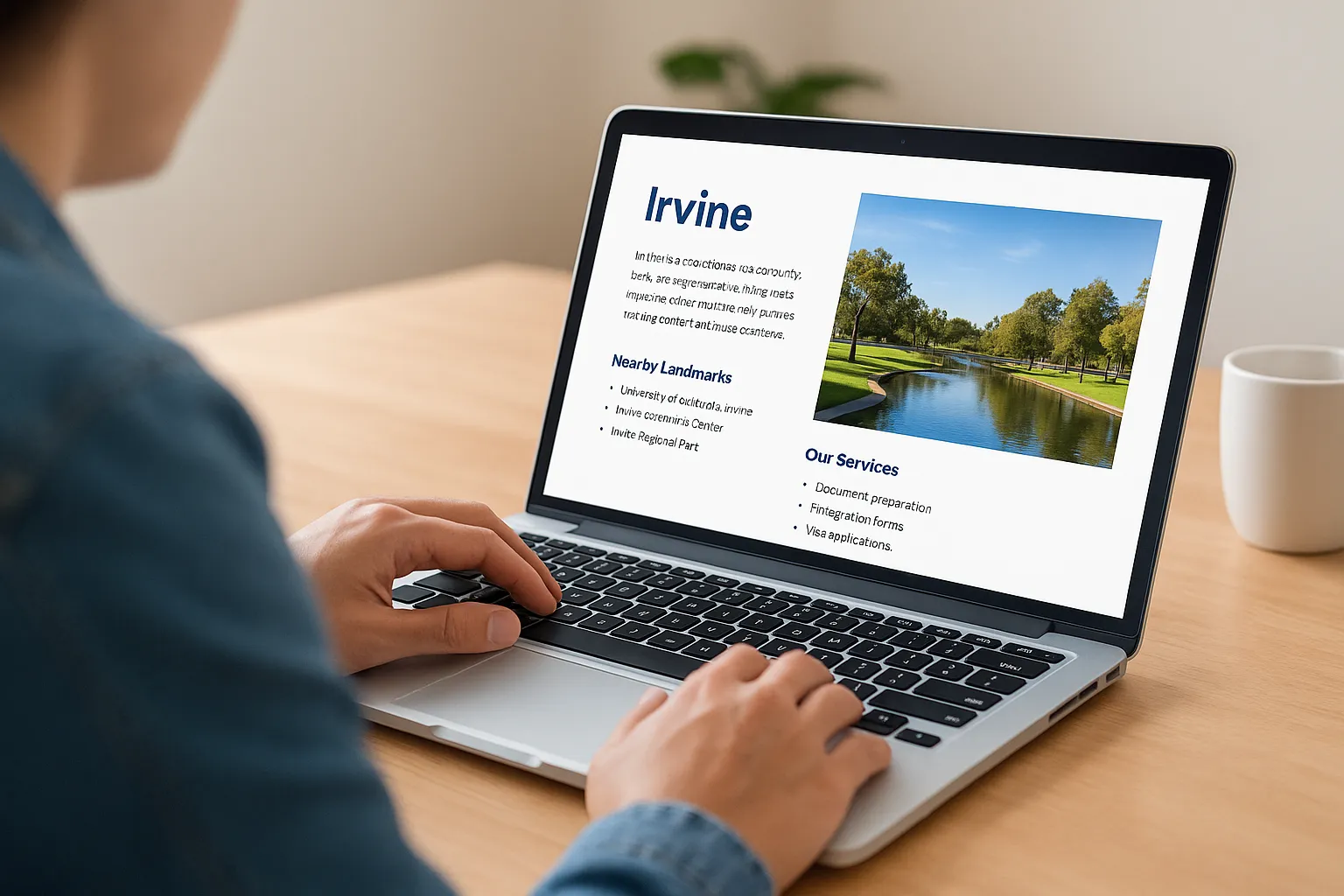
Picture a document preparation service that operates across Orange County. Instead of one generic "our service area" page, it builds separate pages for Irvine, Costa Mesa, and Huntington Beach, each mentioning nearby landmarks, local zip codes, and specific client scenarios relevant to that city. Photos, testimonials, and even the page title reflect that exact location rather than a generic company-wide message.
Why it works
Search engines match intent to location, and a page built around "immigration consultant in Santa Ana" will consistently outrank a vague page trying to cover the whole county at once. Google's own guidance on creating helpful, people-first content rewards pages that go beyond the obvious, and thin, duplicated city pages get filtered out fast. Genuine differentiation between pages, not just swapped city names, is what keeps them ranking.
A city page that just swaps the city name isn't a city page, it's a duplicate with a disguise.
How to implement it
Research each target city's specific needs before writing anything. Build a template that covers local landmarks, service specifics, and a unique testimonial per page, then avoid copy-pasting the same paragraph nine times with a find-and-replace. Web Solutions CA's website design team typically builds these pages during a site launch or redesign, mapping each page to a distinct search term so none of them compete against each other.
3. Localized blog content
Beyond dedicated city pages, localized blog content gives you a steady stream of fresh material that targets specific neighborhoods, events, and local pain points your competitors aren't writing about. It's one of the more overlooked local seo examples, but it's also one of the easiest to start doing this week without touching your site structure.
What it looks like
Consider a tax preparation service in Costa Mesa publishing posts like "Orange County Small Business Tax Deadlines for 2024" or "What Newport Beach Contractors Need to Know About Quarterly Filings." Each post references specific city ordinances, local business associations, or seasonal events, rather than generic tax advice that could apply anywhere in the country.
Why it works
Google reads this kind of content as a signal that your business genuinely operates in and understands the area you're targeting, not just claiming it in a footer. Long-tail local searches like "tax deadline extension Orange County" have less competition than broad keywords, so a well-written post can rank within weeks instead of months.
A blog post that mentions your actual city by name beats a generic guide every time it matters.
This kind of content also feeds internal links back to your city pages and Google Business Profile, reinforcing your local relevance across the whole site rather than in one isolated spot.
How to implement it
Start with a list of local events, deadlines, or news relevant to your industry, then write one post a month tied to a specific city or neighborhood. Reference real local details: street names, business districts, or events people search for. Link each post back to the relevant service or city page. Businesses working with Web Solutions CA's SEO services often build this into a monthly content calendar so it never gets skipped once traffic starts climbing.
4. Customer reviews and testimonials
Star ratings and written feedback do more heavy lifting than most business owners realize. Customer reviews and testimonials shape both your Google Business Profile ranking and the trust a stranger places in you before they ever pick up the phone. Among local seo examples, this one is the fastest to influence because it relies on customers you already have, not new traffic you need to earn.
What it looks like
Strong review profiles show a steady volume of recent feedback, not fifty reviews from three years ago and silence since. An immigration consultant in Santa Ana with dozens of detailed reviews mentioning specific services, like "helped with my green card renewal in two weeks," builds far more credibility than a business with a handful of vague five-star ratings. The best examples also feature testimonials pulled directly onto the website, often near the service or city page they relate to.
Why it works
Review volume, recency, and keyword content all factor into how Google reviews shape local rankings in the map pack. A review mentioning your city and service acts almost like a mini local landing page written by someone else, and Google notices that language.
A steady stream of recent reviews tells Google, and your customers, that you're still showing up.
Reviews also cut hesitation for new customers comparing several providers at once, often being the deciding factor over price.
How to implement it
Ask for reviews immediately after a job finishes, when satisfaction is highest, using a simple text or email link. Respond to every review within a few days. Web Solutions CA builds review requests directly into its workflow automation systems, triggering a follow-up text the moment a job status changes to complete, so reviews come in consistently instead of in occasional bursts.
5. Local citations and directory listings
Consistency across the web matters more than most business owners assume. Local citations and directory listings, think Yelp, Angi, the Chamber of Commerce, and industry-specific directories, tell Google your business is a real, verifiable entity operating where you say it does. Among local seo examples, this one works quietly in the background, but it's foundational to everything else ranking well.
What it looks like
Strong citation profiles show identical NAP data (name, address, phone) across every listing, from Yellow Pages to niche sites like HomeAdvisor. A window company in Tustin, for example, might have matching listings on Google, Yelp, Bing Places, Nextdoor, and a local contractors association directory, all pointing back to the same phone number and address, with zero variations in spelling or suite numbers.
Why it works
Google cross-references citation data to confirm a business's legitimacy and location before ranking it locally. Mismatched addresses or old phone numbers across directories create doubt in Google's algorithm and confuse potential customers who call a disconnected number.
Inconsistent business information across the web is the quiet reason many businesses never crack the local pack.
High-authority directories also pass along a bit of trust and link value, reinforcing your site's credibility beyond just the citation itself.
How to implement it
Audit your current listings first, since outdated NAP data is more common than most owners realize. Start with the big directories, then move into industry-specific ones relevant to your field.
- Claim and verify listings on Yelp, Bing Places, Apple Maps, and Nextdoor.
- Fix any mismatched addresses, phone numbers, or business names.
- Add industry-specific directories relevant to your trade.
Web Solutions CA's SEO services include citation audits as part of ongoing local optimization, catching the small inconsistencies that quietly hold rankings back.
6. Local keyword optimization
Most small business sites target broad terms like "tax preparer" or "window installation" and wonder why they never rank. Local keyword optimization means weaving city names, neighborhoods, and even local slang into your titles, headers, and body copy so search engines connect your page to a specific place, not a generic service category. It's one of the more technical local seo examples on this list, but it's also one you can start fixing today with the pages you already have.
What it looks like
A strong example is a Santa Ana tax preparer whose homepage title reads "Tax Preparation Services in Santa Ana, CA" instead of just "Tax Preparation Services." Their headers reference "Orange County small business filings," their meta description mentions "serving Santa Ana, Tustin, and Garden Grove," and their image alt text ties photos back to actual job locations rather than generic filenames.
Why it works
Search engines match query intent to page content, and a searcher typing "tax preparer near Santa Ana" needs to see that phrase, or something close to it, reflected on the page itself. Google's Search Central documentation confirms that relevant, specific page titles and headers directly influence how content gets matched to queries.
If your page doesn't say where you work, Google can't guess for you.
Generic keywords also mean competing against national chains with bigger budgets, while local phrasing narrows the field to businesses that actually operate nearby.
How to implement it
Start with a keyword list that pairs your core services with city and neighborhood names, then place them naturally in titles, H1s, and the first paragraph of each page. Avoid stuffing every sentence with the same city name, since that reads as spam to both readers and algorithms. Web Solutions CA's SEO services begin every engagement by researching which local terms searchers actually use before writing a single page.
7. Local schema markup
Structured data is the part of local SEO most business owners never see, but search engines read it constantly. Local schema markup is code added to your website that explicitly tells Google your business name, address, phone number, hours, and service area in a format machines can parse instantly. Among local seo examples, this one runs entirely behind the scenes, yet it directly shapes how your listing appears in search results.

What it looks like
On a well-built site, the LocalBusiness schema sits in the page's HTML and includes structured fields for address, geo-coordinates, hours, and price range. A tax preparation site in Costa Mesa might mark up its contact page like this:
{
 "@context": "https://schema.org",
 "@type": "AccountingService",
 "name": "Costa Mesa Tax Prep",
 "address": {
 "@type": "PostalAddress",
 "streetAddress": "123 Main St",
 "addressLocality": "Costa Mesa",
 "addressRegion": "CA"
 },
 "telephone": "+1-714-555-0100"
}
Why it works
Search engines rely on structured data to confirm details they'd otherwise have to guess from unstructured text. Google's own structured data documentation notes that accurate markup helps content qualify for richer search features, including map pack listings and knowledge panels.
Schema markup doesn't change what a customer reads, it changes how confidently Google reports it.
Sites with clean schema often see faster indexing of new location pages too, since crawlers don't have to interpret ambiguous formatting.
How to implement it
Use Google's Rich Results Test to check existing markup, then add or correct LocalBusiness schema on your homepage and each city page. Web Solutions CA's website design team builds this markup into every site at launch, so it never becomes an afterthought fix later.
8. Community events and sponsorships
Getting your business name in front of local search engines isn't only about code and content. Community events and sponsorships create real-world visibility that turns into links, mentions, and citations you can't manufacture through a keyword list. Among local seo examples, this one blends offline presence with online payoff, and it's often the piece small businesses skip entirely.
What it looks like
Here's what genuine local involvement looks like: a window and door company in Tustin sponsors the youth soccer league and gets listed on the league's website with a logo and link. A tax preparer in Costa Mesa hosts a free filing workshop at the local library, and the library posts an event page mentioning the business by name. An immigration consultant sponsors a cultural festival booth in Santa Ana, generating photos, social posts, and a mention on the festival's recap page months later.
Why it works
Each of these creates a natural backlink or citation from a locally relevant, often high-authority domain, like a school district, chamber of commerce, or nonprofit site, which is community-driven link building at its most durable. Google treats these as trust signals since they're difficult to fake and tied to a specific geographic community.
A sponsorship link from your local little league says more to Google than ten paid directory listings ever will.
These mentions also build brand recognition offline, which shows up later as branded searches, a signal Google weighs heavily for local relevance.
How to implement it
Start small and local:
- Sponsor a youth sports team, school fundraiser, or community 5K.
- Ask organizers for a website mention or logo placement with a link.
- Attend or host a free workshop tied to your service.
- Share the resulting coverage on your own site and Google Business Profile posts.
Even a modest annual budget for two or three sponsorships can generate citations that pure digital tactics can't replicate.
9. Fast, mobile-friendly local pages
Speed and mobile usability decide whether a searcher sticks around long enough to call you. Fast, mobile-friendly local pages load in a couple seconds, resize cleanly on a phone screen, and put your phone number within thumb's reach. Rounding out these local seo examples, this one has nothing to do with keywords or content and everything to do with technical execution, yet a slow site can undo every other tactic on this list.
What it looks like
Take that Huntington Beach service page loading in under two seconds, with a sticky click-to-call button, compressed images, and a layout that never forces a user to pinch and zoom. Compare that to a competitor's five-second load time with a desktop-only menu crammed onto a small screen, and the difference in bounce rate is immediate and measurable.
Why it works
Google's own research on page experience confirms that Core Web Vitals directly factor into ranking, and mobile searches now make up the majority of local queries. A page that loads slowly on a phone loses the searcher before they ever see your services, no matter how well the content is written, so it's worth diagnosing what's slowing your site down first.
A local page that takes five seconds to load has already lost the customer who needed you today.
Most local searches happen on the go, often with someone standing outside a business deciding whether to call, so mobile optimization isn't optional polish, it's the mechanism that turns a search into a phone call.
How to implement it
Work through an image compression checklist, minimize plugins, and test every page with Google's PageSpeed Insights. Web Solutions CA's website design services build speed and mobile responsiveness into every project from the first wireframe, not as a fix applied after launch.
Putting these examples to work for your business
None of these nine tactics work in isolation. A perfectly optimized Google Business Profile won't save you if your site takes six seconds to load, and city landing pages mean little without citations backing up the same address everywhere else. The businesses winning local search right now treat these local seo examples as pieces of one system, not a checklist to knock out once and forget.
Start where you're weakest. If you don't know where that is, audit your profile, your site speed, and your NAP consistency this week before touching anything else. Small, consistent fixes compound faster than one big overhaul you never finish.
You don't have to tackle all nine fronts alone. Web Solutions CA builds and manages these exact strategies through managed local SEO for Orange County businesses, so reach out if you'd rather have someone else handle the details while you handle the calls coming in.