

If you run a personal injury law firm in Orange County, you already know the competition for clients is brutal. Someone gets into a car accident in Irvine or slips and falls in Santa Ana, and the first thing they do is grab their phone and search for a lawyer nearby. Local seo for personal injury lawyers is what determines whether your firm shows up in that moment or whether a competitor down the street gets the call instead.
This guide gives you a practical, step by step approach to ranking higher in local search results and turning that visibility into actual consultations. We cover the specific factors Google weighs for legal service providers, including your Google Business Profile, review strategy, and location-specific content that signals relevance to your city.
We built this guide from what actually works for small firms with limited marketing budgets, not massive national practices with unlimited ad spend. You'll learn how to optimize your website, build local citations, and set up conversion tracking so you know which efforts bring in real cases. By the end, you'll have a clear roadmap for making your firm the obvious choice when someone nearby needs a personal injury attorney.
Why local SEO matters for personal injury law firms
Personal injury cases don't wait. Someone gets rear-ended on the 405 or slips in a Costa Mesa parking lot, and within minutes they're pulling out a phone to search for help. That search almost always includes a location, whether it's a city name or the phrase "near me," and Google responds by showing a local pack of three map listings before any organic results even appear, which is why getting into those three map listings matters so much. If your firm isn't in that pack, you're invisible to a client who's ready to call right now.
The near-me search moment decides who gets the call
Mobile search behavior in personal injury cases skews heavily toward immediate action. A person doesn't research attorneys for weeks the way they might shop for a car; they compare a handful of options, check reviews, and pick up the phone within an hour or two. This means your local search rankings matter more than almost any other marketing channel you could invest in, because you're competing for attention in a narrow window when the prospect is actively deciding.
If you're not visible in the local pack when someone searches for an injury lawyer near them, that lead goes to a competitor before you even know it existed.
Personal injury sits in Google's highest-scrutiny category
Google treats legal services as a Your Money or Your Life topic, meaning its algorithms apply extra scrutiny to trust and expertise signals before ranking a page. That's on top of the fact that personal injury is one of the most competitive and expensive practice areas in paid search, with cost-per-click bids in some markets running well past $100. Firms that build strong organic local visibility reduce their dependence on that expensive ad spend and capture cases that would otherwise cost a fortune to win through Google Ads alone.
Local SEO and general SEO aren't the same game
General SEO focuses on ranking a website nationally or for broad topics. Local SEO for personal injury lawyers is narrower and more tactical, built around signals that tell Google exactly where you serve clients and how trustworthy you are within that specific area. Understanding the difference, and the signals Google weighs when ranking local results for a city, determines where you spend your limited marketing hours.
| Ranking Factor | General SEO Focus | Local SEO Focus for PI Firms |
|---|---|---|
| Primary goal | Rank for broad topical searches | Rank in the map pack for city and neighborhood searches |
| Key profile | Website authority, backlinks | Google Business Profile completeness and activity |
| Content targeting | Broad keyword topics | City-specific and practice-area-specific pages |
| Trust signals | Domain authority, mentions | Reviews, local citations, NAP consistency |
| Typical searcher intent | Research and comparison | Immediate need, ready to call |
Moving a firm up this table's local column is exactly what the rest of this guide walks through step by step.
Small firms can outrank bigger names locally
Orange County has no shortage of well-funded personal injury practices with national ad budgets, but local search rewards relevance and consistency over sheer marketing spend. A firm based in Tustin that has a complete Google Business Profile, dozens of recent reviews mentioning specific case types, and location pages built for Irvine, Santa Ana, and Anaheim can outrank a much larger competitor whose local presence is thin. Ranking well isn't about outspending anyone; it's about doing the fundamentals better and more consistently than the firms around you.
When you treat local SEO as a system rather than a one-time project, the payoff compounds. Reviews build over months, citations stay consistent across directories, and location content accumulates authority the longer it's live. Every step in this guide builds toward that same outcome: making sure your firm is the name Google shows, and the name a hurt, worried person recognizes and trusts enough to call.
Step 1. Optimize your Google Business Profile
Your Google Business Profile is the single most important asset in local search for a personal injury firm. It's what populates the map pack, and it's usually the first thing a prospect sees before they ever visit your website. Claim your listing directly through Google Business Profile if you haven't already, then treat every field as a ranking signal instead of a formality.

Fill out every field completely and accurately
Google rewards profiles that look complete and penalizes ones that look abandoned. Half-filled listings with a generic category and no photos rarely make it into the top three map results, no matter how good the firm's actual reputation is, so work through the full profile setup for a California business field by field.
- Choose "Personal Injury Attorney" as your primary category, and add secondary categories like "Law Firm" only if they genuinely apply
- Write a business description that mentions your city and practice areas naturally, not stuffed with keywords
- List your actual office hours, including whether you offer after-hours consultations
- Add your direct phone number, not a call-tracking number that changes
- Upload at least 10 photos: your office exterior, interior, team headshots, and any signage visible from the street
A complete, active Google Business Profile does more for your local rankings than almost any other single change you can make.
Post updates and answer questions consistently
Profiles that show recent activity signal to Google that the business is active and trustworthy. Set a recurring reminder to write a profile post that converts every week or two, whether it's a recent case result you can share publicly, a community event, or a reminder about your free consultation policy. Questions and answers on your profile matter too. Prospects often ask things like "do you handle motorcycle accident cases" directly on the listing, and answering promptly, in your own words, builds trust before they even call.
Match your service area to where you actually take cases
Setting your service area correctly prevents Google from showing your firm for cities you don't realistically serve, which wastes impressions and can hurt your credibility with reviewers who complain about wasted calls. If your firm handles cases across Orange County, list Costa Mesa, Irvine, Santa Ana, Newport Beach, and the other cities you actually work in, rather than a vague radius setting, and follow the rules for local SEO when you serve a wide service area.
Getting the profile right takes a few hours upfront and then roughly 30 minutes a week to maintain. If that ongoing maintenance keeps slipping down your priority list, Web Solutions CA's Google Business Profile optimization service handles the setup and weekly upkeep so your listing stays active without eating into time you'd rather spend on cases.
Step 2. Target location-specific personal injury keywords
Generic keywords like "personal injury lawyer" are expensive to rank for and often too broad to convert. A prospect searching that phrase could be anywhere in the country. Location-specific keywords narrow the field to people who are actually near your office and ready to hire someone this week. Building your keyword strategy around city names, neighborhood terms, and case-specific phrases is what separates firms that show up for real leads from firms burning budget on vanity rankings.
Build a keyword list around city plus practice area
Start by finding the city-level terms people actually search and pairing every practice area you handle with every city you serve. A firm covering Irvine, Santa Ana, and Newport Beach shouldn't rely on one "personal injury lawyer" page. Instead, build separate targets like these:
- "car accident lawyer Irvine"
- "slip and fall attorney Santa Ana"
- "motorcycle accident lawyer Newport Beach"
- "personal injury attorney near me Costa Mesa"
- "wrongful death lawyer Orange County"
Each of these represents a distinct search intent, and Google increasingly rewards pages that speak directly to a specific city rather than a single page trying to rank everywhere at once.
A page built for "car accident lawyer Irvine" will almost always beat a generic "personal injury lawyer" page for someone actually searching from Irvine.
Create dedicated pages instead of stuffing keywords into one
Don't try to cram five cities into a single homepage. Build a distinct landing page for each city and practice area combination, with unique content that references local landmarks, courthouses, or hospitals your firm has actually worked with. A page for Anaheim should read differently than a page for Tustin, even if the legal service is the same. Thin, duplicated pages that swap only the city name rarely rank well and can look manipulative to Google's algorithms.
Use tools to confirm real search demand before you write
Check actual search volume before committing writing time to a keyword. Google's own Keyword Planner shows rough monthly volume for city-level legal searches, and it's free with a Google Ads account even if you're not running paid campaigns. Look for keyword variations too, since prospects phrase things differently: some search "injury attorney," others search "accident lawyer," and both deserve a mention somewhere on your page.
Match content depth to search intent
Someone searching "car accident lawyer near me" wants a phone number and reviews fast, not a 2,000-word legal essay. Someone searching "how much is my slip and fall case worth in California" wants real explanation. Match your page structure to what the searcher actually needs, and you'll convert a much higher share of the traffic these keywords bring in.
Step 3. Build consistent local citations and directory listings
A local citation is any online mention of your firm's name, address, and phone number, whether it's a full directory listing or a simple mention in a local business roundup. Google cross-references these citations to verify that your firm actually exists and operates where you claim. Inconsistent information across even a handful of listings can quietly undermine the trust signals you built with your Google Business Profile in Step 1.
NAP consistency across every listing
Getting your NAP consistency right, meaning your Name, Address, and Phone number match exactly everywhere they appear, is the foundation of citation building. Suite numbers, abbreviations, and old phone numbers from a previous office cause more ranking damage than most firms realize.
One outdated address on a forgotten directory can quietly drag down rankings you worked hard to build everywhere else.
- Use the exact same business name on every listing, no variations like adding "Law Firm" on one site and "Attorneys at Law" on another
- Format your address identically everywhere, including abbreviations like "Ave" versus "Avenue"
- List one primary phone number and stick with it across every platform
- Update old listings immediately after any office move or number change
Priority directories for personal injury firms
Knowing what citations are and how to build them works best when you focus on directories that carry real authority rather than chasing every listing site you can find. Start with the platforms below and expand from there.
| Directory | Why It Matters |
|---|---|
| Yelp | High local search visibility, strong review integration |
| Avvo | Legal-specific, includes peer endorsements and ratings |
| Justia | Widely trusted legal directory, free basic listings |
| Bing Places | Powers Bing's map results, easy to set up |
| Apple Maps (Apple Business Connect) | Feeds directions and search on iPhones |
Legal-specific directories add extra trust
General directories help with visibility, but legal-specific listings like Avvo and Justia carry extra weight because Google understands they're built specifically for attorney credibility, complete with bar admission details and peer reviews. Claiming and fully completing these profiles gives your firm a trust signal that generic business directories can't replicate.
Audit existing citations before adding new ones
Before adding new listings, audit your local search presence by running a search of your firm's name and phone number to find citations you didn't know existed, often left over from a previous address or a directory that auto-generated a listing years ago. Cleaning up these old entries first prevents new, correct citations from competing against outdated ones in Google's index. If auditing dozens of directories manually sounds like a weekend you don't have, Web Solutions CA's local citation support handles the cleanup and ongoing consistency checks for you.
Step 4. Generate and manage client reviews
Reviews carry more weight for personal injury firms than almost any other business category, because a stranger deciding whether to trust you with a lawsuit wants proof that other injured people got results. Google factors review quantity, recency, and content directly into local rankings, and the way reviews boost your rankings works alongside prospects reading them before they ever click through to your website. A firm with 80 recent reviews mentioning specific case types will consistently beat a firm with 12 reviews from three years ago, even if the older firm has more experience.

A steady stream of recent, detailed reviews tells both Google and prospects that your firm is actively winning cases right now.
Ask at the right moment, every time
Timing determines whether a client leaves a review at all. The best moment is right after a settlement check clears or a case resolves, when relief and gratitude are highest. Build the ask into your case closing process so it never depends on someone remembering to do it.
Subject: One quick favor before we close your file

Hi [Client First Name],

It was a pleasure representing you through your case. If you have two
minutes, a short review helps other people in similar situations find
us when they need help.

[Direct Google review link]

Thank you again for trusting us with your case.

[Attorney Name]
Sending a direct review link rather than asking someone to search for you removes the biggest reason people never follow through.
Coach clients on what makes a review useful
A one-line review saying "great lawyer" does far less for your rankings than one mentioning the case type, the outcome, and how the firm communicated along the way. Without asking clients to write anything specific, you can mention in your ask that details help future clients understand what to expect. Reviews naturally referencing terms like "car accident settlement" or "slip and fall claim" also reinforce the exact keyword variations Google already associates with your practice.
Respond to every review, good and bad
Google rewards profiles where the owner engages, and prospects read your responses as closely as the reviews themselves. Reply to positive reviews with a genuine, specific thank you rather than a copy-pasted line. For negative reviews, respond calmly, avoid discussing confidential case details, and invite the person to contact your office directly to resolve the issue.
- Thank every reviewer by first name within a few days of posting
- Never argue publicly or reveal case specifics in a response
- Offer a phone number or email for the reviewer to follow up privately
- Flag reviews that violate Google's policies, such as those from non-clients or competitors
Managing this consistently is what separates firms with a strong review profile from firms that let a handful of old complaints sit unanswered for years, quietly discouraging every prospect who reads them.
Step 5. Publish local content and earn local backlinks
Google uses backlinks and local content as proof that other people and organizations vouch for your firm within your community. A page or two of city-specific keywords isn't enough on its own. You need genuine local content that answers questions your prospects actually have, plus local backlinks from sources Google already trusts within Orange County. Together, these signals tell Google your firm is a real, active part of the community, not just a website targeting keywords from a distance.
Write content that answers real local questions
Start with the questions clients ask during initial calls, then build pages around them instead of guessing at topics. A post explaining what happens after a car accident on the 405 near Irvine, or how California's comparative negligence rule affects a slip and fall claim in Santa Ana, does two things at once: it targets a long-tail keyword variation, and it demonstrates the kind of hands-on knowledge only a firm actually practicing in that area would have.
- "What to do after a car accident in Orange County before calling insurance"
- "How much does a personal injury lawyer cost in California"
- "What is my slip and fall case worth in Santa Ana"
- "Do I need a lawyer for a minor injury accident in Irvine"
Content built around the exact questions your clients ask on the phone will always outperform generic legal blog posts written for no one in particular.
Earn backlinks from organizations already active in your area
Backlinks from local sources carry more local ranking weight than a national legal directory ever will. Sponsor a Little League team in Costa Mesa, join the Orange County Bar Association, or speak at a local business networking event, and ask for a link back to your site as part of the arrangement, one of many strategies for earning links from local sites. Chambers of commerce, local news sites covering community events, and nonprofit organizations you support all represent realistic, earnable link opportunities that a much bigger national firm often can't access.
Track which pages actually generate calls
Publishing content without measuring results wastes the effort you put into writing it. Set up conversion tracking on every location page so you can see which city pages generate phone calls and form submissions, not just traffic. If a page for one city consistently underperforms, revise its content rather than assuming local SEO isn't working. Web Solutions CA's SEO services build this content and outreach process month over month, so your local pages keep gaining authority instead of sitting untouched after launch.
Turning local visibility into signed cases
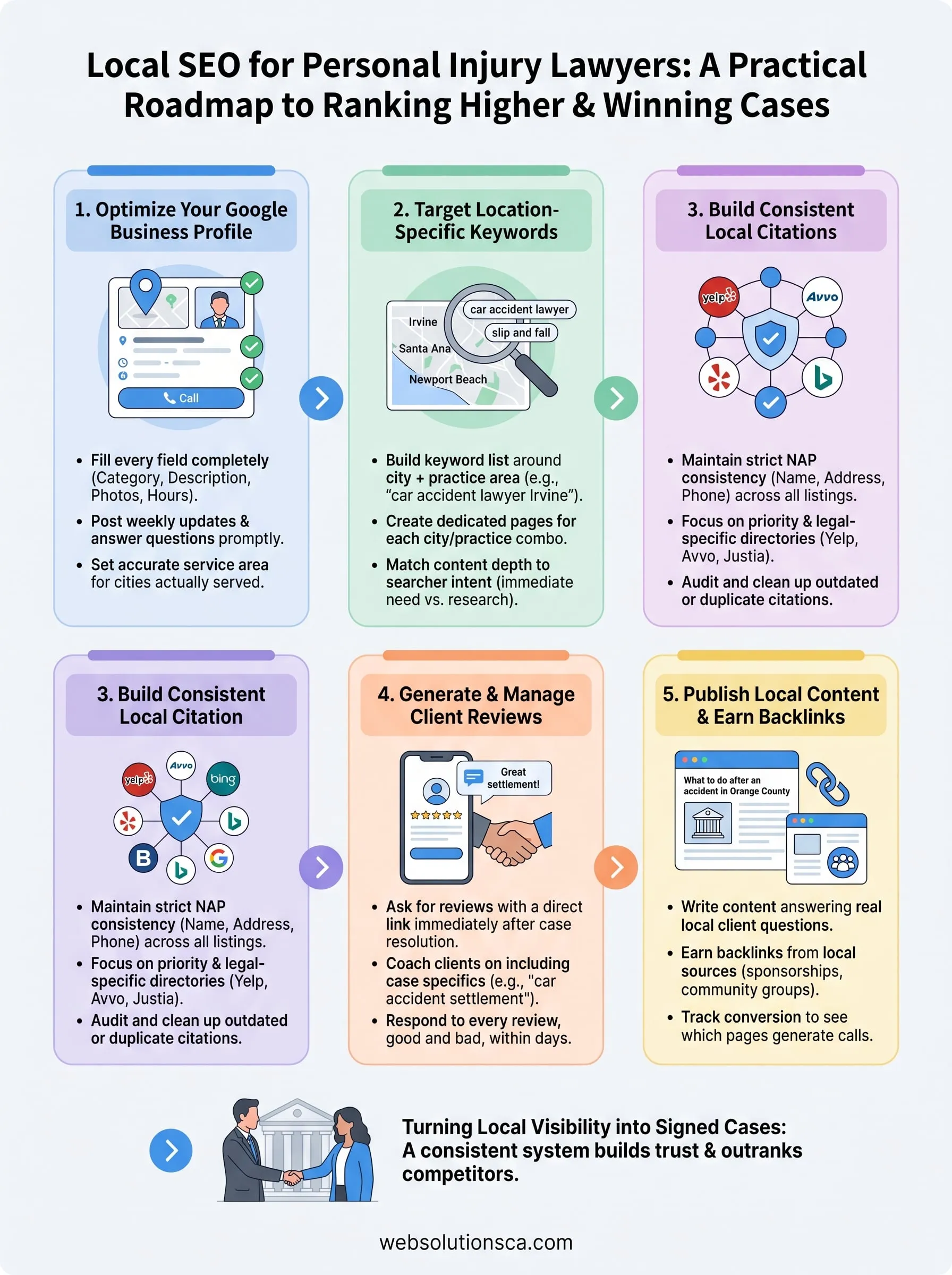
None of these five steps work in isolation. Your Google Business Profile feeds off the reviews you collect, your location pages need the citations to back up their credibility, and every piece of local content you publish gets stronger when real backlinks point to it. Skip one step and the rest carry more weight than they should, which is why firms that treat this as a system consistently outrank firms chasing quick fixes.
Quietly, the firms winning cases right now are the ones that made this work a habit months ago, not a project they'll get to eventually. Someone in Anaheim or Huntington Beach is searching for help this week, and your visibility today determines whether they call you or a competitor.
If building and maintaining all five steps sounds like more than your schedule allows, Web Solutions CA's Google Maps and local search services for Orange County firms handle the entire process so your practice stays visible while you focus on the cases you've already won.